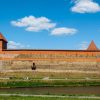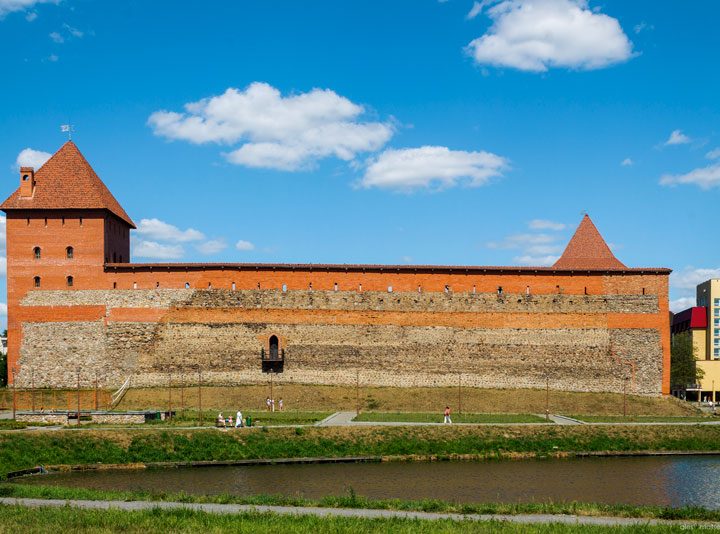
Built on a sandy hilltop surrounded by rivers, Lida Castle rises as one of the oldest stone fortresses in Belarus. Grand Duke Gediminas ordered construction of this fortress in 1323 to protect the population from Crusader raids and safeguard a vital trade centre of the Grand Duchy of Lithuania. Lida Castle and Krevo Castle are two examples of castels, a certain type of defensive castle in Belarus, distinguished by their rectangular plan and powerful walls. This crimson-walled citadel has endured seven centuries of warfare, sieges and reconstruction.
Plan your visit to Lida Castle
Tue–Sun 09:00–18:00
Location of Lida Castle
The town of Lida lies 112km north-east of Grodno in Grodno Oblast, western Belarus. The castle sits at the heart of this historic town, which grew around the fortification. The site enjoys natural defences because the Kamenka and Lida rivers flow to east and west. Builders raised it on a sand hill surrounded by the marshy banks of the Lidea and Kamenka rivers. A moat connected these rivers when workers completed the fortifications. Visitors travelling from Minsk can reach Lida by road in roughly two hours. The castle stands on Zamkavaya Street and dominates the town centre. You can see it from multiple vantage points across the settlement.
History of Lida Castle
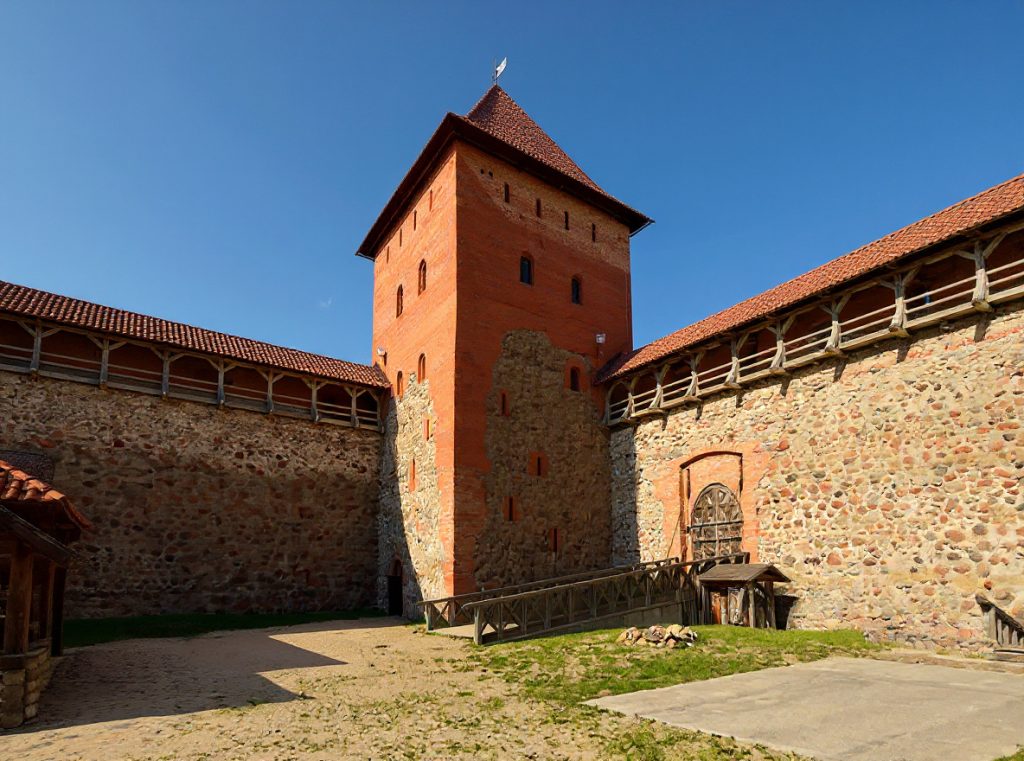
Workers laid the stone foundations in 1323, and construction of the castle lasted about five years. Builders used fieldstone and brick for Lida Castle, combining features of early Gothic and Romanesque architecture. Lida Castle formed part of the defensive line Novogrudok – Krevo – Medininkai – Troki against the crusaders. The castle had two angle towers and a church, which moved outside the walls in 1533. The fortress offered a haven where townspeople could shelter during enemy attacks. Its walls measured two metres thick and twelve metres high.
Despite its strong fortifications, the Teutonic Knights took Lida on several occasions (1384, 1392). In 1392 Vytautas with English and German knights captured the castle after fierce battles. In 1406, Lida’s defenders locked up the family of Yury of Smolensk as hostages. His attempt to take the castle and liberate them failed. Throughout the fifteenth and sixteenth centuries, the fortification witnessed numerous conflicts and hosted significant royal events. King Jagiello held his wedding here in 1422, for example.
The seventeenth century brought devastation. Swedish forces plundered the region during the Great Northern War, while Muscovite armies besieged the walls. After the uprising of Tadeusz Kościuszko in 1794, invading armies destroyed more of the castle walls. In 1891, a severe fire swept through Lida. Authorities then decided to use the fortification materials to rebuild the city. Local residents dismantled sections of wall to obtain bricks and stone. In the 1920s when Western Belarus became part of Poland under the Riga Treaty, Polish restorers carried out restoration works in Lida Castle. The young architect Tadeusz Bursche guided these efforts.
Current status
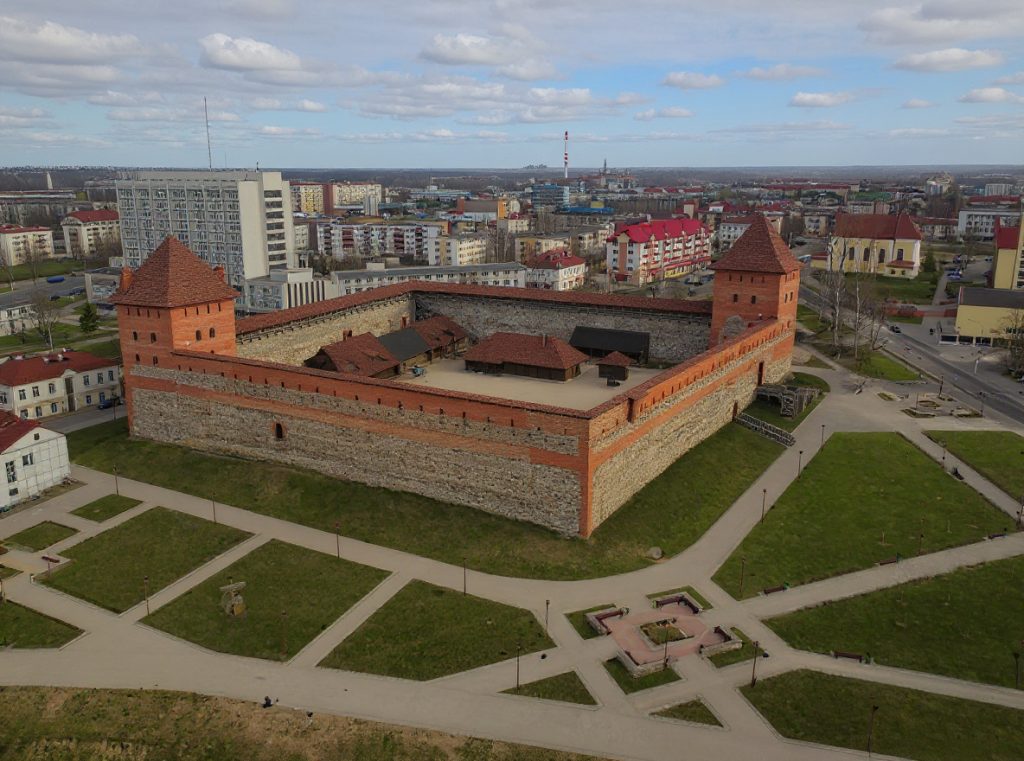
On January 22, 1940 authorities awarded the Castle of Lida the status of an archeological monument. In 1953 the state took the castle under protection. Only in 1982 did workers complete the full conservation of the Lida Castle. The true revival of Lida Castle began only in 2006, when comprehensive restoration commenced. The restorers sought to return the 14th century looks to the castle. Workers gradually restored the walls and the southwestern tower. The Lida Historical and Art Museum now manages the fortress and operates exhibitions in both towers. These exhibitions chronicle the castle’s military history and significant historical figures.
Today Lida Castle attracts visitors all year round, drawing thousands every year. Each year, the castle hosts a medieval-style tournament that brings knights in armour to the courtyard. Jousting and theatrical performances entertain crowds during these events. The restored walls and southwestern tower allow visitors to explore the fortification’s interior spaces and climb for views across Lida. Museum exhibitions occupy both corner towers, presenting archaeological finds and chronicling centuries of conflict and reconstruction. The castle serves as a vivid reminder of medieval military architecture. Its red brick walls still command the landscape as Grand Duke Gediminas intended seven hundred years ago.
Castles near Lida Castle
Frequently asked questions
What are the entry fees for Lida Castle?
Adults pay 15 BYN, students 11 BYN, and schoolchildren 8 BYN. Tickets must be purchased at the castle entrance and cash is required.
What can I see inside Lida Castle?
The castle features museum rooms displaying historical exhibitions, a courtyard with medieval displays, and tower rooms you can climb for views. Some interactive medieval activities are also available.
How do I get to Lida Castle from Vilnius?
Direct buses depart daily from Vilnius Bus Station to Lida, taking about 1.5 hours. By car, it's 111 km via the E28 motorway, also about 1.5 hours.
Is Lida Castle open year-round?
Yes, Lida Castle is open year-round. Hours are Tuesday to Sunday 09:00–18:00, closed Mondays; some sources note hours may extend to 19:00 in summer months.
What historical period does Lida Castle represent?
Built between 1323 and 1330 by Grand Duke Gediminas, Lida Castle is a 14th-century fortress that defended the Grand Duchy of Lithuania against Teutonic Knights. It hosts annual medieval tournaments celebrating its heritage.
Popular right now
Featured listings