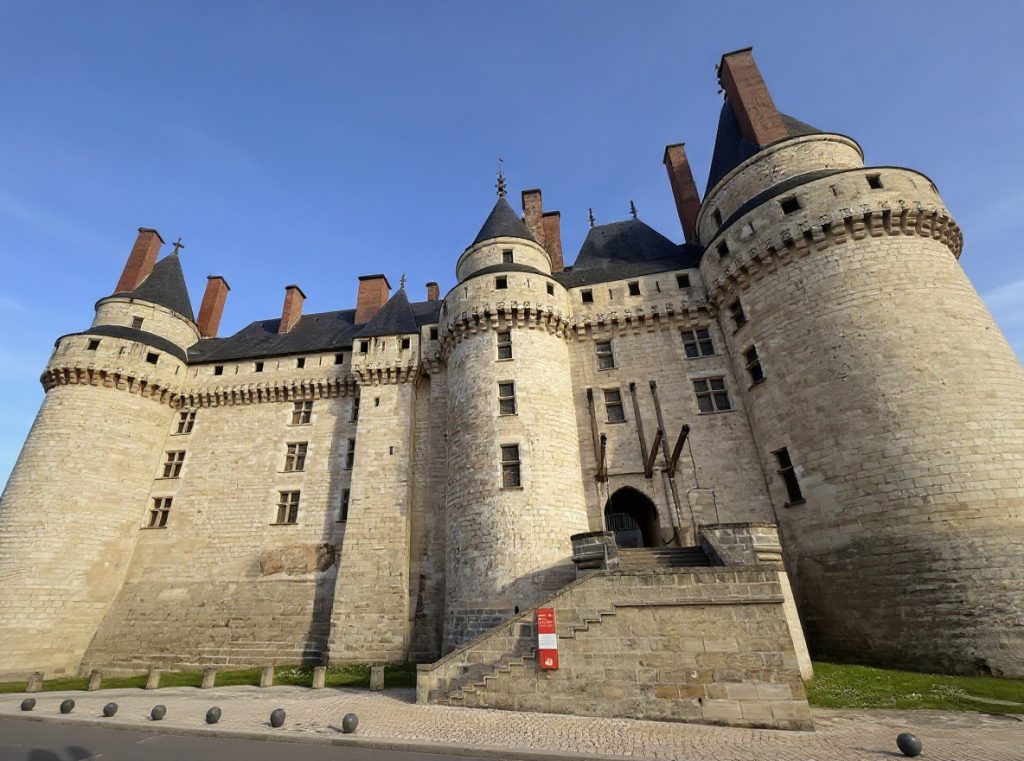
Builders raised Château de Langeais on a rocky promontory above the Loire River. The castle commands attention with its imposing medieval facade and one of France’s last fully operational drawbridges. This late fifteenth-century fortress marks a pivotal moment when military architecture began yielding to residential elegance. The château witnessed one of France’s most consequential royal marriages in 1491, when King Charles VIII wed Anne of Brittany within its walls. Today the Institut de France preserves this architectural treasure as a window into the transition from feudal power to Renaissance refinement.
Plan your visit to Château de Langeais
Tue–Sun 10:00–17:00Hours vary by season: Jan weekends only 10:00–17:00; Feb–Mar & Oct–Nov Tue–Sun 10:00–17:00 (closed Mon); Apr–Jun & Sep daily 9:30–18:30; Jul–Aug daily 9:30–19:00.
Location of Château de Langeais
The château sits at Place Pierre de Brosse in the town of Langeais, in the Indre-et-Loire department of central France. Langeais lies about 24 kilometers southwest of Tours, positioned strategically between the regional capital and Saumur along the Loire Valley. Travelers reach the site in 25 minutes from Tours via the A85 motorway toward Saumur, using exit 7. A railway station stands just five minutes’ walk from the château, with regular connections to Tours and Saumur. The Tours Saint-Pierre-des-Corps TGV station offers high-speed service 55 minutes from Paris Montparnasse. Visitors immediately notice the château’s striking position in the very center of the town, where its tall towers rise above the surrounding rooftops. The Loire flows nearby, though the château now overlooks the town rather than directly commanding the river. Free parking serves visitors who arrive by car.
History of Château de Langeais
Fulk Nerra, Count of Anjou, built the original fortress between 992 and 994 as part of his territorial struggle against the Count of Blois. This early structure ranks as one of the second-earliest known castles in France. Ruins of the tenth-century stone keep still stand in the park. The site changed hands repeatedly through sieges and battles during the following centuries. Count Odo besieged the castle in 995, and the siege continued into 996 when Odo fell ill and died. Richard the Lionheart extended the fortress between 1189 and 1199 under Plantagenet control. Philip II of France reconquered the castle in 1206, though it suffered destruction during the Hundred Years’ War.
In 1465 King Louis XI ordered a completely new château built lower down the slope near the remains of the old fortress. Builders finished construction in 1469. This resulted in a rare late medieval Loire château built in a single, fairly short campaign instead of growing gradually over centuries. In 1466 Louis ceded the château to his cousin François, Count of Dunois, son of Joan of Arc’s companion Jean de Dunois. At dawn on 6 December 1491, King Charles VIII married Anne, the young Duchess of Brittany, in one of the great halls. This union permanently attached the duchy to the French crown. Langeais remained royal property until the reign of Louis XIII. The crown sometimes gave it to noble families as reward or compensation.
In 1886 businessman Jacques Siegfried bought the ruined château and spent about twenty years restoring it. He installed an outstanding collection of tapestries and furnishings and bequeathed the château to the Institut de France. Since 1922 the French Ministry of Culture has listed the château as a historic monument.
Current status
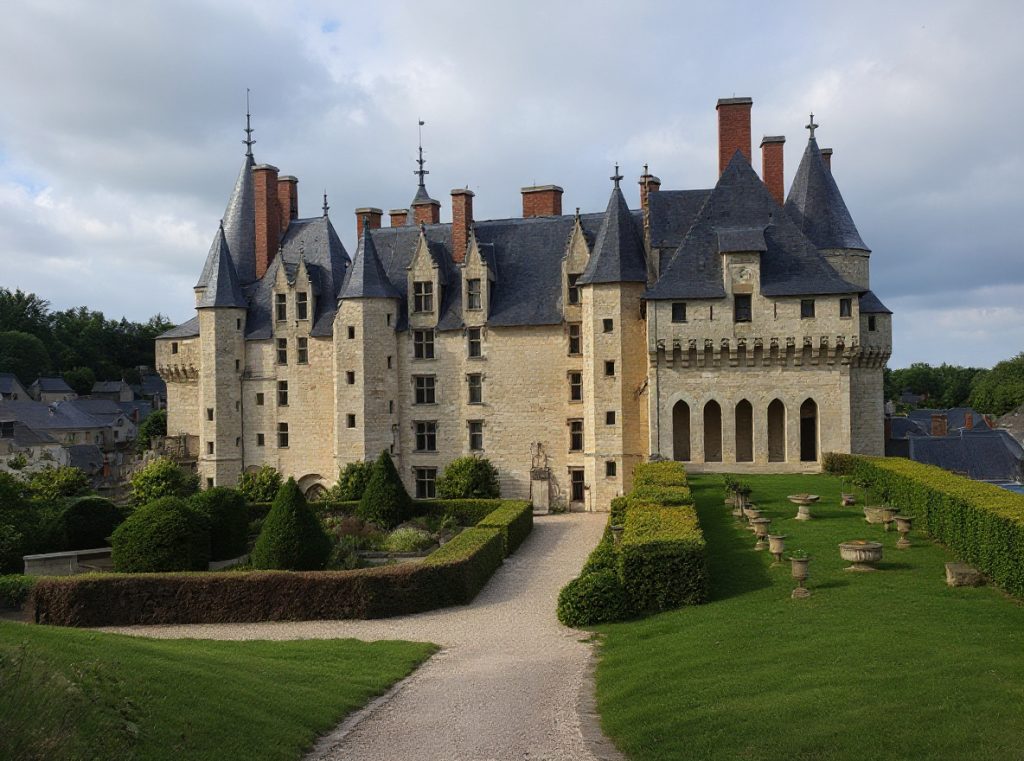
The Institut de France still owns the château and runs it as a museum, maintaining both the building and its remarkable collections. The château opens to the public every day of the year, with daily hours from 9:30 to 18:30. Last admission occurs at 17:30. The working drawbridge, one of the last still operating in France, lowers each morning as the site opens to visitors. The fortress presents two contrasting faces: town-side it appears as a stern medieval fort, while garden-side it shows a joyous residence that anticipated the French Renaissance.
The château offers a tour of fifteen rooms furnished with richly carved medieval furniture. The displays present collections of tapestries, period furnishings, and decorative arts from the fifteenth and sixteenth centuries. A reconstitution of the secret marriage of Charles VIII and Anne of Brittany brings visitors back to the time of the Middle Ages. Inside the gate, visitors can see the ruins of the medieval keep dating from the tenth century. The park surprises visitors with its cedars and sequoias. Animations for young and old run throughout the year. The château charges admission, with tickets ranging from €6 to €12 and free entry for children under ten.
The château exemplifies how French castle architecture evolved at the close of the Middle Ages. Stone walls that once defended against siege now frame gracious rooms where tapestries glow in soft light. Beyond the ramparts the Loire Valley stretches away toward distant horizons.
Castles near Château de Langeais
Frequently asked questions
What is special about Château de Langeais?
Built in 1465 for Louis XI, it is one of the best-preserved examples of late medieval architecture in the Loire Valley, with a working drawbridge and ruins of France's oldest stone keep from 994. Inside, the château recreates the 1491 secret wedding of Charles VIII and Anne of Brittany, a pivotal moment that united Brittany with France.
How long does it take to visit Château de Langeais?
Allow 1.5 to 2 hours to see the 16 furnished rooms, the chapel with its wedding re-enactment, the park, and the 10th-century keep ruins. Guided tours last approximately 50 minutes and cost an additional €2 per person.
Is Château de Langeais open year-round?
Yes, the château is open every day of the year except Mondays from February to March and October to mid-November. In January it opens weekends only. Hours vary by season, with the longest hours in summer (9:30–19:00) and shortest in winter (10:00–17:00).
Can I reach Château de Langeais by train from Tours?
Yes, TER trains run from Tours to Langeais station every 3–4 hours, with a journey time of 20–22 minutes. The château is then a pleasant 5-minute walk from the station through the town centre.
Are there activities for children at Château de Langeais?
Yes, the château offers family-friendly activities throughout the year, including wax figures in period costume, falconry demonstrations in summer, and seasonal events. Children aged 6–17 pay a reduced rate; those under 6 enter free.
Popular right now
Featured listings