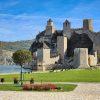
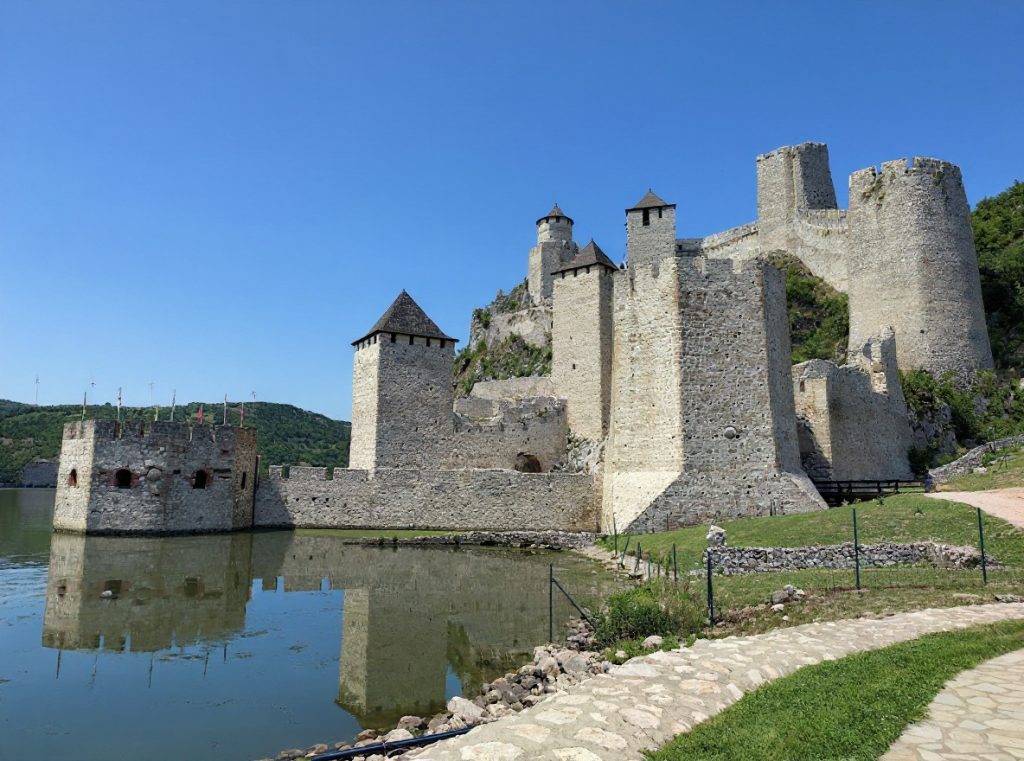
Rising from the cliffs where the Danube narrows into the Iron Gate gorge, Golubac Fortress commands one of Europe’s most strategic river crossings with its nine stone towers and ramparts. Builders raised the fortress during the 14th century when the Medieval Serbian state controlled this region. It stands roughly 4 kilometres downstream from the modern town of Golubac. The fortress successfully repelled over 120 attacks throughout its history. Architects adapted its irregular plan to the rocky terrain and arranged it in three principal compounds: the upper compound with the citadel, the rear compound, and the forward compound.
Plan your visit to Golubac Fortress
Tue–Sun 10:00–14:00Seasonal: Jan–Feb 10:00–14:00, May–Jun 10:00–17:00, Jul–Aug 10:00–18:00; closed Mondays year-round
Location of Golubac Fortress
Golubac Fortress sits as a medieval fortified town on the south side of the Danube River. It stands 4 km downstream from the modern-day town of Golubac, Serbia. The Romanian village of Coronini lies 2 km across the Danube. At this location the Danube stretches 6.5 km wide, so the fortress guards the entrance to the Đerdap Gorge within Đerdap National Park. The Danube itself provided natural protection for the fortress, as did the steep, inaccessible Ridan cliffs. Visitors can reach the site from Belgrade, which lies approximately 130 kilometres to the west. The fortress occupies territory in the Braničevo District of northeastern Serbia. Archaeologists uncovered remains during the 2010s reconstruction that point to Roman and Byzantine settlement before the fortress existed.
History of Golubac Fortress
Hungarian sources from 1335 provide the first known record of Golubac when Hungarian military occupied it. Builders constructed the majority of the fortress early in the 14th century, though the exact builder and founding date remain uncertain. Lazar of Serbia besieged it and acquired it, possibly in 1382. By the Battle of Kosovo in 1389, Serbia held Golubac. The Turks occupied it for the first time following the Battle of Kosovo in 1389. Hungarian captain Péter Perényi took it from them in 1391, but then they recaptured it later the same year.
King Sigismund of Hungary took over the fortress in 1392. The longest uninterrupted Serbian control came in 1403 when King Sigismund of Hungary granted Golubac to Despot Stefan Lazarević. After that the fortress remained a contested prize for centuries. Hungarian king Zigmund unsuccessfully sieged Golubac in 1428. The Ottomans held the fortress for extended periods. Even Matthias Corvinus managed to take it back briefly in 1458, only to lose it again to Mehmed II that same year. Modern Serbia definitively acquired Golubac from the Ottoman Empire in 1868.
After World War I, engineers carved a road right through the fortress’s double portcullises. Then, in the 1960s, the construction of the Iron Gate hydroelectric dam raised water levels and submerged parts of the lower fortress. The fortress suffered decades of neglect until a major restoration began in the twenty-first century.
Current status
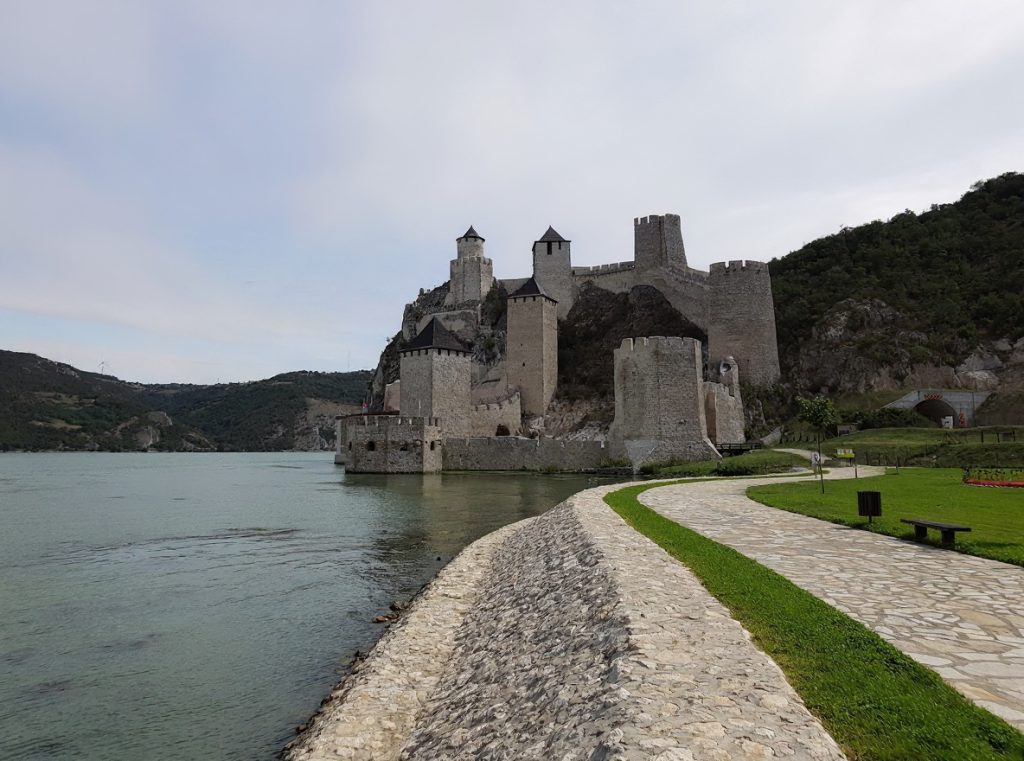
Authorities declared Golubac a Cultural Monument of Exceptional Importance in 1979, so the Republic of Serbia now protects it. It has its own state administration, a distinction it shares among Serbian cultural monuments only with Belgrade Fortress. The Revitalization of the Golubac fortress project ran from 2014 to 2019 when workers completely reconstructed the fortress and saved it from decay. Officials fully reconstructed Golubac and ceremonially reopened it on 29 March 2019.
The reconstructed Golubac fortress now welcomes visitors year-round with its nine towers connected by ramparts, a palace, and an archaeological park. The park features the “Roman House”, Kodze Mahmud Pasha’s hammam, and a medieval limestone visitor center alongside a modern one. Visitors can join guided tours or explore on their own. The Palace houses a digital presentation of the Fortress in the form of historical timeline, interactive map, and 3-D model of the fortification. Film screenings also run there. The exhibitions teach visitors about the most famous battle for Golubac Fortress and the knights who fought it. They also cover periods of rule by Hungarians, Serbs and Ottomans, as well as recent archaeological finds. The site provides stunning views across the widest stretch of the Danube.
When the morning light strikes its stone walls, the fortress seems to rise directly from the river itself. Nine towers stand sentinel over the water. Their weathered stones bear witness to seven centuries of conflict, conquest, and survival at the threshold between empires.
Castles near Golubac Fortress
Frequently asked questions
What ticket zones are available at Golubac Fortress?
Zone I (Green) is open to all visitors and includes the Palace and three towers. Zones II–IV are adults-only adventure routes with restricted access and require advance booking for some.
Is Golubac Fortress accessible for wheelchairs?
Wheelchair users can access the Palace only in the Green Zone. The towers and upper routes involve stairs and steep climbs and are not wheelchair accessible.
Can I book a guided tour at Golubac Fortress?
Free short talks are given hourly in the Palace in Serbian and English. Group guided tours require at least 5 days' advance notice via email to info@tvrdjavagolubackigrad.rs.
Are there restaurants near Golubac Fortress?
There is a coffee shop on site (open 10:00–14:30). Traditional restaurants with Danube views are available 4 km away in Golubac town and further east in Đerdap National Park.
What is the best way to combine Golubac Fortress with other sites?
Many visitors combine it with Lepenski Vir archaeological site (35 km east, prehistoric settlement) and a scenic drive through Đerdap National Park along the Danube gorge. Full-day tours from Belgrade often include both.
Popular right now
Featured listings