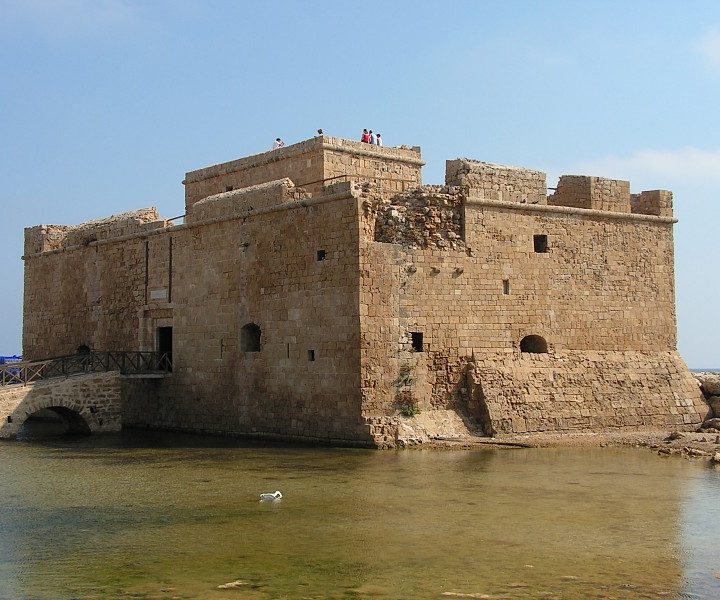
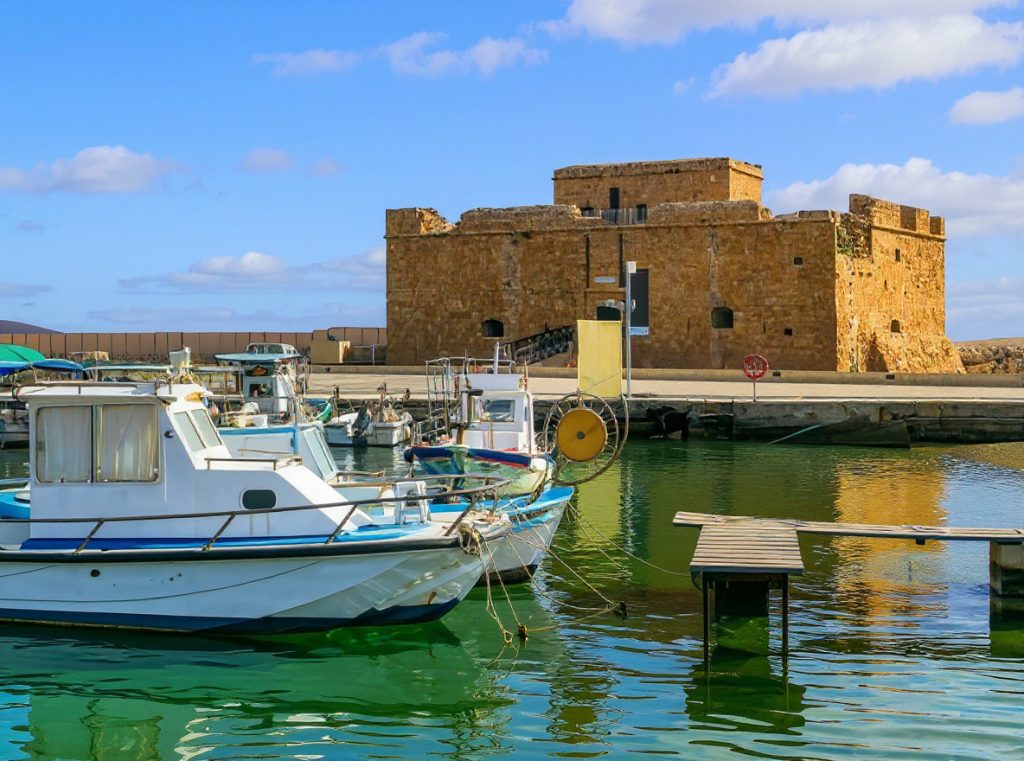
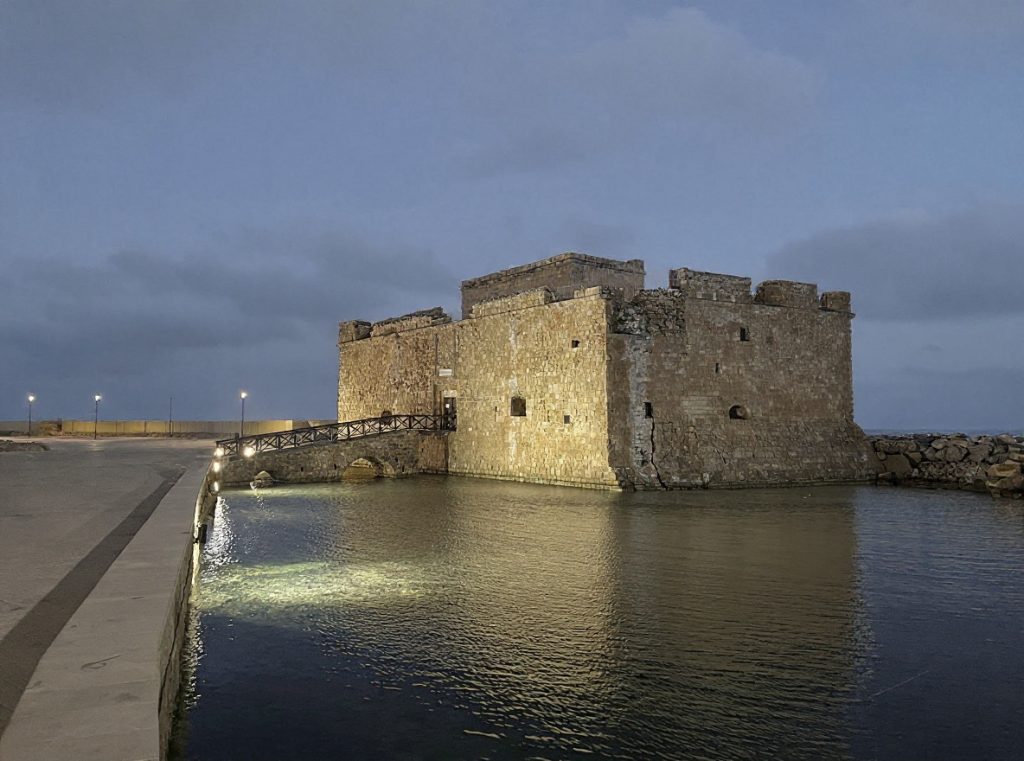
At the western edge of Paphos harbour, Paphos Castle rises from the waterfront as a compact square tower built from dressed limestone blocks. This medieval fortress guards the harbour entrance where successive empires—Byzantine, Frankish, Venetian and Ottoman—left their architectural imprints across eight centuries. The castle’s modest footprint belies its turbulent past of construction, destruction and repeated rebuilding. Today it stands as an enduring symbol of Cyprus and hosts cultural events against a backdrop of Mediterranean waters.
Plan your visit to Paphos Castle
Location of Paphos Castle
Paphos Castle sits at the western end of Kato Paphos harbour in southwest Cyprus. The fortress occupies a prime waterfront position on the Coastal Broadwalk, just steps from the harbour promenade lined with cafés and restaurants. Visitors staying in coastal hotels can reach the castle on foot during a pleasant seaside walk. City buses run regularly to the harbour terminus, so the entrance is just minutes away. For those travelling by car or taxi, parking areas lie near the port. Paphos International Airport, Cyprus’s second-largest gateway, serves the region and sits a short drive from the harbour district.
History of Paphos Castle
The story of this site began when the Byzantines built a fort in the tenth century to protect the harbour from Arab raids. A devastating earthquake destroyed that original fortress in 1222. The Lusignans, who ruled Cyprus during the Frankish period, then erected a new castle in the mid-thirteenth century to replace the ruined Saranta Kolones fortress inland. They constructed two towers connected by a defensive wall to control the port’s gateway. The Genoese occupied the castle in 1373 during their incursions into Cyprus. King Jacques I de Lusignan ordered restoration of the damaged towers in 1391, strengthening them into a more formidable defensive structure.
When Venice gained control of Cyprus, the Venetians concentrated their military resources elsewhere on the island. In 1570, anticipating an Ottoman invasion, they demolished the castle to prevent it from falling into enemy hands. The Ottomans conquered Cyprus in 1571 and found only ruins. Ahmed Pasha, the Turkish governor, ordered the castle rebuilt in 1592. Ottoman engineers constructed the current structure on the foundations of the western Frankish tower, incorporating some Venetian elements. A Turkish inscription above the entrance commemorates this reconstruction. Workers built a large square tower with an enclosed courtyard in the centre. The ground floor featured a central hall flanked by small rooms that served as prison cells. Twelve battlements crowned the roof, each holding a cannon to defend the harbour. A garrison of approximately fifty soldiers manned the fortress during Ottoman rule.
Current status
When Cyprus became a British colony in 1878, Paphos Castle lost its military function. The British authorities used the fortress as a storage facility for salt until 1935. That year, the newly founded Department of Antiquities designated Paphos Castle an ancient monument and took it under protection. The castle joined the Paphos Archaeological Park when UNESCO inscribed the site as a World Heritage property in 1980. The Department of Antiquities manages the fortress today and opens it to visitors year-round except on public holidays.
Visitors enter through the single gateway and explore the central hall and former prison cells on the ground floor. Stone staircases lead to the roof, where the twelve battlements offer panoramic views across the harbour and Mediterranean Sea. The entrance fee remains modest, supporting ongoing maintenance and preservation work. Operating hours extend from half past eight in the morning until half past seven in the evening during summer months, with shorter winter hours. The ground floor welcomes wheelchair users, though the roof remains unreachable for those with mobility limitations.
The castle serves a vibrant cultural role beyond its historical significance. Each September, the square in front of the fortress transforms into an open-air venue for the Paphos Aphrodite Festival, an international opera event that draws performers and audiences from across Europe. The medieval walls provide a dramatic backdrop for musical performances under the Mediterranean stars. The castle has become one of Cyprus’s most photographed landmarks, particularly at sunset when golden light washes over the limestone walls and reflects in the calm harbour waters. After centuries of conflict and transformation, the fortress now welcomes visitors to discover layers of history preserved in stone.
Frequently asked questions
How much does it cost to visit Paphos Castle?
Admission to Paphos Castle is €2.50 for adults. Children under 12 enter free when accompanied by an adult.
What can you see inside Paphos Castle?
The castle has two floors with limited interior displays and historical information panels at the entrance. The main attraction is the rooftop terrace, which offers panoramic views of the harbour and Mediterranean Sea.
What are the opening hours of Paphos Castle?
From 16 April to 15 September the castle is open daily 08:30–19:30. From 16 September to 15 April it closes earlier at 17:00, and it is closed on public holidays including Christmas, New Year and Orthodox Easter.
Is Paphos Castle wheelchair accessible?
The ground floor of Paphos Castle is accessible to wheelchairs and pushchairs. However, access to the rooftop terrace requires climbing stairs and is not wheelchair-friendly.
Can you combine Paphos Castle with other nearby attractions?
Yes, the castle is located at Paphos Harbour, within walking distance of the Paphos Archaeological Park and Tombs of the Kings. A combined day pass for €8.50 covers admission to all Department of Antiquities sites.
Popular right now
Featured listings