
Rising from the plains of eastern Lithuania, Medininkai Castle commands the landscape with its formidable defensive walls and restored tower. This enclosure castle spreads across 6.5 hectares, which makes it the largest of its type in Lithuania and one of the largest castles in Central and North-Eastern Europe. Builders constructed the castle in the transitional period from the Romanesque to the Gothic style, so it ranks among the earliest enclosure castles in Lithuania. For centuries, this fortress defended the Grand Duchy of Lithuania against invaders from both west and east.
Plan your visit to Medininkai Castle
Wed–Sun 10:00–18:00May–Sep: Mon closed, Tue–Sun 10:00–19:00; Oct–Apr: Mon–Tue closed, Wed–Sun 10:00–18:00; Nov–Feb closes 17:00
Location of Medininkai Castle
Medininkai Castle sits 32 kilometres from the centre of Vilnius in the village of Medininkai, Vilnius district. Builders raised the castle on a plain, and a swamp surrounded it from the north and from the west. A nameless brook ran through the middle of the swamp. Unlike many medieval fortresses perched on hills, this castle relied on its marshy surroundings and massive walls for defence. The castle stands near Lithuania’s highest peaks, Aukštojas and Juozapinė Hills, in a landscape rich with ancient burial mounds and traces of settlements. Medininkai town grew alongside one of the oldest and largest trade routes in Lithuania, which Lithuanians used to reach the Russian lands. Visitors can reach the castle by car from Vilnius in roughly thirty minutes when they travel east toward the Belarusian border.
History of Medininkai Castle
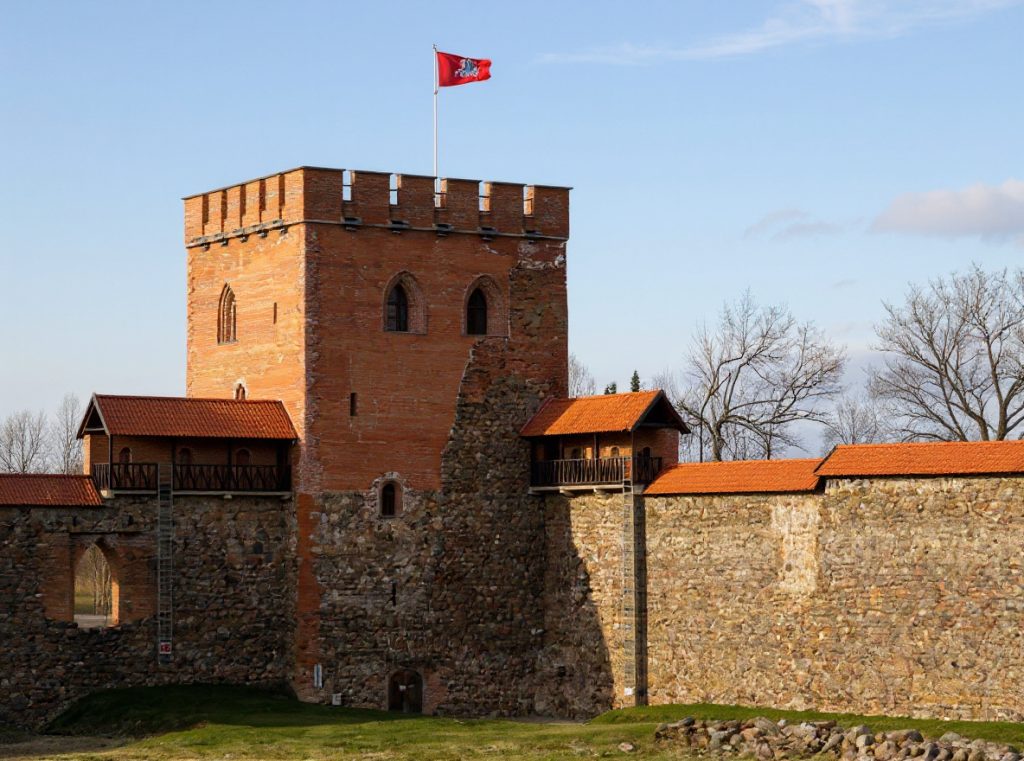
Historians believe builders raised Medininkai Castle in the first half of the 14th century, during the reign of Grand Duke Gediminas of Lithuania (1316–1341). The fortress served as one of the points that defended the Lithuanian state with its capital Vilnius against the aggression of the Teutonic and Livonian Orders, and a possible attack from the east. The rectangular castle’s yard covered approximately 1.8 hectares, and walls 15 metres high and 2 metres thick protected it. The castle had 4 gates and towers. Residents used the main tower (donjon), about 30 metres high, for living quarters. Builders made the walls and towers from field stones and bricks in the Baltic brick bonding method.
Chronicles first mentioned the castle as a military object in 1402, when the Grand Commander of the Teutonic Order, Wilhelm von Helfenstein, failed to capture Vilnius but seized and burned down Medininkai Castle. Apparently fire destroyed only the wooden buildings. Grand Duke Vytautas visited it a number of times; in 1415 he wrote a letter to master of the Teutonic Order there. When a medieval chronicle referred to his 1426 stay, it noted “unsere husse Medniki”. A military unit named “chorągiew miednicka” from Medininkai took part during the Battle of Grunwald. After Vytautas’ death, the castle’s military importance declined. In the beginning of the 16th century, fire damaged the wooden buildings in the courtyard. Builders erected a wooden manor there some decades later.
Wars in 1655 and 1812 ravaged the abandoned castle. In 1812, the Grande Armée occupied Medininkai Castle while retreating from Moscow during the failed French invasion of Russia. Soldiers demolished and burned the wooden buildings in the winter to provide warmth for the French troops.
Current status
Restoration works began in 1959, when many prominent architects took part in this work. The project stopped in 1981, yet restoration resumed only ten years later. Workers implemented the programme for castle reconstruction and adaptation for tourism in 2010–2012. In 2004 Medininkai Castle became a department of Trakai History Museum, which continues to manage the site today. The museum charges a modest admission fee.
The main tower of the castle rises five stories tall and invites visitors to learn more about the history of the Grand Duchy of Lithuania and its brick castles and explore unique archaeological findings. Exhibits include 14th–18th century weaponry: cannons, stone projectiles, archaeological finds; a collection of silverware from the 10th–20th centuries; and a collection of hunting trophies and hunting knives from the President of the Republic of Lithuania, Algirdas Mykolas Brazauskas. Visitors can climb to an observation deck for panoramic views of the Medininkai highlands. Annual events include Medininkai Castle Games, musical performances and ceremonial days. Staff also organise conferences and fine art exhibitions there, including photography, graphics, and painting. Educational activities for children and adults take place in the conference hall and in the castle yard. The five-storey donjon tower rises above the remains of the defensive walls, where medieval life once thrived along Lithuania’s eastern frontier.
Castles near Medininkai Castle
Frequently asked questions
What can I see inside Medininkai Castle?
The five-storey keep houses a museum with exhibits on Lithuanian castles, medieval armour and weapons, and a collection of hunting trophies and knives from former President Algirdas Brazauskas. The rooftop observation deck offers views of the Medininkai Highlands and Lithuania's two highest hills.
How large is Medininkai Castle?
Medininkai Castle is the largest enclosure-type castle in Lithuania by area, covering 6.5 hectares including double defensive ditches. The rectangular castle has four towers connected by walls almost 2 metres thick and 15 metres tall, with a 30-metre-tall main tower (donjon).
Are there facilities at Medininkai Castle?
The castle has an accessible lift for wheelchairs and prams. There are no cafés or restaurants in the village, so visitors should bring food; tables are available in the castle courtyard for picnics.
When was Medininkai Castle built?
The castle was built in the late 13th or early 14th century, likely during the reign of Grand Duke Gediminas. It was restored between 2010–2012, and the Trakai History Museum opened a permanent exhibition in the keep in 2012.
What events are held at Medininkai Castle?
The castle hosts the annual Medininkai Castle Games on the last weekend of September, featuring medieval combat demonstrations, archery, and traditional craft fairs. Special events, concerts, and educational activities for children and adults take place throughout the year.
Featured listings