
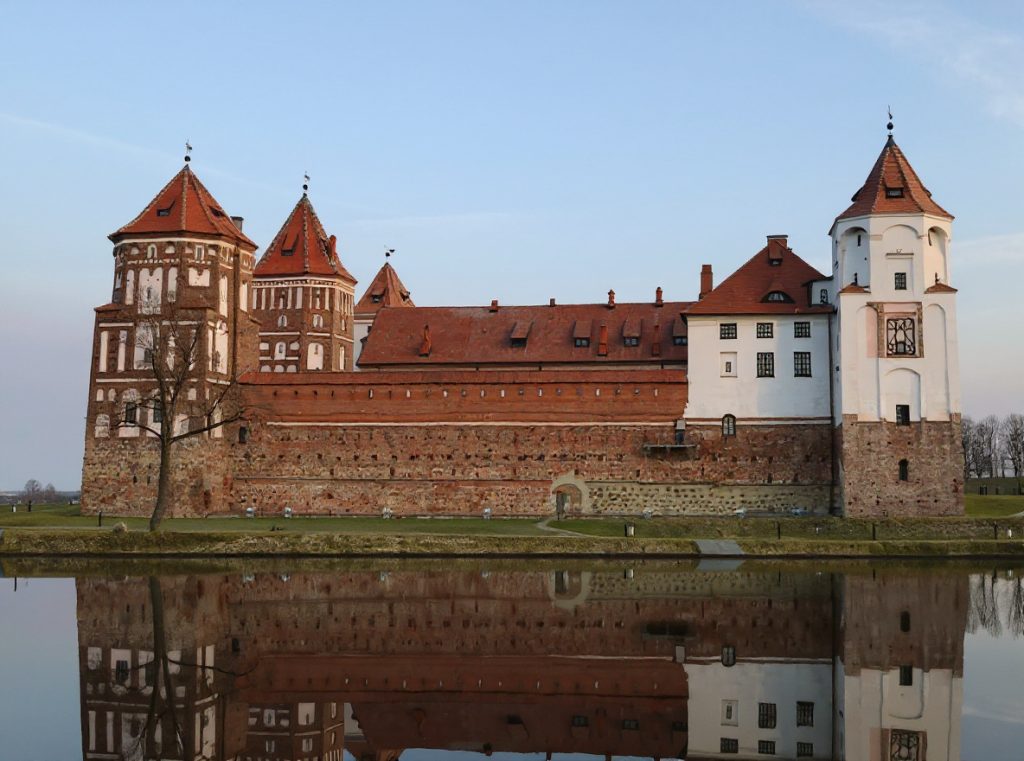
Mir Castle stands in the Grodno region of Belarus as a remarkable fusion of Gothic, Renaissance and Baroque architecture. Five distinctive defensive towers rise from thick brick-and-stone walls that have witnessed five centuries of turbulent European history. The complex earned UNESCO World Heritage status in 2000, and today it serves as one of Belarus’s most important cultural landmarks. Visitors encounter not just a medieval fortress, yet also a testament to the artistic and military ambitions of the noble families who shaped this region.
Plan your visit to Mir Castle
Location of Mir Castle
Mir Castle sits in the town of Mir, in Karelichy District of Grodno Oblast, 29 kilometres north-west of Nesvizh Castle, another UNESCO World Heritage site. The town lies on the banks of the Miranka River, about 85 kilometres southwest of the capital, Minsk. Regular bus services connect Minsk to Mir, so travellers can reach the castle in approximately ninety minutes by road. The castle dominates the small town, which makes orientation straightforward for visitors arriving by car or coach. The complex stands 164 metres above sea level in relatively flat terrain, surrounded by landscaped parkland and an artificial lake created during later renovations.
History of Mir Castle
Duke Yuri Ilyinich initiated construction of the castle in the 1520s. At the first stage, five towers were erected, connected by walls up to three metres wide at the base. Five towers surrounded the courtyard of the citadel, the walls of which formed a square of 75 metres on each side. The frequent Tatar raids and tensions among feudal lords made strong fortifications essential. Under Ilyinich, five towers were erected, connected by thick walls, but construction of the citadel was not completed. When the Ilyinich dynasty died out in 1568, the castle passed into the hands of Mikalaj Kryštafor “the Orphan” Radziwił. He refitted it with a two-winged, three-storey stately residence along the eastern and northern inner walls. Plastered façades were decorated with limestone portals, plates, balconies and porches in the Renaissance style. The Radziwił family owned the property for several centuries. Earth walls were built around the castle with bastions at the corners, surrounded by a water moat. An Italian garden was laid to the north of the walls and an artificial lake was established to the south. Wars brought repeated damage. During the Napoleonic wars the castle suffered severely. In 1891 the castle was sold along with Mir lands to Nikolai Ivanovich Svyatopolk-Mirsky, a cavalry general. Nikolai Svyatopolk-Mirsky began restoring his new property, and his son continued the work, led by renowned architect Teodor Bursze. The Svyatopolk-Mirski family owned the castle until 1939. During the Great Patriotic War, from May to August 1942, the Nazis created a ghetto in the castle, confining about 800 local Jews. After the liberation of Belarus in July 1944, locals whose houses had been destroyed by the war found shelter in the castle.
Current status
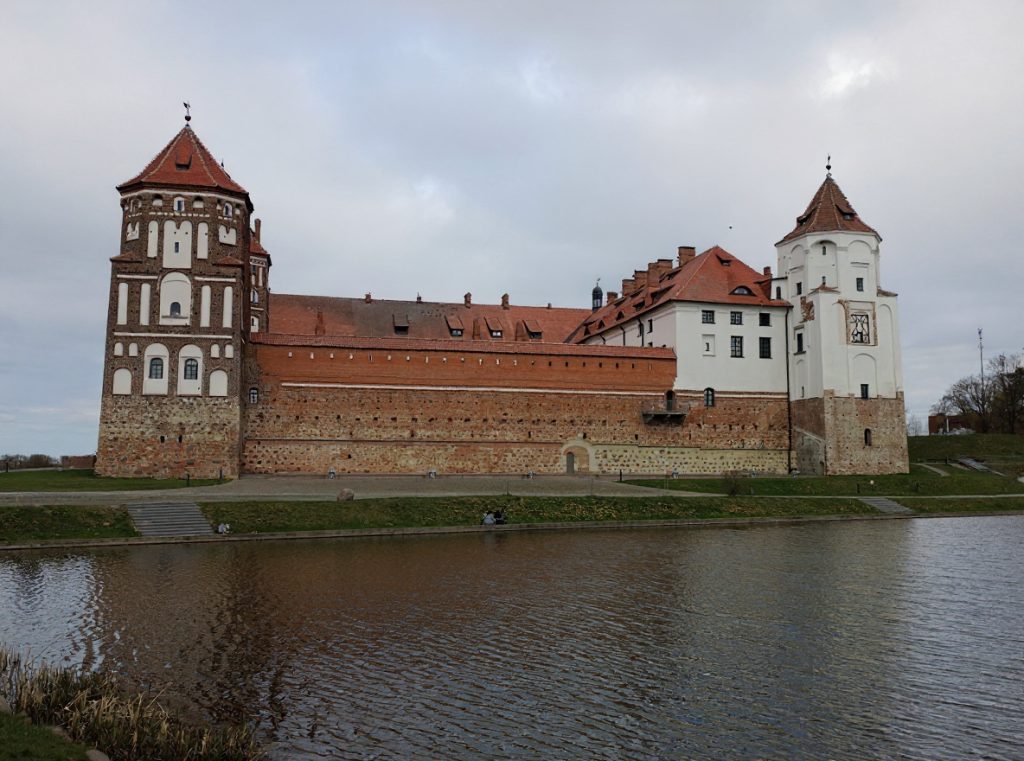
In 1947 the castle was taken under State protection. The year 1983 marked the beginning of long-term restoration work on the building. In 1987, Mir Castle Complex became a branch of the National Art Museum of the Republic of Belarus. The restoration and final transformation into a museum were completed on December 16, 2010. The Mir Castle Complex Museum was founded on 1 April 2011. In 2000, the castle was included in the UNESCO World Heritage List, underlining its uniqueness and importance to the world’s architectural heritage. Currently, the museum has 36 exhibits in 42 halls, some with recreated interiors of the 17th-18th centuries. The ensemble includes a castle-museum of the 16th-20th centuries with 39 full-fledged expositions, earth ramparts, picturesque parks and a pond, and a church-mausoleum of Princes Svyatopolk-Mirsky. The complex offers well-developed infrastructure: two conference halls for hosting events, a 16-room hotel, a restaurant with dishes of historic cuisine, and a souvenir shop with products of Belarusian craftsmen. On the concert grounds, music and knightly festivals, as well as arts and crafts festivals are traditionally held. In 2019, the complex was visited by more than 320 thousand tourists. Stone walls glow warmly in evening light, while the towers cast long shadows across the courtyard where nobles once gathered. The castle endures, a silent guardian of centuries past.
Castles near Mir Castle
Frequently asked questions
Is Mir Castle a UNESCO World Heritage Site?
Yes, Mir Castle was inscribed on the UNESCO World Heritage List in 2000 as an outstanding example of 16th-century Central European castle architecture. The complex blends Gothic, Renaissance, and Baroque styles.
Can I stay overnight at Mir Castle?
Yes, the castle operates a small hotel with rooms furnished in period style, with prices starting from around 260 BYN per night. Hotel guests receive discounted entry to the museum.
How long does it take to visit Mir Castle from Minsk?
A day trip from Minsk is feasible; buses depart several times daily and take around 2 hours each way. Most visitors spend 2–3 hours at the castle, allowing time to return to Minsk the same day.
What can I see inside Mir Castle?
The museum displays period furniture, portraits, weapons, tapestries, and ornate interiors including a grand ballroom with a caisson ceiling. The underground storerooms and towers are also open to visitors.
Are there guided tours available at Mir Castle?
Yes, guided tours in various languages are available for groups of up to 25 people, with a 45-minute tour costing 24 BYN or a 70-minute tour for 39 BYN. Audio guides cost 5 BYN and are offered in several languages including English.
Featured listings