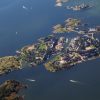
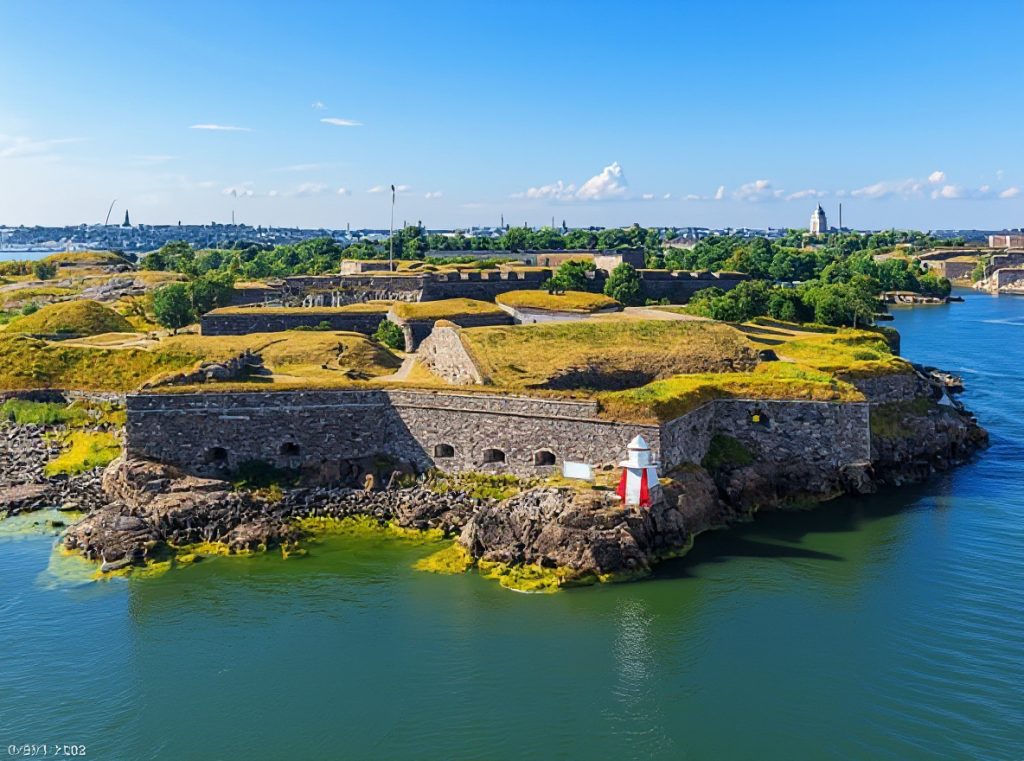
Spread across six fortified islands in Helsinki harbor, Suomenlinna rises from the Baltic Sea as a monument to three centuries of military architecture and geopolitical struggle. UNESCO added the site to its World Heritage List in 1991 because it represents a unique monument of military architecture. Another special feature of the fortress is that in the course of its history, it has served in the defence of three realms: Sweden, Russia and Finland. Suomenlinna is now a living district of Helsinki with about 800 inhabitants. The fortress is one of Finland’s most popular tourist sites, so it attracts approximately one million visitors every year.
Plan your visit to Suomenlinna
Location of Suomenlinna
Suomenlinna sits about four kilometres (2.5 mi) southeast of the city center of Helsinki, Finland. Both tourists and locals visit this popular destination. The sea fortress comprises eight islands, though builders fortified only six of them. Public transport (HSL) ferries make the fortress easily accessible all year from the Market Square (daily) or from Katajanokka (on weekdays). The travelling time is approx. 15 minutes. A waterbus service operates during the summer months. Visitors can walk freely across the islands because Suomenlinna charges no entrance fee. Ferry tickets must be purchased before boarding, since the vessels do not sell them on board. The journey offers views of Helsinki’s coastline and the scattered archipelago.
History of Suomenlinna
Construction of Suomenlinna began in 1748, under Swedish rule. Swedish Admiral Augustin Ehrensvärd started building the island fortress in 1748 when he adapted Vauban’s bastion fortification theory to the specific geography of six rocky islands in Helsinki harbour. The fortress was meant to act as a naval base to defend the mainland. Sweden sought to counter Russian expansion in the Baltic and required a base to maintain its archipelago fleet. Over the following 24 years, workers completed the principal works: the King’s Gate, the Crown Bastion, the Ehrensvärd Bastion, and the dry dock, finished in 1756. A naval military school opened at the fortress in 1779, so it assumed a dual role as both arsenal and training institution.
In 1808, Suomenlinna surrendered to Russian troops, and it became a Russian military base and garrison town. The surrender opened the way for Russia to incorporate Finland as the Grand Duchy of Finland within the Russian Empire. Russian forces expanded the complex substantially when they added new buildings and strengthened artillery positions. It suffered heavy damage during the Crimean War (1853–1856) when Anglo-French forces bombarded it. The Russians constructed the Orthodox garrison church in 1854, which still dominates Iso Mustasaari island today. Under Russian administration, the fortress was known as Viapori.
The fortress received its current name, Suomenlinna, in 1918. Finland had become independent a year before, and a new regime took over the fortress. During the Finnish Civil War, the islands briefly housed a prison camp. Suomenlinna remained under the control of the Finnish Defense Department until 1973, when authorities transferred most of it to civilian administration. Throughout these three periods, each nation developed and modified the fortifications while preserving the core bastion structure.
Current status
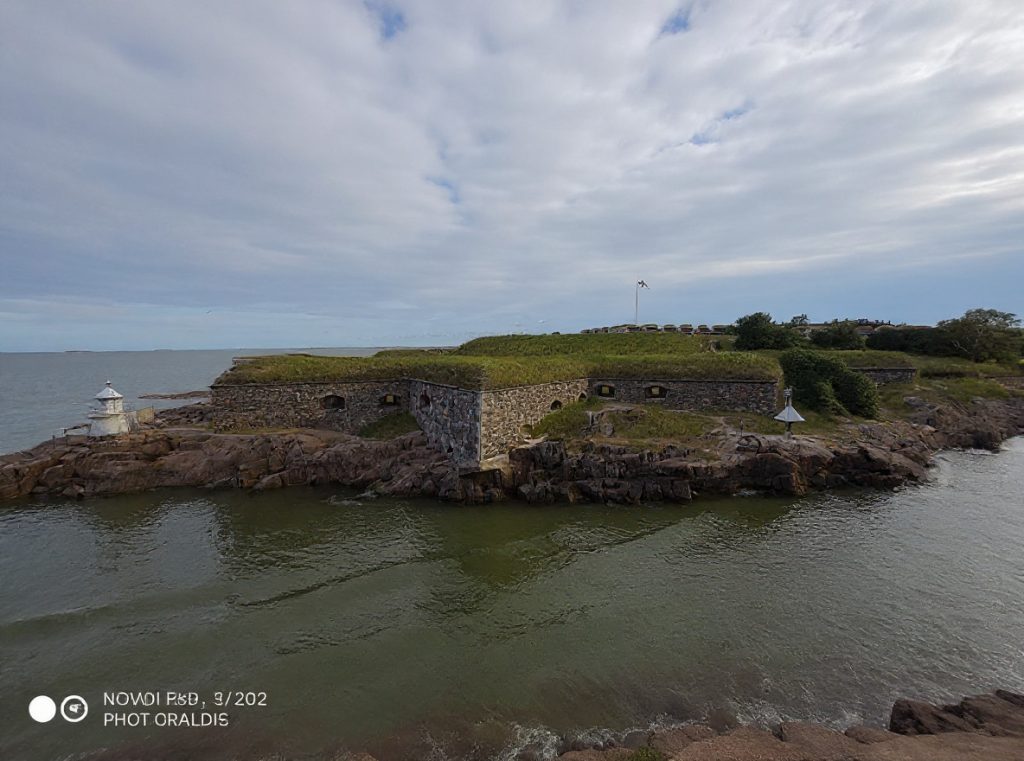
The Governing Body of Suomenlinna, operating under the Finnish Heritage Agency, restores, maintains, presents, and manages Suomenlinna. Approximately 200 buildings stand in an area of 80 hectares on the eight islands of the Suomenlinna district. The fortress features about 6 kilometres of walls and 105 cannons. Museums open year-round include the Suomenlinna Museum and the Military Museum, with its popular submarine Vesikko attracting thousands annually. Restaurants, cafés, galleries and workshops operate throughout the islands, alongside an open prison that integrates inmates into community restoration work.
Builders developed Suomenlinna over a period of three centuries. It is nowadays a unique residential district of Helsinki and a popular tourist destination. The military architecture of the six fortified islands recounts the history of the Kingdom of Sweden, the Russian Empire and the Republic of Finland. Residents live in historic military buildings converted to apartments, so they share the islands with visitors who wander the fortification walls, explore tunnels and enjoy waterfront parks. The church tower doubles as a lighthouse, guiding vessels through the approaches. Conservators follow careful management plans to balance residential life, tourism and heritage preservation. On summer evenings, locals gather on the bastions as the sun sets over the Baltic. In winter, waves freeze against ancient stone ramparts and transform the sea fortress into a quiet retreat.
Castles near Suomenlinna
Frequently asked questions
Is Suomenlinna free to visit?
The fortress itself is free to explore and open year-round. Individual museums charge admission (Suomenlinna Museum €10), and you need a ferry ticket (€3.30 each way or included in HSL day pass).
How do I get to Suomenlinna from Helsinki?
Take the HSL public ferry from Market Square (route 19), which runs every 15-20 minutes in summer and every 40-60 minutes in winter. The crossing takes 15 minutes and costs €3.30 each way or is included in any HSL day ticket.
How long does it take to see Suomenlinna?
Allow 3-4 hours minimum to see the main sights including the museum and walking the fortress grounds. The islands are connected by bridges and cover a large area, so comfortable walking shoes are recommended.
Can I visit Suomenlinna in winter?
Yes, Suomenlinna is accessible year-round by ferry. The fortress grounds are open 24/7, though some museums and cafés operate on reduced hours or close seasonally from October to April.
What should I see at Suomenlinna fortress?
Visit the Suomenlinna Museum for the fortress history, walk the historic fortifications and bastions, see the submarine Vesikko (summer only), explore the Military Museum, and walk along the coastal walls for views of the archipelago. Free maps available at the Visitor Centre.
Featured listings