
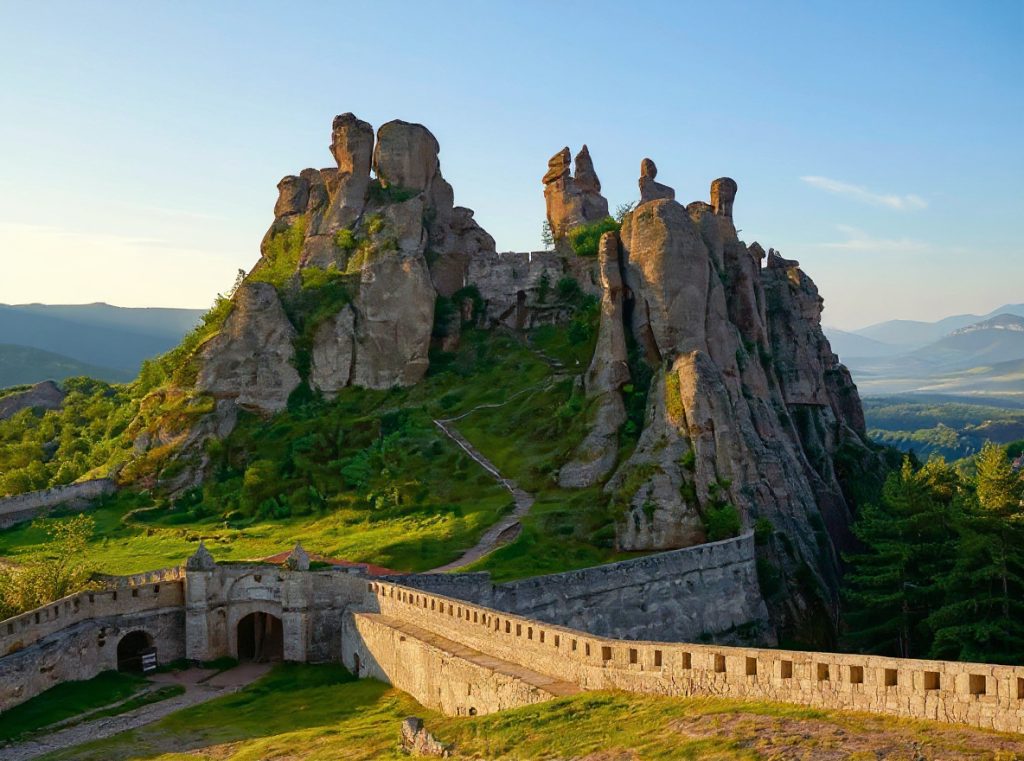
Built into the dramatic red sandstone cliffs of northwest Bulgaria, Belogradchik Fortress ranks as one of the nation’s most remarkable ancient strongholds. Locals know it as Kaleto. The fortress integrates human engineering with nature’s own defences so completely that the two become almost indistinguishable. It covers a total area of 10,210 square metres. Yet on two sides it relies entirely on sheer rock faces that tower up to seventy metres high. Since Roman times, armies and empires have fortified this natural citadel, leaving layers of history embedded in its walls.
Location of Belogradchik Fortress
Belogradchik Fortress sits on the slopes of the Balkan Mountains in the Vidin Province of Bulgaria. It lies close to the town of Belogradchik in the country’s far northwest. The fortress occupies a position near Bulgaria’s borders with Serbia and Romania. This strategic location controlled trade and military routes through the region for centuries. Visitors reach the site from Sofia, roughly 180 kilometres to the southeast, by road through winding mountain terrain. The fortress sits in the town of Belogradchik, and hiking trails and guest houses occupy the immediate vicinity. The red sandstone formations that frame the fortress extend across fifty square kilometres of mountainside. They create one of Bulgaria’s most distinctive landscapes.
History of Belogradchik Fortress
The Romans constructed a stronghold at Belogradchik during the 3rd century AD. They built it to protect the transport of goods and gold from Thracian lands. Engineers positioned this early fortification on the highest naturally inaccessible part of the rocks now called the citadel. It remained in use throughout the Byzantine period for surveillance of the surrounding region. After the Slavic invasions destroyed much of the original structure, rebuilding began in the seventh century and continued through the medieval period.
Ivan Stratsimir, the Bulgarian tsar of Vidin, extended the old fortress in the 14th century. He made Belogradchik second in importance only to the tsar’s capital fortress of Baba Vida. His builders added fortified garrisons and strengthened the defensive walls. In 1396 the Turks conquered Belogradchik and incorporated it into the Ottoman Empire. The Ottomans carried out major renovations in the early nineteenth century. They transformed the medieval structure into a modern military installation. French and Italian engineers participated in the expansion, bringing European military design to the fortress and adding artillery positions.
The stronghold played an important role in the Ottoman suppression of the Bulgarian Belogradchik Uprising of 1850. During this uprising, Bulgarian peasants marched on Belogradchik but failed to take the fortress. After the rebels failed, executioners killed some of the town’s leaders. Soldiers last used Belogradchik in warfare during the siege of Belogradchik in the Russo-Turkish war in 1878 and the Serbo-Bulgarian War in 1885. Following these conflicts, the fortress ceased its military function.
Current status
Authorities declared the site a national landmark in 1965, as published in Issue 41 of the State Gazette. It ranks as one of the most unspoiled ancient structures in Bulgaria. The local museum of history manages it as a cultural monument. Today the fortress operates as an open-air museum, attracting thousands of visitors each year. It serves as the town’s primary cultural and historical tourist attraction. Together with the Belogradchik Rocks, it draws the main flow of tourists into the region.
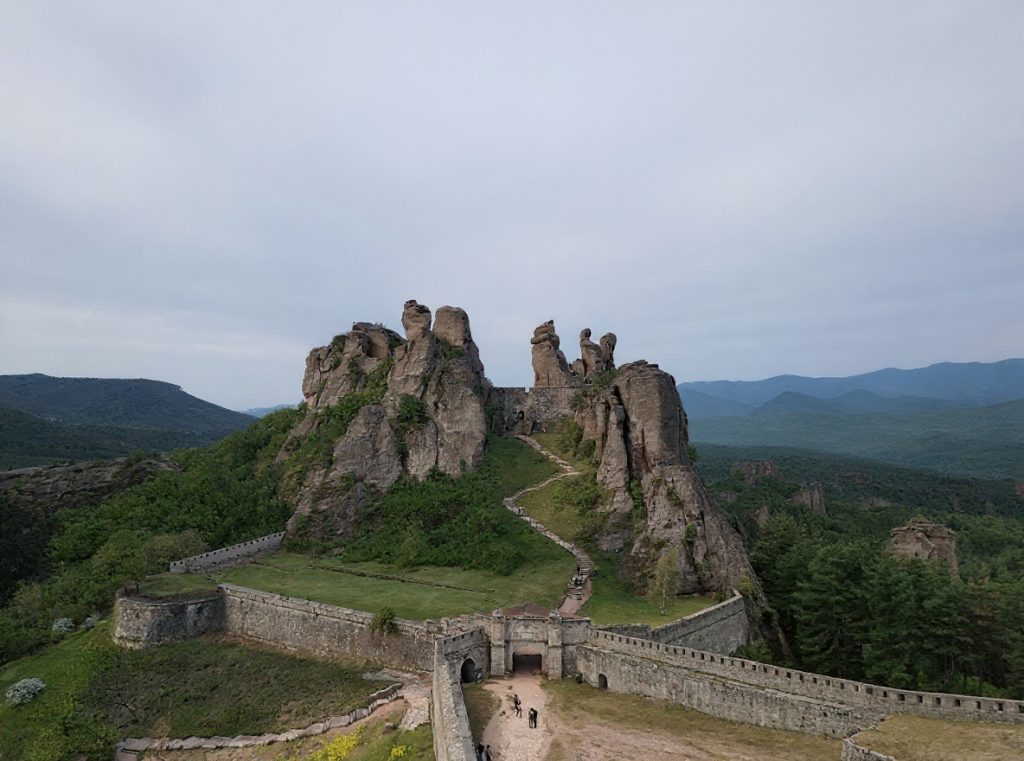
Three fortified courtyards connected by gates lead visitors upward through the complex. Walking paths offer views across the Balkan foothills and into neighbouring Serbia. The fortress walls still display gun embrasures and bastions, silent reminders of centuries of military use. Tours run in Bulgarian and German, though the site’s layout makes self-guided exploration straightforward. Information markers explain the different construction phases and the civilisations that shaped the stronghold. The fortress stays open daily, with extended hours during summer months.
In recent years the site has expanded beyond its historical role to host cultural events. Open-air concerts and historical re-enactments now take place among the ancient walls. Lighting illuminates the fortress at night, so its stonework glows against the dark sandstone cliffs behind it. Visitors who climb the steel ladders bolted into the rock reach the highest viewpoints. There, fortress and mountain merge into a single defensive whole. The red cliffs, carved by wind and time into towers and pillars, continue to guard Belogradchik just as they did two thousand years ago.
Featured listings