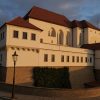
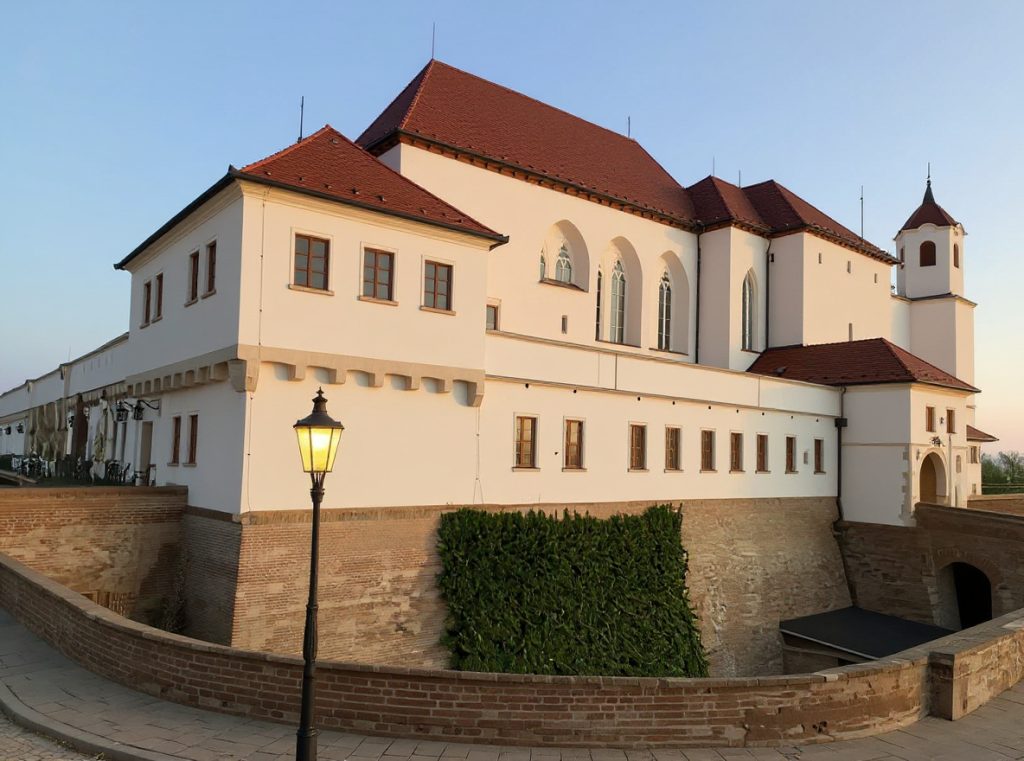
Rising above the Moravian capital on a strategic hilltop, Špilberk Castle commands the skyline of Brno with its powerful silhouette. Czech King Přemysl Otakar II founded this Gothic fortress in the 13th century. The first written mention of the castle dates back to 1277. Around the mid-13th century, it began as a major royal castle. In the mid-14th century, it became the seat of the Moravian margraves. Builders then gradually turned it into a huge baroque fortress that would earn a dark reputation across Europe. Through centuries of transformation, this imposing stronghold has witnessed the rise and fall of empires. It served as both royal residence and prison before emerging as a cultural treasure of the Czech Republic.
Plan your visit to Špilberk Castle
Location of Špilberk Castle
Špilberk sits at the top of a hill in Brno. The city’s residents can see it from almost anywhere. The fortress occupies an elevated position in southern Moravia, the second-largest urban centre of the Czech Republic. The most popular and pleasant way to reach it is a walk from the historic part of the city. The journey from the main square takes no more than 10–15 minutes. Visitors can take tram lines 12, 3, or 5 and get off at the Špilberk stop. They then complete the final approach on foot through the surrounding parkland. Driving directly up to the castle is not possible, so the final stretch must be on foot through the park. This uphill walk rewards visitors with progressively improving views of the Moravian capital spreading below.
History of Špilberk Castle
Czech king Přemysl Otakar II founded Špilberk in the middle of the 13th century. He conceived its construction on a very grand scale, both as firm support for his power and as a dignified seat for the rulers of Moravia. Throughout the 14th and 15th centuries, Špilberk served as the residence of the Moravian margraves. They ruled all of Moravia from here. The town of Brno bought the castle in 1560 and made it into a municipal fortress.
The fortress played an important role during the thirty years war. In 1645 it resisted Swedish army attacks. In the 17th and 18th centuries, extensive renovations transformed Špilberk into a monumental Baroque fortress. In 1783, Emperor Joseph II decreed that it become a jail for serious criminals. Soon it also held political prisoners from countries throughout the Austro-Hungarian Empire. From 1783 to 1858, Špilberk gained the reputation as the “Prison of Nations.” It became one of the harshest prisons in the Austrian Empire. The last large “national” group of political prisoners at Špilberk consisted of nearly 200 Polish revolutionaries. Most participated in the Kraków Uprising of 1846. After that, Austrian Emperor Franz Joseph dissolved the Špilberk prison in 1855.
In 1809, Napoleon destroyed some parts of the fortress, so Spielberk lost its military importance. After 1855, the castle served as military barracks. During both world wars, the castle again functioned as a jail. The Czechoslovak army left Špilberk in 1959, putting a definite end to its military era. In 1960, Špilberk found new life as the home of the Brno City Museum. In 1962, authorities granted it the status of a national cultural monument of Czechia.
Current status
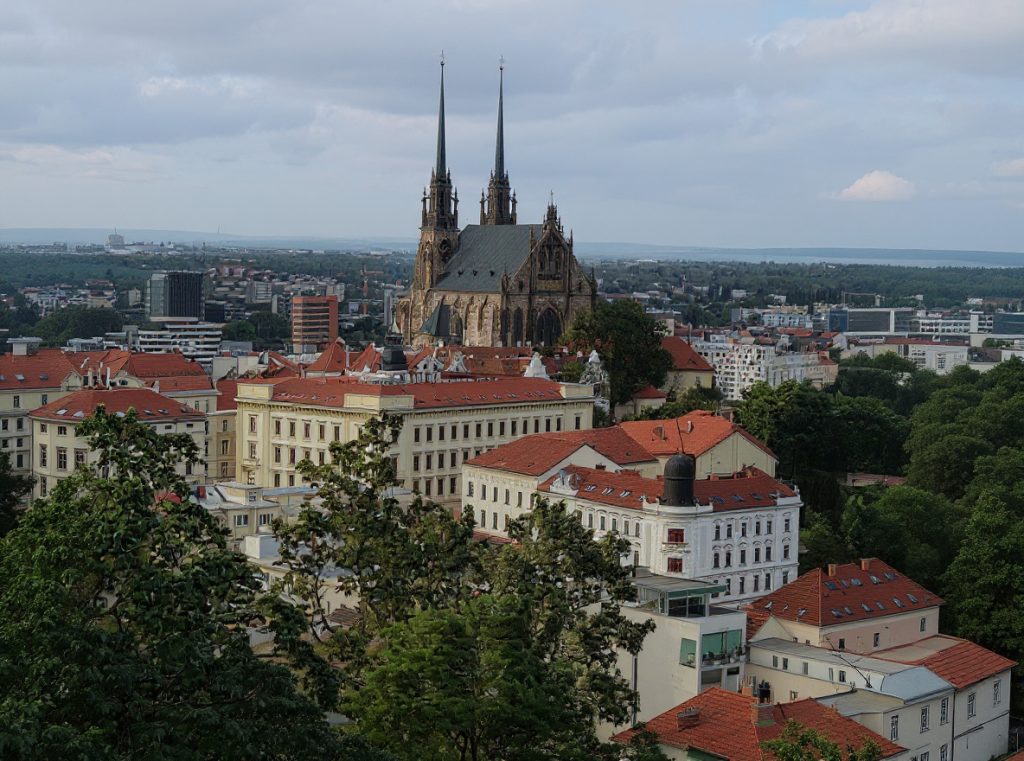
The castle also serves as a cultural centre, housing Muzeum města Brna (the Brno City Museum). Since 1960, Špilberk Castle has been the home of the Brno City Museum. It hosts numerous permanent and temporary exhibitions with several exhibition spaces totaling over 3,000 square meters. Collections range from Brno’s history to contemporary art installations. Of particular interest are the famous casemates—the former prison that people knew in the 18th and 19th centuries as the “Prison of Nations”. The castle’s large interior courtyard holds a fifteen-bell carillon, a lookout in the corner tower, and the Baroque Holy Trinity chapel.
Concerts, theatrical performances, and festivals often take place there. Over 100,000 people visit the museum exhibitions annually, including the casemates. Its lookout tower, terraces, and courtyards provide magnificent panoramic views of Brno. The surrounding park has become a beloved green space for locals and visitors alike. It offers tranquil paths through mature woodland and open meadows where the city’s residents gather on summer evenings.
Today Špilberk Castle acts as both guardian and witness to eight centuries of Central European history. The fortress walls that once imprisoned revolutionaries now embrace a vibrant cultural institution. Exhibition halls illuminate the past while concert halls and courtyards pulse with contemporary life. From its commanding heights, the castle continues to watch over Brno. It has transformed from a symbol of oppression into an emblem of resilience and renewal.
Castles near Špilberk Castle
Frequently asked questions
Can I visit Špilberk Castle for free?
The castle grounds, courtyards and surrounding park are free to access daily. Entry tickets are required for the museum exhibitions, casemates prison, lookout tower and royal chapel.
What are the main attractions inside Špilberk Castle?
The castle houses the Brno City Museum with seven permanent exhibitions on Brno's history. The casemates – underground prison corridors that held political prisoners during Habsburg rule – are the most popular feature.
How do I get to Špilberk Castle from Brno city centre?
Take tram 5, 11 or 12 to Komenského náměstí stop, then walk uphill for about 10 minutes. Bus 52 and 84 also serve nearby stops, though bus 80 is temporarily out of service.
How long does it take to tour Špilberk Castle?
Allow 1.5 to 2 hours to visit the museum circuit and walk the ramparts with city views. If you include the guided casemates tour, plan for 2.5 to 3 hours in total.
What opening hours does Špilberk Castle have?
The castle grounds are open daily 06:00–23:00 year-round. Museum exhibitions and the casemates typically open 10:00–18:00, with seasonal variations; check the official website for current times.
Featured listings