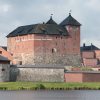

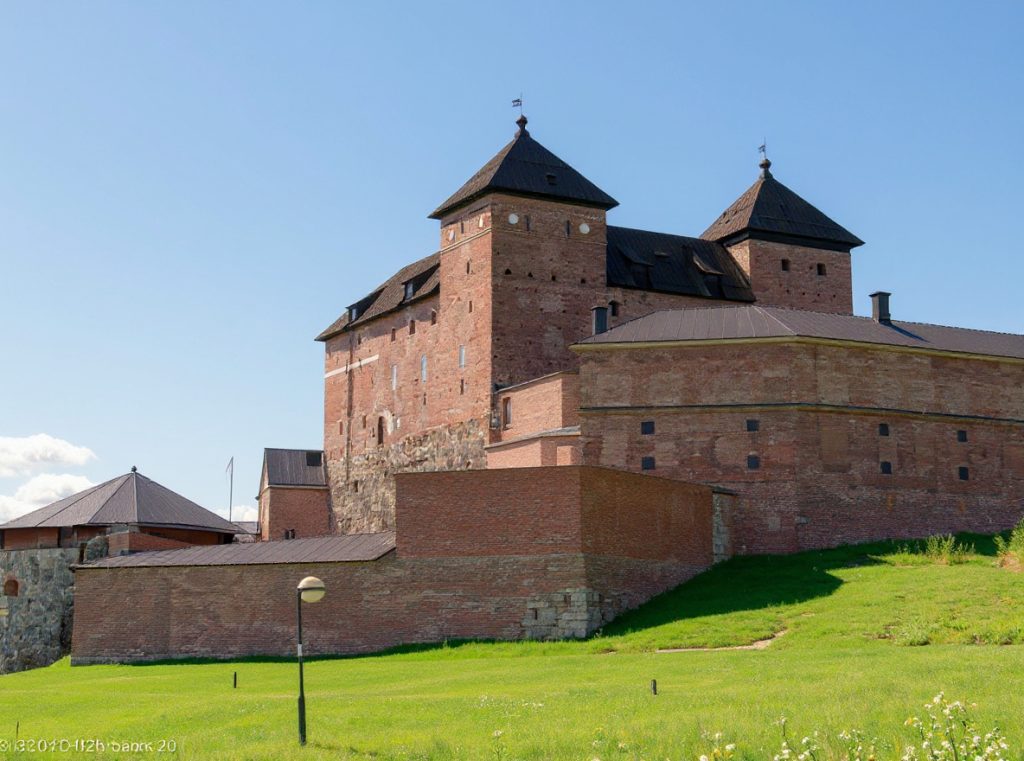
On the shores of Lake Vanajavesi, Häme Castle commands its ancient site with red brick walls and grey stone foundations. The fortress rose in the late 13th century as one of three Swedish strongholds in Finland, alongside the castles of Turku and Vyborg. For seven centuries the structure evolved through war, governance and imprisonment, yet its medieval core endures. Today the National Museum of Finland operates the castle as a museum, where visitors walk through vaulted halls that once housed Swedish nobility and royal commandants.
Plan your visit to Häme Castle
Tue–Fri 10:00–16:00
Sat–Sun 11:00–16:00Summer Jun–Aug: daily 10:00–17:00; May: daily 10:00–16:00; Sep: Tue–Sun 10:00–16:00 (closed Mon).
Location of Häme Castle
The castle sits in Hämeenlinna, a city between Helsinki and Tampere in the Kanta-Häme region of southern Finland. Though builders first raised it as an island fortress, it now stands on the coast of Lake Vanajavesi. Hämeenlinna lies roughly 100 kilometres north of Helsinki, so travelers can reach it easily by Highway 3 (E12). Trains run regularly from the capital to Hämeenlinna railway station. From there the castle is a pleasant 20-minute walk. Drivers approaching from the city centre follow signs to Kustaa III:n katu, where the fortress appears beside the lake. Parking sits nearby, though a fee may apply. The position on the lake’s edge gives the castle commanding views. It once served a strategic purpose, controlling routes into the Finnish interior.
History of Häme Castle
The decision to establish Häme Castle came after the Swedish earl Birger’s crusade into this part of Finland. The expedition’s exact date remains uncertain—scholars have suggested both 1239 and 1249. The castle’s oldest sections almost certainly date from the end of the 1200s, when Sweden sought to strengthen its hold on the Häme region. The Swedes also needed to secure their eastern frontier against Novgorod. The first written record of the castle dates to 1308.
The oldest part, the fortified camp, included a square-shaped greystone wall with defensive towers at the northern, eastern and southern corners. In the final decades of the 13th century, builders improved life at the fort. They constructed vaulted brick rooms just inside the walls. In the 14th century the fortress expanded into a sophisticated brick castle with vaulted rooms, a grand King’s Hall, and features adapted for emerging firearms. The lower tiers of the keep and curtain wall are masoned granite while the upper tiers are red brickwork.
At the end of the Middle Ages some of the most influential Swedish houses governed the castle—the Tott, the Sture and the Posse. Besides serving as a defence against the Novgorodians, Häme Castle functioned as a residence and administrative centre. The fortress lost its status as an administrative centre in 1634. Military importance faded by the end of the 16th century. In the 1730s engineers surrounded the castle with a heptagonal system of bastions, which they strengthened in the 1770s. The Russian Empire took over the castle in 1808 without a fight and soon turned it into a prison. The castle and its surroundings remained in prison use from 1837 to 1972.
Current status
Restoration work began in 1956 and concluded in 1988. When workers removed constructions from the prison period, conflicting alterations made complete historical restoration impossible. As a result, some second floor rooms remain in ruins. Restorers reconstructed the Queen’s Chamber and King’s Hall as they appeared in the late 15th century. The Finnish National Board of Antiquities owns the castle, and it currently functions as a museum that the National Museum of Finland operates.
The castle opens to the public all year round. Staff organize guided tours, events and exhibitions. Permanent exhibitions explore the riches of Häme, the castle’s history, and medieval weaponry. The fortress also hosts temporary exhibitions and cultural events, including medieval festivals that bring period life vividly to the grounds. Visitors can try on armour and medieval costumes, walk through the vaulted brick chambers, and climb the towers for views across the lake. The castle offers spaces for private events, from weddings to corporate gatherings, within its historic walls.
Grey stone and red brick frame the water, where centuries of Finnish history converge. The moat surrounds the keep, the battlements rise above the curtain walls, and the towers watch over Hämeenlinna as they have for more than 700 years. Häme Castle endures, a living monument where the medieval past remains palpable in every chamber and courtyard.
Castles near Häme Castle
Frequently asked questions
Are guided tours available at Häme Castle?
Yes, guided tours are included in the admission price and run hourly throughout the day. In summer (July–August), English tours are offered at 10:00, 11:00, 14:00, 15:00 and 16:00; in other months English tours run at 11:00 and 14:00.
Is Häme Castle open all year?
The castle is open year-round except for the last two weeks of December. From January to April and October to mid-December it is closed on Mondays, but open daily from May to September.
Can I visit Häme Castle with a combined ticket?
Yes, a combined ticket for the Castle Peninsula museums is available. From May to September it costs €28 for adults (€13 children) and includes Häme Castle, Museo Militaria and the Prison museum.
What is the history of Häme Castle?
Häme Castle was built in the late 13th century as a Swedish military fortress on the border with Novgorod. It served as a noble residence during the Middle Ages and later as a prison from 1837 to 1972 before becoming a museum.
Is there parking at Häme Castle?
Yes, free parking is available near the castle. It is a 4-minute drive from Hämeenlinna city centre via Kaivokatu road, or a pleasant 20-minute walk from the railway station.
Featured listings