
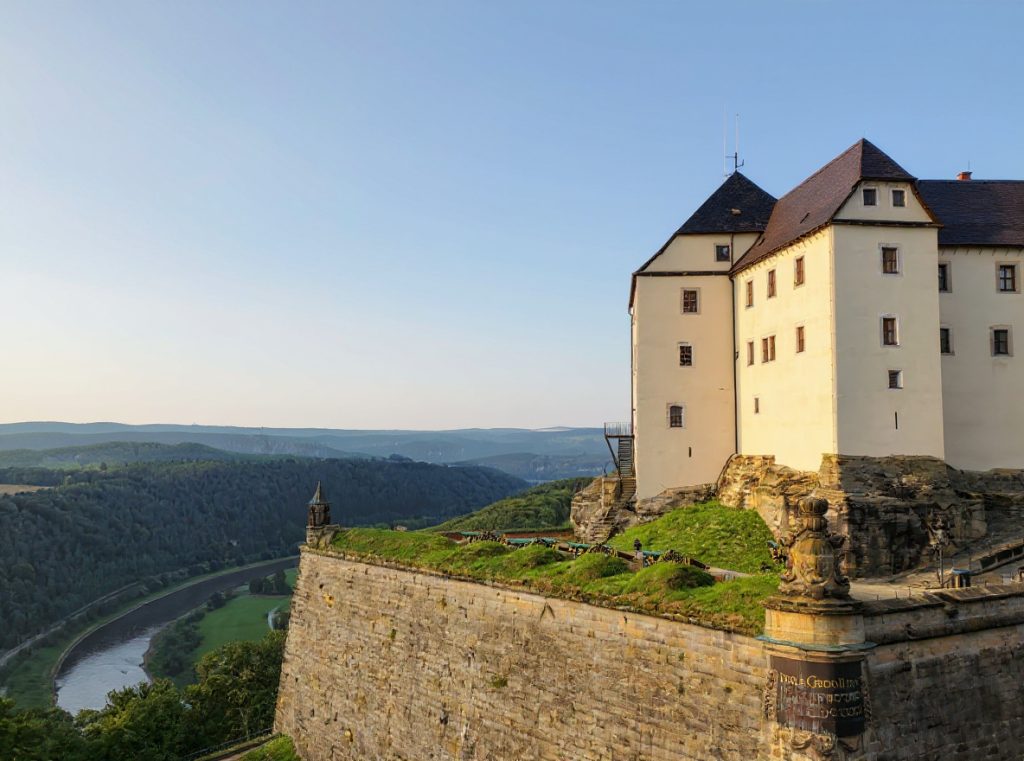
Rising 240 metres above the River Elbe on a flat sandstone plateau, Königstein Fortress commands the landscape of Saxon Switzerland with walls and bastions that have never fallen to an enemy. A charter of King Wenceslas I of Bohemia first mentioned this vast hilltop stronghold in 1233. For eight centuries it served Saxon rulers as refuge, treasury, prison and symbol of power. The 9.5-hectare plateau holds more than 50 buildings accumulated over four centuries. This forms one of Europe’s largest mountain fortresses. Today it operates as an open-air museum where visitors walk through centuries of military architecture and Saxon history.
Plan your visit to Königstein Fortress
Location of Königstein Fortress
The fortress sits near Dresden in Saxon Switzerland, above the town of Königstein on the left bank of the River Elbe. It rises directly above Königstein town, located within Saxon Switzerland National Park. The site lies about 35 kilometres southeast of Dresden. Visitors reach the fortress by S-Bahn train S1 from Dresden to Königstein station. From there they either walk up the steep path or take the Festungsexpress shuttle bus. An elevator from the base of the cliff provides access to the plateau. The address is Festung Königstein 1, 01824 Königstein. A 1.7-kilometre panorama trail along the walls offers views of Saxon Switzerland National Park, the Eastern Ore Mountains and towards Dresden.
History of Königstein Fortress
Builders probably began stone castle construction as early as the 12th century. The oldest surviving structure is the castle chapel, which craftsmen built at the turn of the 13th century. Duke Wenceslaus I of Bohemia founded the fortress between 907 and 935 AD. Successive Bohemian kings then used it to guard an important trade route and their border. By the 15th century the castle had transferred to the Elector of Saxony. Between 1589 and 1591 Prince-Elector Christian I of Saxony and his successor developed the castle into the strongest fortification in Saxony. They surrounded the hill with high walls.
Between 1563 and 1569 workers dug a well 152.5 metres deep into the rock. This made it the second-deepest castle well in Europe. Between 1516 and 1524 Celestine monks established a monastery at Königstein. The fortress underwent great expansion during the latter 16th century amid tensions between German Catholics and Protestants, when commanders considered it impregnable. In times of war Saxon princes stored their treasure and artworks in Königstein. During peaceful times they used the fortress as a hunting lodge. Between 1591 and 1922 Königstein served as a Saxon state prison.
During the Thirty Years’ War the Swedes ranged across Saxony. In 1639 they burned the town below, yet they left the fortress untouched. After the Napoleonic Wars the development of long-range guns meant the castle no longer suited use as a fortress. As a result it became a state prison instead. Authorities held prisoners of war here during the Franco-Prussian War, World War I and World War II. During Allied bombing curators stored the magnificent Dresden art collection within its walls. The fortress never fell to an enemy. It held inmates including Russian anarchist Mikhail Bakunin and French General Henri Giraud, who escaped in 1942.
Current status
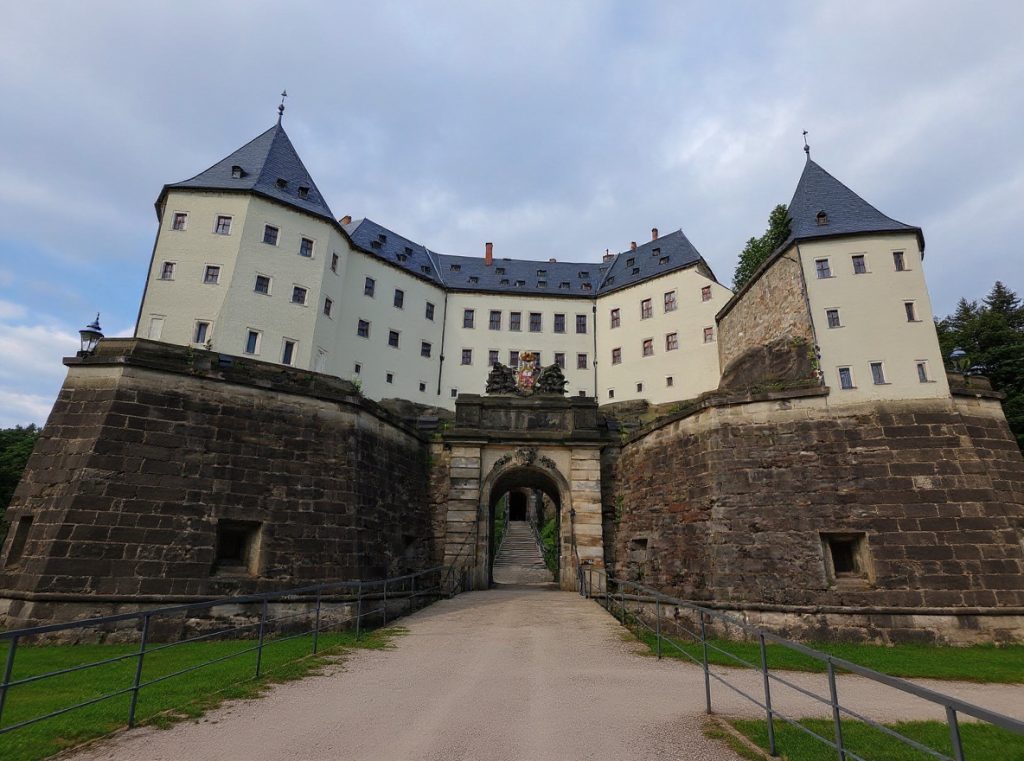
On 29 May 1955 Königstein became a museum. Restorers have systematically restored the fortress since 1990. It became a state fortress between 1589 and 1591. Since 1955 it has operated as a museum. The Free State of Saxony owns the site, which Festung Königstein gGmbH operates. The fortress remains intact and ranks among Saxony’s foremost tourist attractions, with 700,000 visitors per year. Around half a million visitors from around the world arrive annually. Modern exhibitions and interactive stations bring history to life across buildings documenting 400 years of fortress architecture. Highlights include the 152-metre-deep well, Germany’s oldest preserved barracks from 1590, and the first Saxon garrison church from 1676.
The fortress opens daily throughout the year. Admission charges apply for entry. Exhibitions, guided tours and audio guides give insight into 800 years of life on the Königstein. The site includes barracks, casemates, armouries, watchtowers, a small pleasure castle, a church, defence facilities, cannons, flowering gardens and panoramic views. Visitors explore the ramparts, walk through historic chambers, and discover how this unconquered fortress shaped Saxon history. From its windswept plateau, the same vistas that once reassured princes now invite travellers to pause above the winding Elbe. Sandstone pinnacles rise through morning mist while forests blanket the valleys of Saxon Switzerland.
Castles near Königstein Fortress
Frequently asked questions
What is included in the Königstein Fortress ticket?
The admission ticket includes use of the panorama lift (April–October) and passenger lift, plus entry to all exhibitions on the fortress plateau. Audio guides are available for an additional €2.
Is Königstein Fortress open year-round?
Yes, the fortress is open daily except 24 December. Summer hours (28 March–1 November) are 9am–6pm, winter hours (2 November–19 March) are 9am–5pm, with extended hours to 7pm on Advent weekends.
How steep is the walk to Königstein Fortress?
The fortress sits 240 metres above the Elbe Valley. From Königstein station it's a steep 25–45 minute uphill walk, or you can take the Festungsexpress shuttle bus to avoid the climb.
Can I visit Königstein Fortress with young children?
Yes, children under 7 enter free and the fortress has interactive exhibitions designed for children. The lift takes you up to the plateau, avoiding stairs, and there's plenty of open space to explore.
Was Königstein Fortress ever conquered?
No, Königstein Fortress was never taken by force in over 800 years. Its strategic position on a flat-topped rock made it one of Europe's most impregnable fortresses, serving as Saxony's state prison and treasury strongbox.
Popular right now
Featured listings