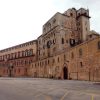
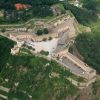
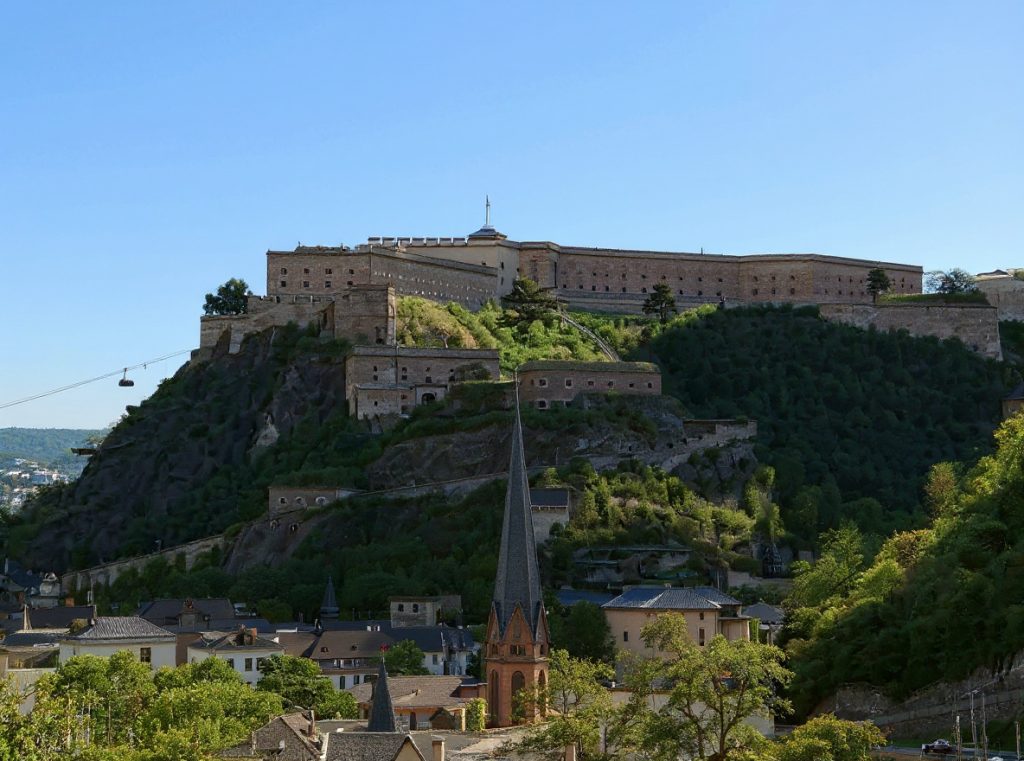
Perched on a rocky spur 118 metres above the Rhine, Ehrenbreitstein Fortress commands the confluence where the Rhine and Moselle rivers meet in Koblenz. Builders raised this monumental stronghold in its current form between 1817 and 1828. It ranks as Europe’s second-largest preserved fortress. Yet its origins reach back to the year 1000, when the Conradine Ehrenbert raised a castle here. Today the complex contains several museum buildings, including the Landesmuseum Koblenz, along with historic ramparts and memorials. Since 2002, the fortress has formed part of the UNESCO World Heritage Upper Middle Rhine Valley.
Plan your visit to Ehrenbreitstein Fortress
Location of Ehrenbreitstein Fortress
Ehrenbreitstein Fortress stands on the east bank of the Rhine opposite the mouth of the Moselle, overlooking the city of Koblenz. The most exciting route to the fortress uses the modern cable car. It departs from the Rhine embankment near the famous Deutsches Eck. The car then delivers passengers straight to the fortress gates in just a few minutes. The B42 highway and the local train station sit conveniently close to the foot of Ehrenbreitstein mountain. City buses reach the foot of the hill where the fortress stands. Parking sits near the entrance to the fortress grounds. From this commanding height, visitors gain panoramic views across Koblenz and the river valleys below.
History of Ehrenbreitstein Fortress
The hill saw its first settlement in the 4th millennium BC. Builders raised fortifications in the 10th or 9th century BC. In the 11th century, the castle became the property of the Trier archbishop Poppo, whose successor enlarged the complex. From the 15th to the 18th century, the fortress remained in the hands of the Archbishops of Trier. They constantly expanded and modernised it, turning it into one of the most powerful fortifications of its time. Beginning in 1729, Archbishop Franz Georg von Schönborn developed the complex into a major Baroque fortress.
French Revolutionary troops captured Koblenz on 23 October 1794 and besieged Ehrenbreitstein four times from 1795. After an almost year-long blockade, the under-supplied garrison capitulated on 27 January 1799. French forces blew up Ehrenbreitstein in 1801 to prevent the enemy from taking hold of a fully functional fortress. It sat just a few metres away from French territory on the left bank of the Rhine. After the Congress of Vienna in 1815, the Rhineland passed to Prussia. King Frederick William III of Prussia then ordered the fortress to be completely restored and significantly expanded. He made it part of a grand defensive system.
Under the direction of Prussian engineer Carl Schnitzler, builders reconstructed the fortress between 1817 and 1828. They incorporated the latest military architectural techniques of the time. The Prussians built a system of fortification around Koblenz from 1815 until 1834, the so-called Festung Koblenz. Festung Ehrenbreitstein formed a part of this larger system. Fortress Koblenz ranked as the largest military fortress in Europe except for Gibraltar. During its years of active service, the fortress never faced an attack. The fortress remained in military use until 1918. The right-bank works, including Ehrenbreitstein, remained operational until the end of the First World War.
Current status
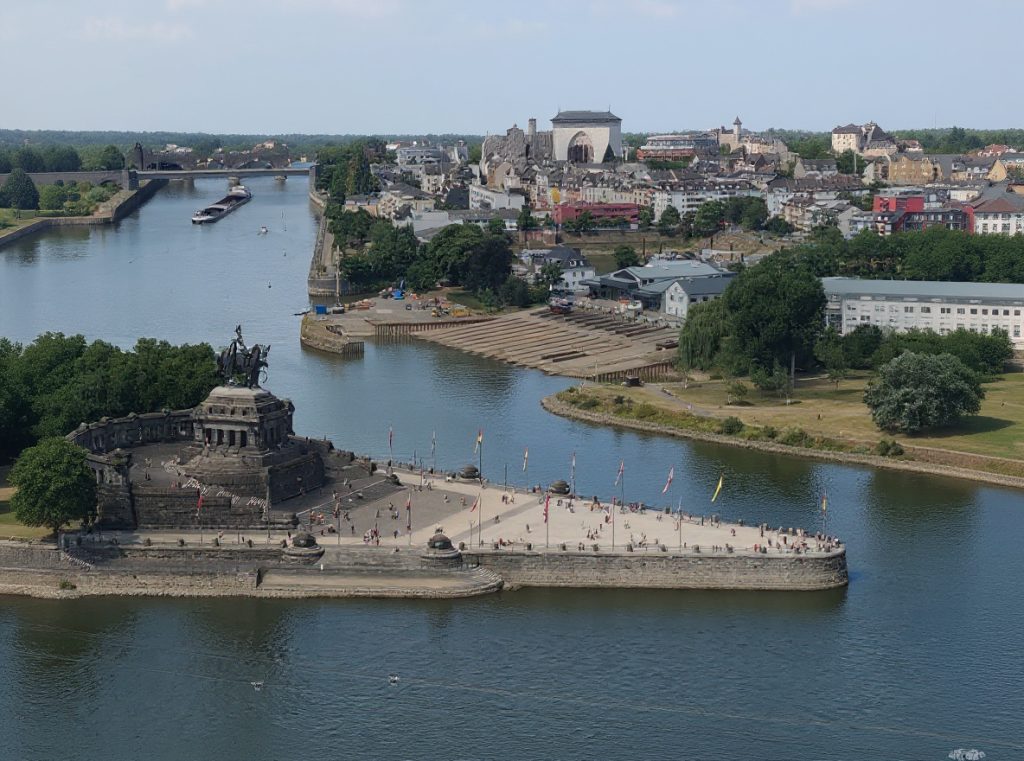
Ehrenbreitstein Fortress in Koblenz now serves as the headquarters of the General Directorate for Cultural Heritage Rhineland-Palatinate. It ranks as one of the 11 fortress monuments in the GDKE’s inventory and care. Visitors can enjoy a lively cultural centre with an exciting history. Four exhibition buildings form part of the Koblenz State Museum. They feature interesting permanent and temporary exhibitions that focus on photography, archaeology, winemaking and hospitality. The displays also showcase economic and cultural history. The fortress also houses the memorial of the army and the youth hostel Koblenz.
Builders designed the fortress as a bastioned fortress, a style characterised by angular bastions projecting from curtain walls. These bastions provide overlapping fields of fire and eliminate blind spots. Workers plastered the facades and painted them yellow, with restrained architectural details picked out in red sandstone. The fortress preserves a fortress church, a three-aisled gallery basilica. Ehrenbreitstein Fortress serves not only as a historical site but also as a cultural venue. It hosts concerts, theatre performances and other events. Visitors who make the ascent discover rooms where centuries of military architecture merge with sweeping vistas. Stone walls hold stories of siege and survival. The rivers below still flow as they did when medieval lords first claimed this strategic height.
Castles near Ehrenbreitstein Fortress
Frequently asked questions
How do I get to Ehrenbreitstein Fortress from Koblenz city centre?
The most scenic route is via the Koblenz cable car, which departs every minute from Konrad-Adenauer-Ufer near Deutsches Eck and takes about 10 minutes. Alternatively, take a train to Koblenz-Ehrenbreitstein station and use the fortress lift.
Is Ehrenbreitstein Fortress open all year?
Yes, the fortress is open daily year-round. From April to October it opens 10:00–18:00, and from November to March 11:00–16:00, with outdoor areas and restaurants accessible until around midnight.
What can I see inside Ehrenbreitstein Fortress?
The fortress houses the Koblenz State Museum with exhibitions on archaeology, regional history, photography, and fortress history. Visitors also enjoy panoramic views of the Rhine and Moselle confluence from the ramparts.
Does Ehrenbreitstein Fortress admission include the cable car?
No, fortress admission (€10 for adults) is separate from the cable car. A combination ticket costs €21.90 for adults and includes cable car round trip plus fortress entry.
Is Ehrenbreitstein Fortress suitable for children?
Yes, children aged 7–17 pay €4 (under 7 free), and family tickets are available. The fortress park includes a children's playground and adventure golf course accessible with the cable car ticket.
Popular right now
Featured listings