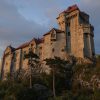
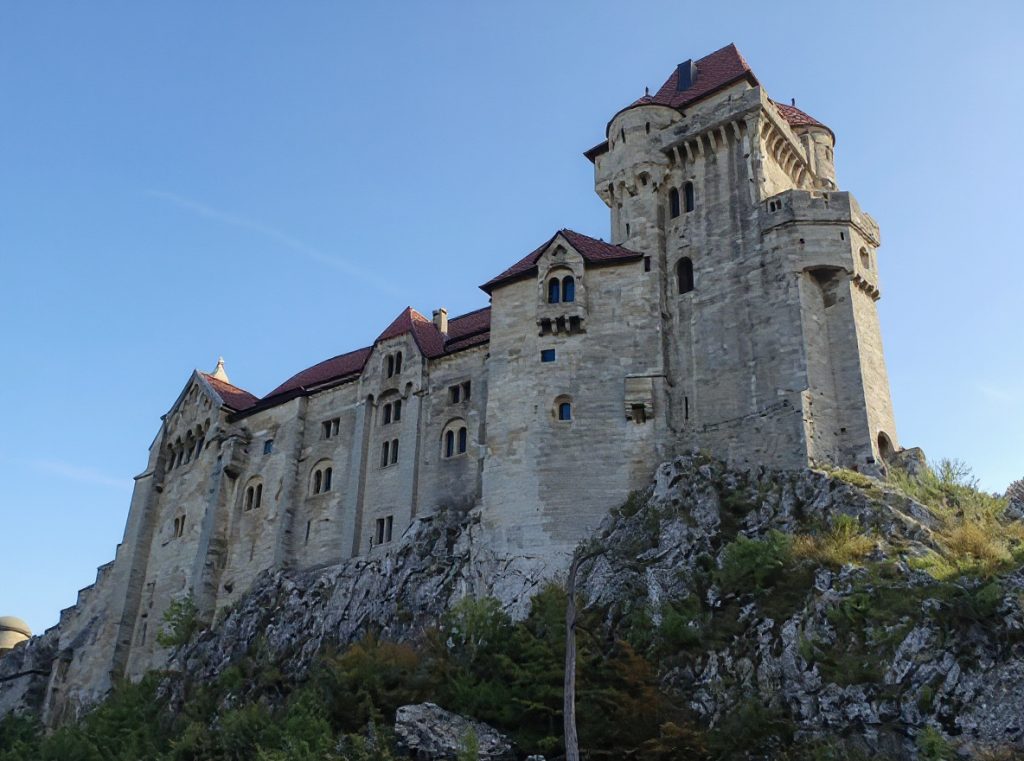
Perched on a narrow rocky ridge at the edge of the Vienna Woods, Liechtenstein Castle rises from its limestone crag with medieval walls and neo-Gothic towers. This fortress serves as the ancestral seat and place of origin of the House of Liechtenstein. The family rules the Principality of Liechtenstein today. Major parts of the Romanesque castle from around 1130 survive, so it ranks among Europe’s rare preserved secular buildings from the 12th century. From its ramparts, visitors command one of the finest panoramas over Vienna and the surrounding basin.
Plan your visit to Liechtenstein Castle
Fri–Sun 11:00–15:00Summer (Apr–Sept): Mon–Tue, Thu–Sun 10:00–16:00, closed Wed. Winter (Oct–Mar): Fri–Sun 11:00–15:00.
Location of Liechtenstein Castle
Liechtenstein Castle sits near Maria Enzersdorf in Lower Austria, bordering Vienna. The fortress stands approximately 16 kilometres south of the Austrian capital. Visitors can reach the castle via Metro U6 to Siebenhirten. From there they take Bus 270 to Mödling: Maria Enzersdorf, Franz Josef Straße. The castle occupies a hilltop position on the southern edge of the Vienna Woods. It overlooks the thermal springs line that marks the transition from the Alps to the Pannonian Plain. A short walk from the bus stop leads through forested paths to the castle entrance. The dramatic setting on a limestone outcrop appears visible for miles. This location proved ideal for both defence and display when Hugo von Liechtenstein selected the site in the early 12th century.
History of Liechtenstein Castle
Hugo von Liechtenstein built the castle around 1122–36 on a fief he received from the Babenberg margraves of Austria. Hugo I took his family name from the castle, establishing the House of Liechtenstein. The name derives from the German for “bright stone.” This refers to the pale limestone from which builders quarried the construction material. The castle originally started with a tower but probably expanded immediately into a larger palace complex during the 12th century. The fortress formed part of a defensive line along the eastern edge of the Vienna Woods. Rulers built it to protect the region from invasions, particularly by Hungarian forces.
From the 13th century onward, the castle passed through several noble families, including the Walsee, Stadeck, Cilli, and Khevenhüller. The castle remained in Liechtenstein ownership until 1295. Then it passed out of the family through a marriage contract. In 1529, during the Siege of Vienna, the fortress suffered destruction. The Ottomans largely destroyed the castle in 1683, which rendered it almost completely uninhabitable. For more than a century the ruins stood abandoned on their hilltop.
In 1808, Prince Johann I of the Liechtenstein family reacquired the castle. The castle remained in ruins until 1884. Then architect Carl Gangolf Kayser rebuilt it for Prince Johann II of Liechtenstein. This comprehensive 19th-century restoration work gave the castle its current neo-Gothic appearance while preserving the surviving Romanesque core. The castle suffered damage during World War II and the Soviet occupation that followed. Subsequent repairs restored the fortress once more.
Current status
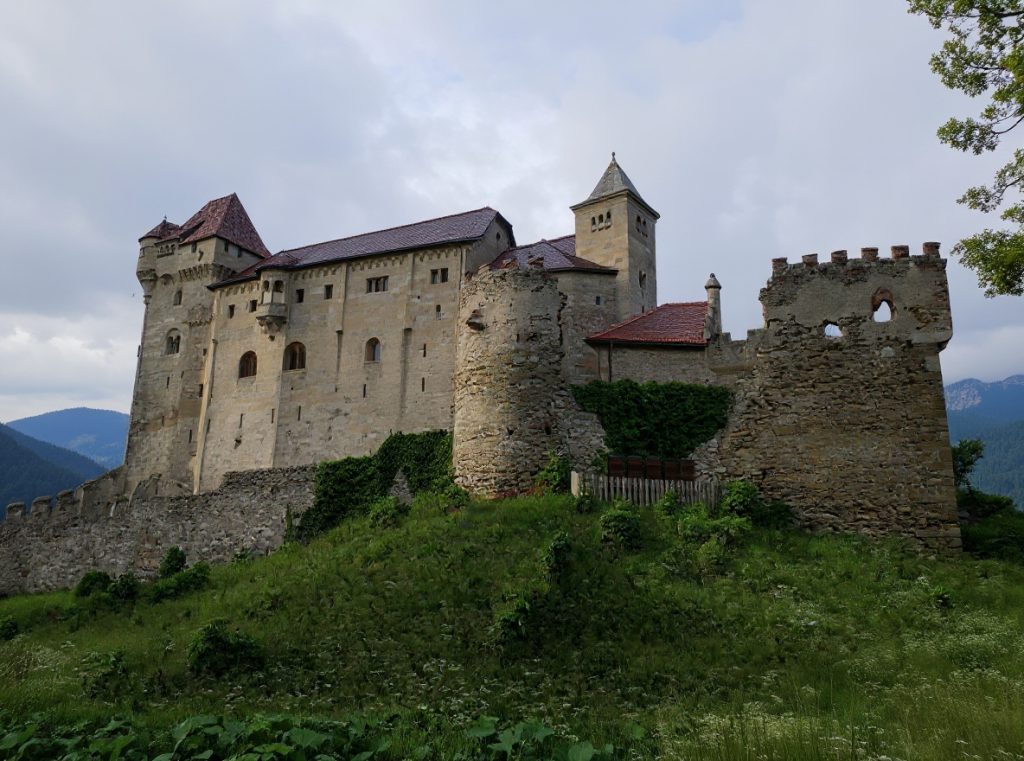
Since 2007, the Liechtenstein estate administration has managed the property. The castle reopened to the public in spring 2010. Today, the Stiftung Fürst Liechtenstein (Prince of Liechtenstein Foundation) manages the castle and offers guided tours. During opening hours, guided tours in German and English take place once an hour. Visitors can only explore the castle on a guided tour. The castle operates with summer hours from April through September and reduced winter hours from October through March. Tours lead visitors through preserved Romanesque chambers, the chapel, treasury, and residential quarters.
The castle displays substantial parts of the Romanesque structure from 1130. Visitors also see numerous pieces including weapons, furniture, beamed ceilings, reliefs, and the chapel. The fortress has served as a museum since 1812. Plus you get one of the most beautiful views over Vienna from the battlements. The castle hosts special exhibitions on the 900-year history of the princely house. Cultural events such as the Nestroy Festival took place at the castle from 1983 to 2012. Annual festivals continue at the west side of the castle walls during summer months.
Visitors who climb to the battlements discover why medieval lords chose this commanding site. The panorama sweeps across the Vienna Basin to the distant spires of the capital. The Vienna Woods stretch in dark green waves to the south and west. Stone staircases worn smooth by centuries of footsteps connect chambers where Romanesque columns stand beside neo-Gothic vaulting. These layers reflect the castle’s centuries of evolution and its enduring role as the symbolic cradle of a European princely dynasty.
Castles near Liechtenstein Castle
Frequently asked questions
Can I visit Liechtenstein Castle without a guided tour?
No, the interior of Liechtenstein Castle can only be visited on a guided tour. Tours run every hour on the hour and last approximately 50 minutes in both German and English.
How far is Liechtenstein Castle from Vienna city centre?
Liechtenstein Castle is 19 km south of Vienna in Maria Enzersdorf. By public transport, the journey takes approximately 1 hour via U6 and bus connections.
Is Liechtenstein Castle the same as Vaduz Castle in Liechtenstein?
No, they are different. Liechtenstein Castle in Austria is the ancestral seat of the princely family who later founded the country of Liechtenstein, where Vaduz Castle now serves as the royal residence.
Are there parking facilities at Liechtenstein Castle?
Yes, there is a free car park for castle visitors. From the car park, it's a 10-minute walk uphill to the castle entrance.
Is Liechtenstein Castle open year-round?
The castle operates on a seasonal schedule: daily except Wednesday from April to September, and only Friday to Sunday from October to March. It closes from the fourth Sunday of Advent until 6 January.
Featured listings