Rising from the summit of Vomero Hill, Castel Sant’Elmo commands Naples with its extraordinary six-pointed star form and volcanic stone walls. The fortress sits adjacent to the Certosa di San Martino. Its name derives from a tenth-century church dedicated to Sant’Erasmo, shortened through time to “Elmo”. Between 1537 and 1547, military architect Pedro Luis Escrivá from Valencia gave the castle its hexagonal star shape. The fortress now serves as a museum, exhibition hall, and offices.
Plan your visit to Castel Sant’Elmo
Tue Closed
Wed–Sun 08:30–18:30
Location of Castel Sant’Elmo
The castle stands on Vomero Hill overlooking Naples. Today it houses a museum as well as the management offices of the Campania Museum Complex and the Museum of the XIX Century in Naples. Castel Sant’Elmo sits on Vomero Hill adjacent to the Certosa di San Martino, overlooking Naples. Visitors can reach the fortress by taking the funicular railway to Morghen station, followed by a short walk up Via Tito Angelini. The castle’s elevated position offers commanding views over the entire city, the Bay of Naples, Mount Vesuvius, and the surrounding islands. From this strategic height, the fortress once monitored all approaches to the city. It also controlled the vital routes between upper and lower Naples.
History of Castel Sant’Elmo
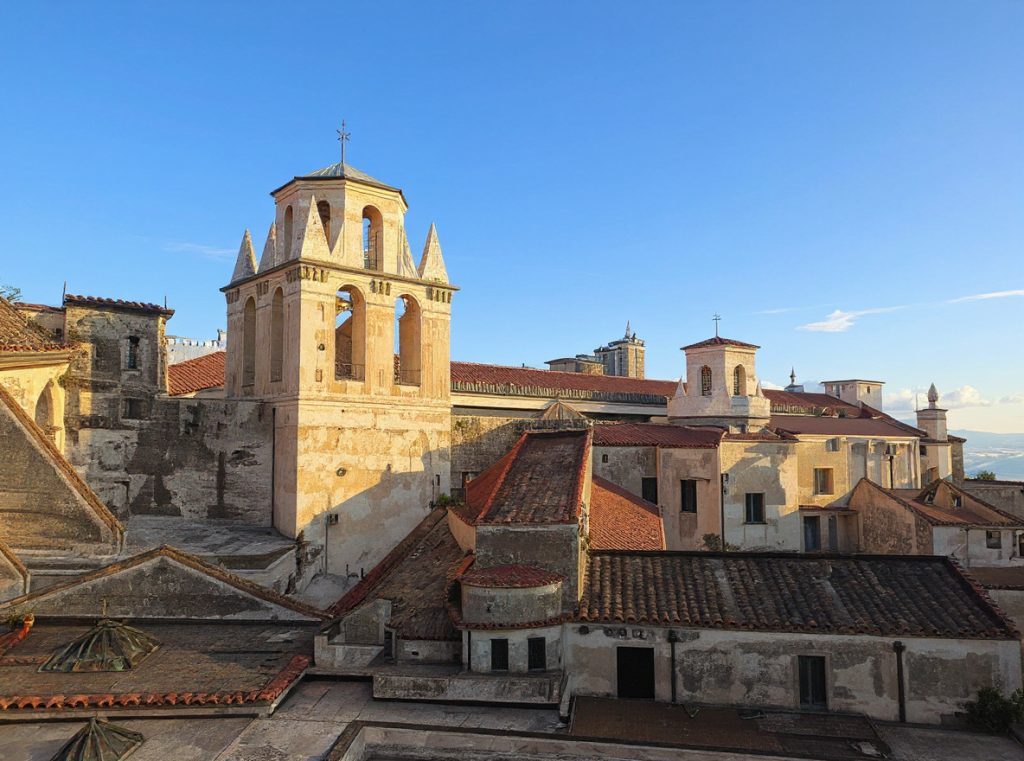
In Norman times, a watchtower called Belforte stood on Sant Elmo hill. In 1325, Charles, Duke of Calabria and son of King Robert, founded the nearby Charterhouse of St. Martin. In 1329 Charles began construction of the castle at the same location where the watchtower stood. Workers completed the project in 1343. An earthquake in 1456 severely damaged the Angevin fortress when it demolished the external walls and towers. The Aragonese rulers of Naples, notably Don Pedro de Toledo, included it in a comprehensive scheme to fortify the city’s land perimeter. The daring hexagonal shape drew fierce criticism from contemporaries, so much so that in 1538 Escrivá defended his design in a published Apologia. In 1587 lightning struck the castle and destroyed the barracks and military houses and the internal church. As a result, workers rebuilt the structure between 1599 and 1610 under architect Domenico Fontana. During its history, the castle served various purposes, including as a royal residence, a prison, and a military stronghold. After the collapse of the republic, it remained a prison. It continued as a military prison until 1952.
Current status
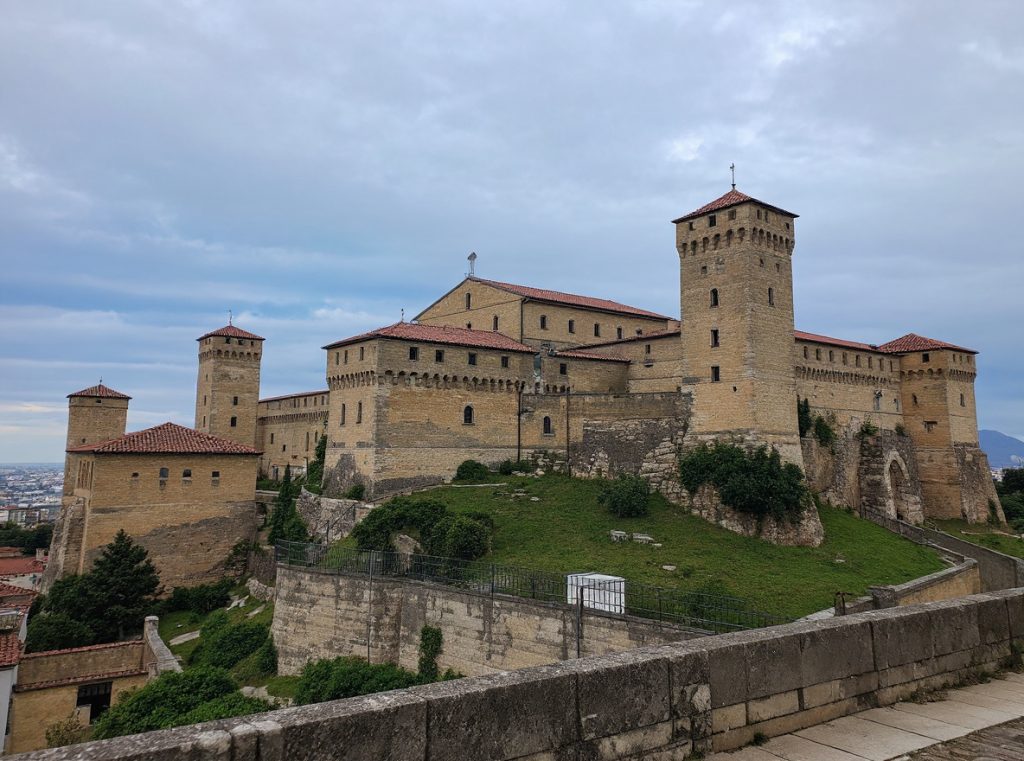
The fortress continued as military property until 1976. Then the provincial authority of the Provveditorato alle Opere Pubbliche of Campania undertook a large restoration project. In seven years this effort freed the original castle of centuries of accretions and made it structurally sound. In the 1980s Castel Sant’Elmo became a structure of cultural and museum interest. From 1982 the entire complex passed to the custody of the Superintendence for Artistic and Historical Heritage of Naples. The fortress opened to the public in 1988. The City of Naples owns the fortress, while the Naples Ministry of Culture controls it and keeps it open to the public. The castle now houses the Museo del Novecento, dedicated to twentieth-century Neapolitan art. The museum displays works documenting major influences in the local art scene including Futurism and the Nuclear Art movement. Visitors walk the restored galleries, parapet walkways and underground chambers. An auditorium seating 700 occupies spaces that once served as prison cells. The massive star bastions remain intact. Their geometric clarity still demonstrates the military engineering principles that made this fortress revolutionary in the sixteenth century. From every angle of the ramparts, the panorama unfolds across Naples, the gulf, and the distant mountains. This sweeping view once allowed defenders to monitor every approach to the city below.
Castles near Castel Sant’Elmo
Frequently asked questions
What can you see from Castel Sant'Elmo?
Castel Sant'Elmo sits 250 metres above sea level on Vomero Hill, offering 360-degree views of the Gulf of Naples, Vesuvius, the city centre, the Phlegraean Fields, and the islands of Capri and Ischia. The ramparts provide multiple viewpoints around the star-shaped fortress.
Is Castel Sant'Elmo worth visiting?
Yes, it offers exceptional panoramic views of Naples and the bay for a modest entry fee. The medieval fortress also houses the Museo del Novecento (20th-century art) and hosts temporary exhibitions and cultural events throughout the year.
How do I get to Castel Sant'Elmo from Naples city centre?
The easiest route is the Montesanto funicular (€1.30) from Montesanto station to Morghen, then a 5-minute walk. Alternatively, take Metro Line 1 to Vanvitelli and walk 15 minutes uphill, or bus V1 to Piazzale San Martino.
When is Castel Sant'Elmo open?
The castle is open Monday and Wednesday to Sunday from 08:30 to 19:30, and closed on Tuesdays. Last entry is at 18:30, one hour before closing.
What is the history of Castel Sant'Elmo?
Built in 1329 on the site of a 10th-century church dedicated to St Erasmus (Sant'Elmo), the castle was converted into a fortress in 1537 with its distinctive six-pointed star shape. It served as a military stronghold under Angevin, Aragonese, and Bourbon rule.
Popular right now
Featured listings