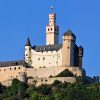
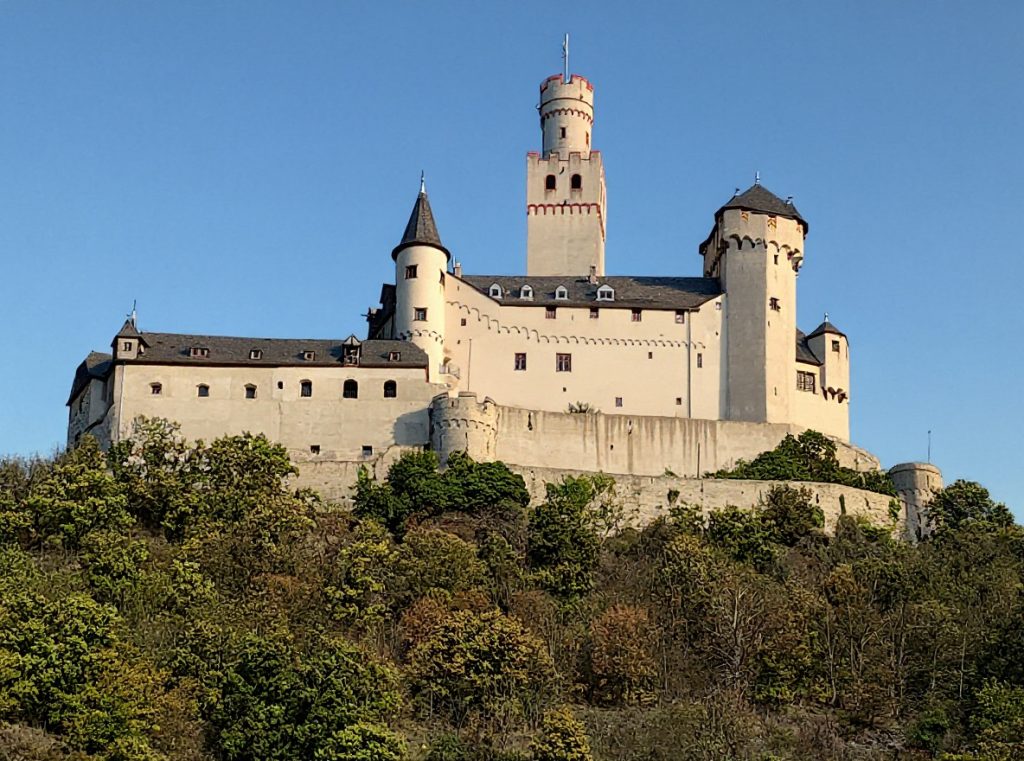
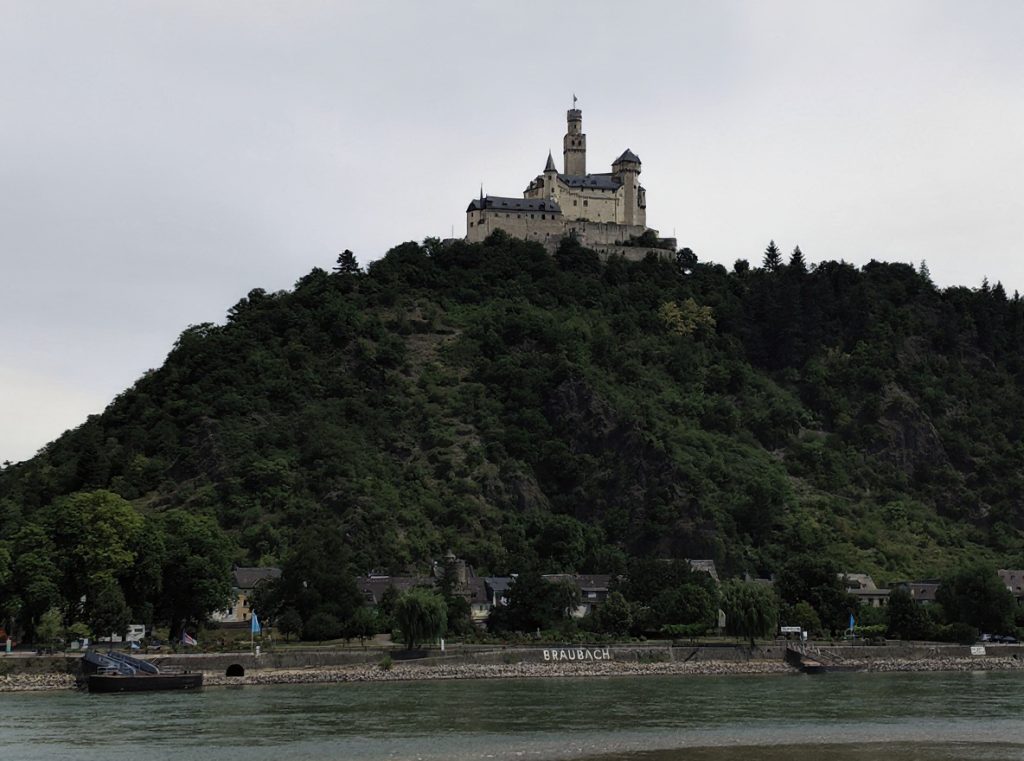
Crowning a volcanic rock spur above the Rhine, Marksburg Castle holds the remarkable distinction of being the only hilltop fortress on the Middle Rhine that never fell to destruction. For more than 900 years the castle has watched over the town of Braubach and the river below. Its medieval walls and towers stand intact through countless wars and sieges. Today it offers one of the most authentic glimpses into medieval fortress life anywhere in Germany.
Plan your visit to Marksburg Castle
Location of Marksburg Castle
The castle sits above the town of Braubach in Rhineland-Palatinate, Germany, on the right bank of the Rhine between Koblenz and Bingen. It forms one of the principal sites of the UNESCO World Heritage Rhine Gorge. Braubach railway station offers the nearest public transport connection. From there, a steep twenty-minute walk through forest trails leads up to the castle entrance. During summer months a shuttle service runs between the town and the fortress. The castle occupies such a commanding position that visitors can see it for miles along the river in both directions. Travelers arriving by car can follow the B42 road and take the Braubach exit, then follow brown tourist signs directly to the castle. The strategic importance of this location becomes immediately clear when one sees how thoroughly the fortress dominates the Rhine bend below.
History of Marksburg Castle
The Noble Freemen of Braubach built the castle around 1117, though documents first explicitly mentioned it in 1231. The Lords of Eppstein constructed the castle to protect the town of Braubach and to reinforce the customs facilities. They took advantage of its position to collect tolls from ships passing on the river below. The Romanesque castle complex featured a characteristic Staufer-era design with a triangular layout. It included a three-storey tower keep and a simple hall within a triangular curtain wall. Builders dedicated the castle chapel to St. Mark the Evangelist, from whom the fortress eventually took its name.
In 1283 Count Eberhard of Katzenelnbogen bought the castle. Through the fourteenth and fifteenth centuries his family transformed it substantially. The Counts of Katzenelnbogen built the Gothic sections of Marksburg Castle, giving it its striking form. When the last Count of Katzenelnbogen died in 1479, the territories passed to the Landgrave of Hesse through marriage. The heiress Anna married Heinrich of Hesse, so the castle changed hands. The Hessian rulers modernised the castle for the gunpowder age, adding artillery batteries and ramparts. During the Napoleonic period the castle served as a prison.
In 1900 the owners sold the castle for the symbolic price of 1,000 Gold Marks to the German Castle Association. This organization had been founded a year earlier to preserve Germany’s castles. Professor Bodo Ebhardt, privy court planner and architect in Berlin, carried out extensive restoration of the castle. In March 1945 American artillery fired from across the Rhine damaged the castle. Yet the damage remained limited compared to what other Rhine fortresses had suffered through centuries of warfare.
Current status
The Marksburg has served as the head office of the German Castle Association since 1931. The German Castles Association dedicates itself to the conservation of historic defensive and residential buildings. It maintains its headquarters at Marksburg Castle. Today the castle houses the headquarters and offices of the German Castles Association. The organization’s specialist library comprises over 25,000 volumes, though it now occupies the nearby Philippsburg Palace in Braubach. The castle welcomes visitors daily except Christmas Eve and Christmas Day, with guided tours offered throughout the year.
Access to the interior requires a guided tour, so visitors explore the authentic medieval rooms and fortifications with expert guides. Tours pass through multiple gates including the drawbridge gate and fox gate. Guides lead groups up the riders’ stairway carved from bedrock centuries ago. Visitors can see the wine cellar, kitchen, bedrooms, chapel, great hall, and armoury. They also explore impressive artillery batteries with cannons that once faced the Rhine. The steep medieval terrain and numerous staircases mean the castle cannot accommodate wheelchairs. The fortress remains remarkably true to its medieval character, with most of its construction dating from the thirteenth to fifteenth centuries.
The castle stands as a living monument to medieval military architecture. Its walls bear witness to nearly nine centuries of history, from the age of knights to the present day. It still fulfills its founders’ purpose of guarding the Rhine and the town below.
Castles near Marksburg Castle
Frequently asked questions
Can I visit Marksburg Castle without a guided tour?
No, Marksburg Castle can only be visited as part of a guided tour lasting approximately 50 minutes. Tours in English are offered daily during summer and on weekends in winter.
How do I get to Marksburg Castle from Koblenz?
Take a regional train from Koblenz Hbf to Braubach (13 minutes, every 30 minutes). From Braubach station, follow the uphill forest trail to the castle, which takes about 30 minutes.
Do I need to book tickets in advance for Marksburg Castle?
Individual visitors do not need to book in advance; tickets are sold on-site at the souvenir shop. Reservations are only required for groups and special tours.
What makes Marksburg Castle unique among Rhine castles?
Marksburg is the only hilltop castle on the Middle Rhine never destroyed, preserving its original medieval architecture. It survived centuries of conflict and World War II completely intact.
Is there parking available at Marksburg Castle?
Yes, there is attended parking near the castle for €4 per car. From the car park, it's a short 5-minute uphill walk to the castle entrance.
Popular right now
Featured listings