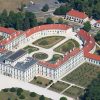

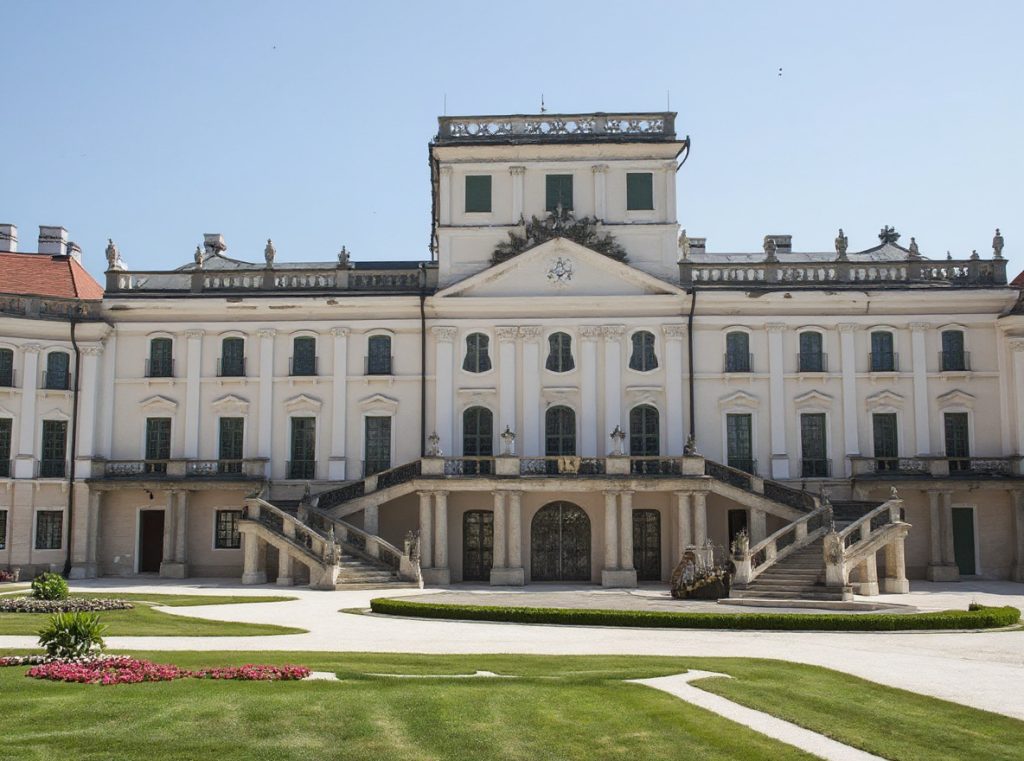
Builders raised Esterháza Palace on the flat lands near Fertő Lake as Hungary’s most magnificent Baroque-Rococo creation. Prince Nikolaus Esterházy transformed a modest hunting lodge into a sprawling 126-room residence that rivals the grandest courts of Europe. The palace earned its nickname as the “Hungarian Versailles” through its lavish interiors, formal gardens and role as an 18th-century cultural centre. Composer Joseph Haydn spent decades here, creating masterpieces while the prince hosted elaborate celebrations.
Plan your visit to Esterháza Palace
Tue–Sun 10:00–17:00
Location of Esterháza Palace
The palace sits in Fertőd, western Hungary, near the southern shore of Fertő Lake on the Austrian frontier. It occupies Győr-Moson-Sopron county, roughly two hours by car from Budapest via the M1 and M85 highways. The surrounding area lies within the Fertő-Hanság National Nature Park, a UNESCO biosphere reserve. Despite its somewhat isolated position, Fertőd connects easily to nearby Sopron, Fertőszentmiklós and Kapuvár by road and rail. The palace grounds extend across a 200-hectare park. Visitors arriving from Austria can reach the site within a short drive from Eisenstadt.
History of Esterháza Palace
Anton Erhard Martinelli built a hunting lodge called Süttör on this site around 1720 for József Esterházy. The structure served as a simple retreat until 1762, when József’s second son Miklós inherited the estate after his elder brother’s death. Prince Nikolaus Esterházy, known as “the Magnificent,” could not reshape the family’s main residence in Eisenstadt to suit his grand vision. So he chose to transform Süttör into a palace worthy of imperial comparison.
Construction began in earnest in 1762, though Nikolaus drew on the hunting lodge as his nucleus. The originally marshy terrain required canals and dams before building could advance. Johann Ferdinand Mödlhammer served as the first architect, then Melchior Hefele succeeded him in 1765. Some scholars suggest Nicolaus Jacoby also contributed designs. The prince had visited Versailles in 1764, and his palace reflects that inspiration. Austrian palaces like Schönbrunn also influenced the final design. Workers first inhabited Eszterháza in 1766, yet work continued for years. The opera house opened in 1768, the marionette theatre in 1773. Workers completed a fountain in front of the palace in 1784, when the prince considered his project finished. The endeavour cost an astronomical 13 million Austrian gulden.
Prince Nikolaus spent ten months each year at Esterháza, filling it with luxurious festivities and musical performances. Joseph Haydn lived on the estate from 1766 to 1790 and composed most of his symphonies for the prince’s orchestra. Haydn conducted more than a hundred opera performances annually in the main theatre, which seated 400 until fire destroyed it in 1779. The palace’s geographic isolation caused loneliness among musicians, so Haydn famously composed his Farewell Symphony as a subtle protest. Nikolaus Esterházy died in 1790, ending the golden age.
Current status
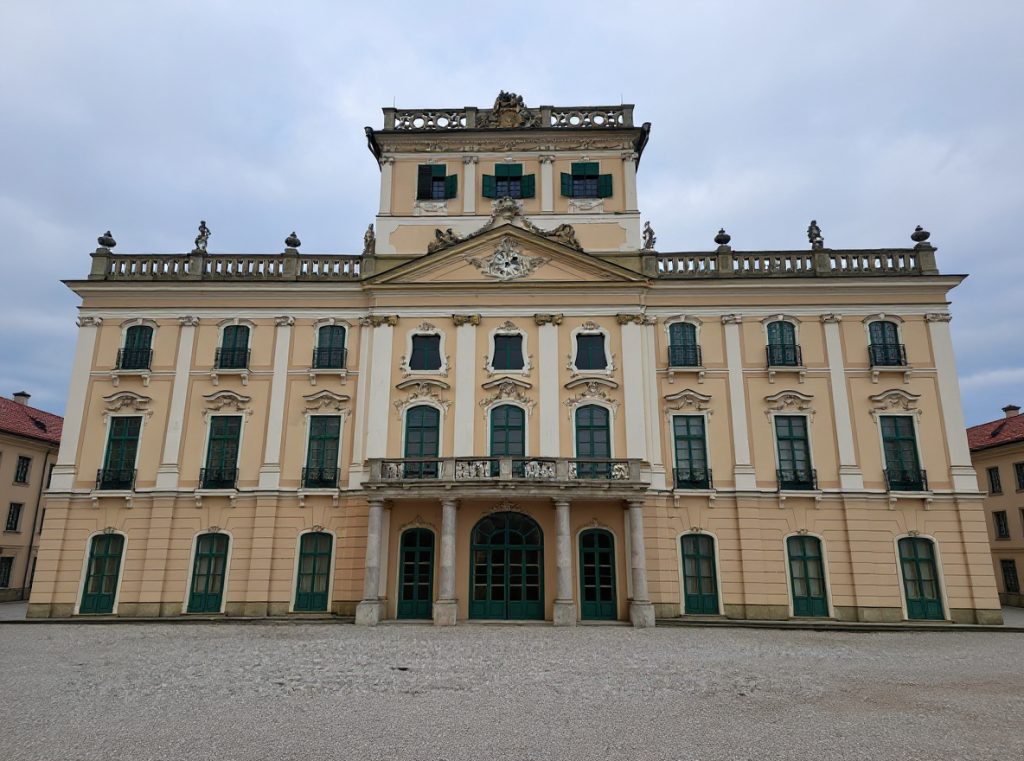
Since 1996, the National Trust of Monuments for Hungary has managed the palace. In 2014, it became the centrepiece of the Eszterháza Cultural, Research and Festival Centre, which now oversees restoration and cultural programming. The palace opens to the public, welcoming visitors with its centuries-old halls, frescoes, and stucco work. The Sala Terrena on the ground floor displays a ceiling that Josef Ignaz Mildorfer frescoed in 1766. Upstairs, the banquet hall and music hall form the heart of the building. The marionette theatre still hosts performances, echoing Haydn’s era.
The 200-hectare park surrounds the main building and features Baroque landscaping once considered the finest example of Hungarian garden artistry. An orangerie, administrative buildings, stables and a row of houses for palace staff complete the complex. The ceremonial courtyard served as a parade ground rather than a garden. Modern exhibitions, concerts and family programmes fill the palace calendar year-round. Classical music events pay homage to Haydn’s legacy. The site charges admission and runs guided tours. Opening hours vary by season, generally Tuesday through Sunday.
Eszterháza remains an emblem of Hungary’s cultural heritage because its U-shaped form and ornate details honour one prince’s ambition. The palace still enchants those who wander its halls and gardens, much as it dazzled Europe’s aristocracy two and a half centuries ago.
Castles near Esterháza Palace
Frequently asked questions
Who was Joseph Haydn and what is his connection to Esterháza Palace?
Joseph Haydn was the court composer for Prince Miklós Esterházy and lived at Esterháza Palace from 1766 to 1790. The palace features exhibitions dedicated to him, and the Haydn Hall hosts classical concerts during the summer season.
How large is Esterháza Palace and why is it called the Hungarian Versailles?
Esterháza Palace features 126 rooms and is Hungary's largest Baroque-Rococo palace, surrounded by extensive gardens and parkland. It earned the nickname 'Hungarian Versailles' due to its opulent architecture and the Esterházy family's lavish lifestyle, which rivalled European royalty.
Are there concerts held at Esterháza Palace?
Yes, the palace hosts the Haydneum concert series during summer (typically July and August) with period instrument performances in the Apollo Hall. Classical music concerts and the Eszterháza Festival celebrate the palace's musical heritage throughout the warmer months.
Can I visit Esterháza Palace in winter?
The palace has limited winter opening from November to March, operating only Friday to Sunday from 10:00 to 16:00. Winter visits are by guided tour only, with the last group departing at 14:45.
Is Esterháza Palace part of a UNESCO World Heritage Site?
Yes, Esterháza Palace is part of the Fertő-Neusiedlersee Cultural Landscape, inscribed as a UNESCO World Heritage Site. The palace sits within the Fertő-Hanság National Park, a protected biosphere reserve.
Popular right now
Featured listings