
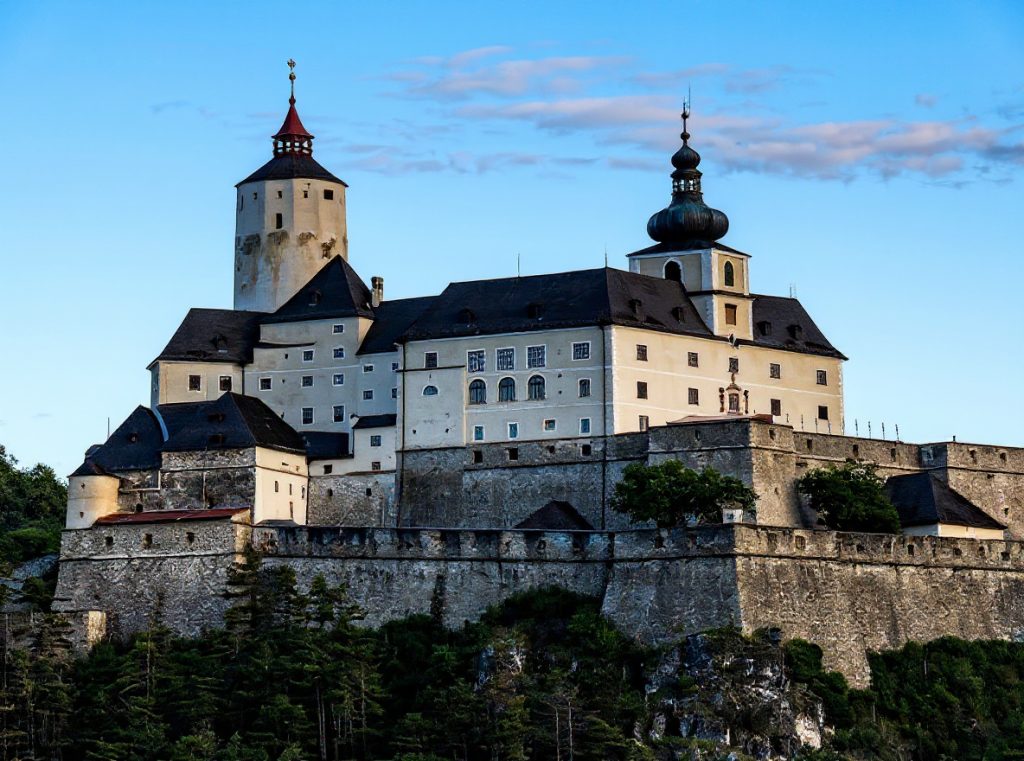
Perched on a dolomite rock in the foothills of the Rosaliengebirge mountains, Forchtenstein Castle commands the valleys of northern Burgenland from its height of 511 metres above sea level. The Lords of Mattersburg constructed the first fortifications in the early 15th century, anchoring their power with a soaring 50-metre keep. For six centuries this fortress has guarded the treasures of one of Central Europe’s most powerful families. The Esterházy princes transformed it into a repository for priceless armour, baroque art and the spoils of Ottoman wars.
Plan your visit to Forchtenstein Castle
Sat–Sun 10:00–13:00May–Sep daily 10:00–16:00; Oct Wed–Sun 10:00–16:00; Nov–Mar Sat–Sun & holidays 10:00–14:00 (guided tours only at 11:00 & 13:00)
Location of Forchtenstein Castle
Forchtenstein Castle sits approximately 20 kilometres southwest of Eisenstadt, the capital of Burgenland. The fortress rises on a steep rock above the village of Forchtenstein in the district of Mattersburg. Visitors reach it via Melinda-Esterházy-Platz 1 in the town centre. The castle overlooks the Wulka valley and commands views across the plains towards the Hungarian border. Its elevated position on the edge of the Rosalia Mountains made it a strategic stronghold along the historic frontier between Austria and Hungary. Today the site lies within easy reach of Vienna, roughly 60 kilometres to the northwest.
History of Forchtenstein Castle
The Lords of Mattersburg began construction around 1400, though some sources suggest work commenced in the late 14th century. They built the central keep and initial fortifications, then renamed themselves the Lords of Forchtenstein after their new seat. When the male line died out around 1450, the House of Habsburg acquired the property. The Habsburgs held it for 170 years, leasing it to various noble families including the Counts of Weissbriach and Hardegg. During this period the structure underwent few changes.
The castle’s fate shifted dramatically in 1622 when Emperor Ferdinand II granted it to Nikolaus Esterházy, founder of one of Hungary’s wealthiest aristocratic dynasties. Nikolaus and his successors, particularly Prince Paul I Esterházy, launched extensive renovations between 1630 and 1634. Viennese builder Simon Retacco and architect Domenico Carlone transformed the medieval fortress into an elegant baroque residence. The Esterházys added frescoed courtyards, a richly decorated chapel, and strengthened the defences. The castle proved its worth when Ottoman armies swept through the region in 1529 and again in later Turkish wars. Forchtenstein remained the only fortress in the area never to fall.
After Paul’s death the castle evolved from residence into treasury. The family stored their most valuable possessions here: weapons, armour, silverware, paintings and curiosities collected across generations. In the 18th century, master builder Ferdinand Mödlhammer extended the complex further. When Austria and Hungary separated in 1921, the new border divided the Esterházy estates. Financial records stayed at Forchtenstein while family archives went to Budapest. From 1954 to 1983 the castle hosted annual theatre performances. Conservation work and new exhibitions have continued into the 21st century.
Current status
The Esterházy family still owns Forchtenstein Castle today. They operate it as a museum showcasing one of Central Europe’s largest private armories and an extraordinary baroque treasury. Guided tours reveal the arsenal with weapons spanning four centuries, the portrait gallery of Esterházy ancestors, and chambers filled with Turkish war trophies. The treasure room holds masterworks of jewellery and porcelain. Recent exhibitions explore themes from strong women in Renaissance art to wartime seizures in 1918–1921. The castle opens Wednesday through Sunday from April through October, with guided tours available on Mondays and Tuesdays. Cultural events, concerts and an annual Christmas market draw over 100,000 visitors each year.
The fortifications climb the rock in layers: massive walls, the towering keep crowned with red and black turrets, gatehouses opening onto frescoed courtyards. Inside, baroque stuccowork adorns the chapel, while exhibition halls display centuries of aristocratic patronage. Forchtenstein serves as both monument and living museum. Its stones hold the memory of sieges weathered, treasures guarded, and a noble family’s enduring legacy in Burgenland.
Castles near Forchtenstein Castle
Frequently asked questions
What can I see inside Forchtenstein Castle?
The castle houses one of Europe's largest private armouries with over 400 years of military equipment, plus the Esterházy treasure chamber with silver furniture, portraits, and exotic Ottoman war tents. The exhibitions cover 10 rooms across the first floor, kitchen, and bakery areas.
Do I need a guided tour to visit Forchtenstein Castle?
From May to October, you can explore independently with an audio guide (€4, available in German, English, Hungarian) or join a guided tour. From November to March, the castle is only accessible via guided tours on Saturdays, Sundays, and public holidays at 11:00 and 13:00.
How difficult is access to Forchtenstein Castle?
The castle sits on a steep dolomite rock at 511 metres elevation. Visitors should expect climbing stairs and walking on uneven historic surfaces; comfortable shoes are essential and the interior has no heating.
Can I visit Forchtenstein Castle as a day trip from Vienna?
Yes, the castle is 69 km from Vienna (about 1 hour by car). By train and bus via Wiesen-Sigleß station and regional bus 7993 takes approximately 1.5–2 hours each way, making it feasible for a half-day or full-day trip.
What makes Forchtenstein Castle historically significant?
Built in the 15th century, it was the only fortress in the region never conquered by Ottoman invaders during the Turkish sieges of Vienna. Since 1626 it has belonged to the Esterházy princes, who used it as a secure vault for their treasures and military arsenal.
Popular right now
Featured listings