
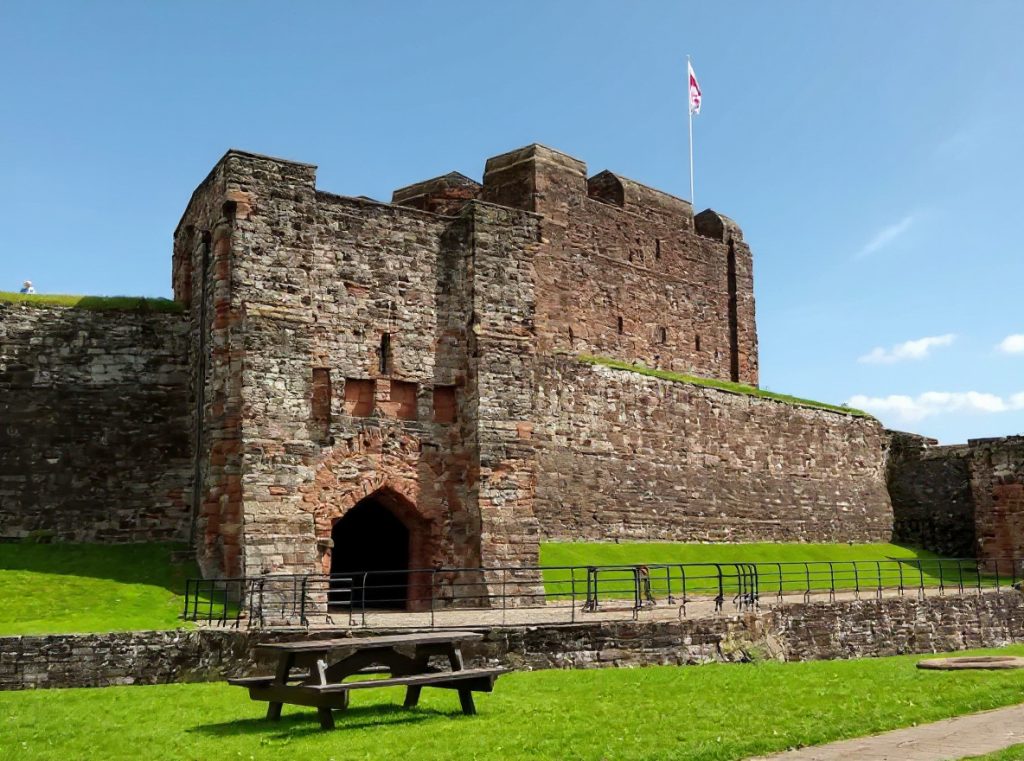
Rising on a commanding bluff above the confluence of two rivers, Carlisle Castle guards the historic border between England and Scotland. For nine centuries this stone fortress dominated the wild western March. Its massive walls endured more sieges than any other castle in the British Isles. Today its grey and red sandstone ramparts still stand because they bore witness to centuries of conflict, conquest and intrigue.
Plan your visit to Carlisle Castle
Sat–Sun 10:00–16:00Apr–Oct daily 10:00–17:00; Nov–Dec weekends 10:00–16:00; closed 24–26 Dec & 31 Dec & 1 Jan
Location of Carlisle Castle
Carlisle Castle sits at the northern edge of Carlisle city centre in Cumbria, where the Rivers Eden and Caldew meet. The fortress occupies the site of the Roman fort of Luguvalium, close to Hadrian’s Wall. Visitors reach the castle easily on foot from Carlisle Railway Station, which sits half a mile to the south. The M6 motorway provides direct road access to the city from across northern England and southern Scotland. The main entrance faces south along Castle Way, where a cobbled approach leads to the imposing gatehouse.
History of Carlisle Castle
William II of England founded the castle in 1092 when he drove Scottish forces from Cumberland. His builders erected a timber motte-and-bailey fortress on the Roman ruins. Thirty years later, in 1122, Henry I visited Carlisle and ordered stone walls and towers. Masons constructed the great keep that still forms the castle’s core, so they created one of England’s most formidable border strongholds.
The castle immediately became a focal point for Anglo-Scottish conflict. King David I of Scotland captured it in 1135, beginning 700 years of struggle for control. Henry II retook Carlisle in 1157 and installed Robert de Vaux as governor. Through the medieval period the fortress served as headquarters of the Western March. This buffer zone protected England’s northwestern frontier. Robert the Bruce besieged the castle in 1315 following his victory at Bannockburn, though the garrison held firm.
The Union of the Crowns in 1603 should have ended the castle’s military importance, yet conflict returned. During the Civil War, Parliamentarian forces besieged Carlisle in 1644 and starved the city into submission. A century later the castle faced its final siege. In 1745 Jacobite forces under Bonnie Prince Charlie captured and fortified the stronghold. Government troops recaptured it within weeks. Defenders and prisoners alike faced brutal retribution. Through the 19th century the castle evolved into an army barracks. Queen Mary’s Tower, which builders completed in 1308, once held Mary Queen of Scots prisoner. Workers modified the medieval battlements in 1541 when Stefan von Haschenperg added gun embrasures to modernise the defences.
Current status
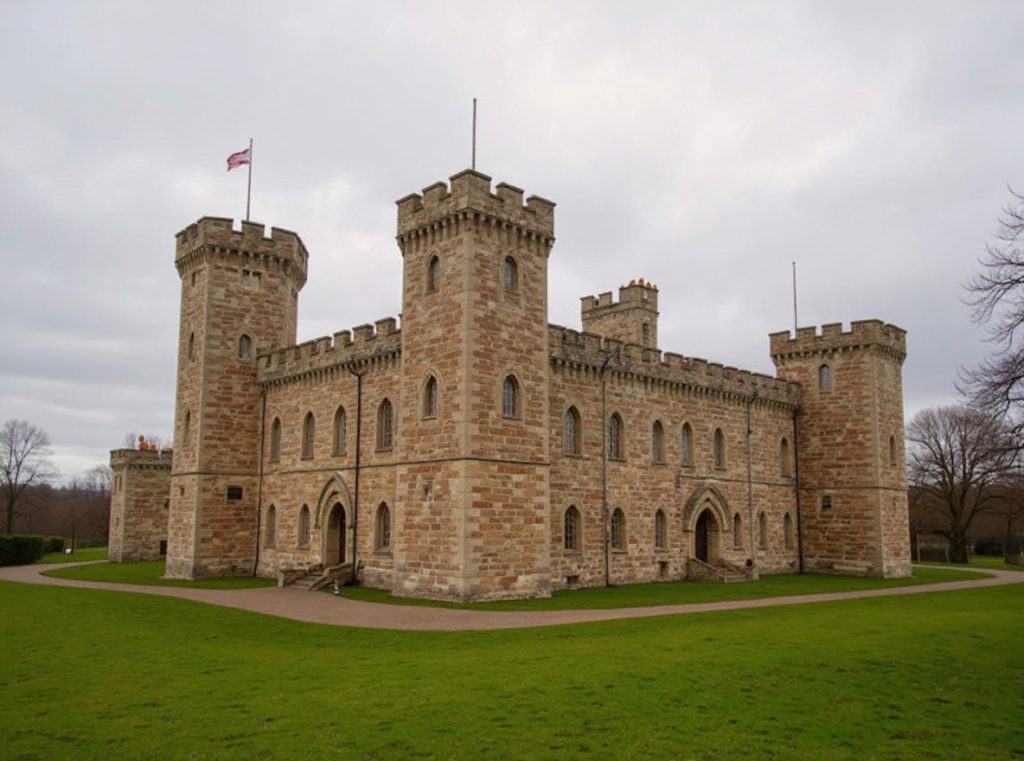
English Heritage manages Carlisle Castle and opens it daily to visitors. The fortress remains remarkably intact despite its turbulent past. Guests explore the Norman keep, walk the curtain walls, and descend into dungeons where the famous ‘licking stones’ recall desperate prisoners. These captives licked moisture from the walls. The inner bailey houses Cumbria’s Museum of Military Life, which tells the 300-year story of the region’s regiments. Parts of the complex still serve the Army Reserve, so they continue a military tradition that spans nearly a millennium.
The castle stands as a powerful reminder of the centuries when this borderland knew no peace. Siege engines and cannon fire scarred its weathered stones. These walls speak to the determination of those who held them against impossible odds. As dusk falls over the Eden valley, the great keep casts its shadow across the city it has guarded since Norman times.
Castles near Carlisle Castle
Frequently asked questions
What is Carlisle Castle famous for?
Carlisle Castle has dominated the city for nine centuries as a working fortress near the Anglo-Scottish border. Mary Queen of Scots was imprisoned here in 1568, and it has been central to conflicts including the English Civil War and Jacobite Uprising.
Is Carlisle Castle open in winter?
Yes, but with reduced hours. From November to December, the castle opens weekends only 10:00–16:00. It closes for Christmas Eve, Christmas Day, Boxing Day, New Year's Eve and New Year's Day.
What can you see inside Carlisle Castle?
Visitors can explore vaulted passages, chambers and staircases, climb the ramparts for views over Carlisle, and visit the medieval keep. The ticket also includes entry to Cumbria's Museum of Military Life located within the castle grounds.
How do I get to Carlisle Castle by train?
Carlisle Castle is 15 minutes' walk from Carlisle railway station, which has regular trains from London, Edinburgh, Glasgow, Newcastle and Lancaster. You can also take local buses 61, 63 or 67 from near the station to Market Hall, a short walk from the castle.
Do I need to book tickets in advance for Carlisle Castle?
Booking online in advance is recommended to get a discount of around 15% off the walk-up price. English Heritage members must still book online in advance but enter for free with their membership card.
Popular right now
Featured listings