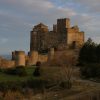
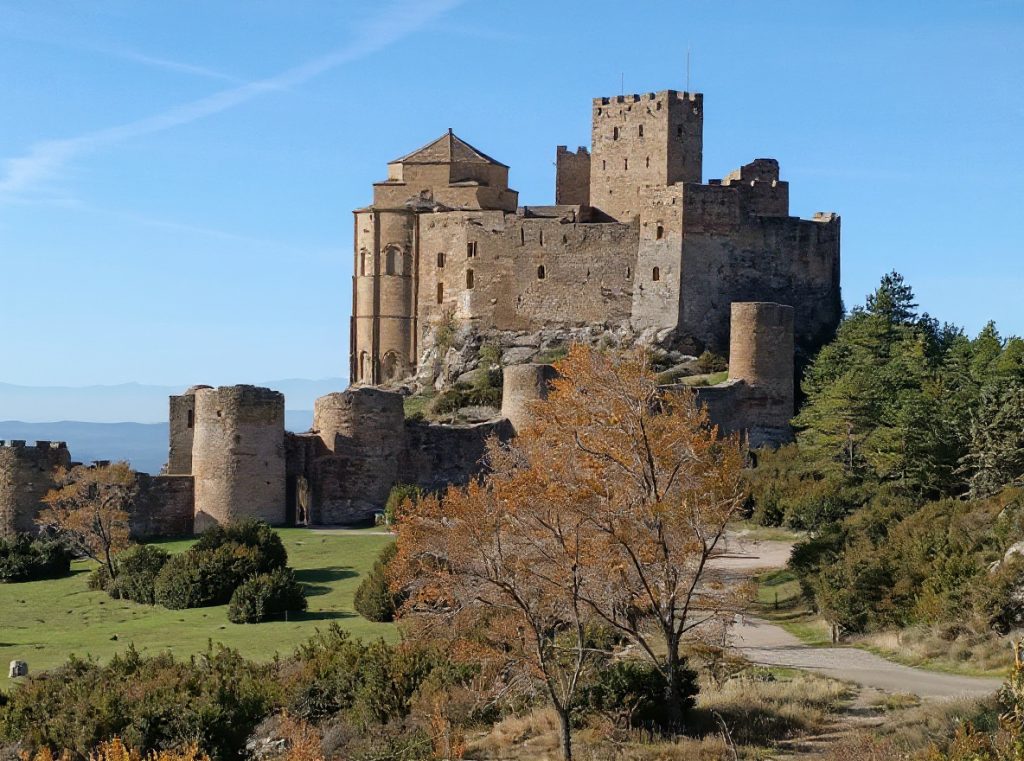
On a limestone outcrop high above the plains of Aragon, Loarre Castle commands the landscape with its soaring towers and ancient walls. This 11th-century fortress rises 1,071 metres above sea level in the foothills of the Pyrenees. Builders raised it when these lands formed the Christian frontier against Muslim territories. The castle blends military might with monastic devotion in a way few European strongholds achieve. Today it ranks as one of the finest examples of Romanesque architecture in Spain.
Plan your visit to Loarre Castle
Tue Closed
Wed–Sun 11:00–17:30Winter (Nov–Feb) 11:00–17:30, closed Mondays except holidays; spring/autumn 10:00–19:00; summer (mid-Jun to mid-Sep) 10:00–20:00.
Location of Loarre Castle
Loarre Castle sits in Huesca Province, within the autonomous community of Aragon in northern Spain. The fortress overlooks the Hoya de Huesca plains from its dramatic rocky perch. Visitors find it near the village of Loarre, approximately 35 kilometres northwest of the city of Huesca. Zaragoza lies roughly 90 kilometres away. The winding approach road climbs through the foothills of the Sierra de Loarre. As you ascend, the castle comes into sight with increasingly spectacular views. Most travellers reach the site by car along the A-1206 road. The nearest major airport operates in Zaragoza, though the drive from Barcelona takes around three hours. Public transport serves Huesca city, but reaching the castle itself requires private transport. The mountain setting provides sweeping panoramas across the fertile plains toward distant peaks.
History of Loarre Castle
King Sancho III of Navarre, known as Sancho the Great, founded the castle around 1020. He built it as a frontier outpost during the Christian reconquest of Iberian lands. The fortress defended the northern border of the emerging Kingdom of Aragon against Muslim forces based in Huesca and the surrounding lowlands. The strategic position allowed Christian forces to control the plains below, particularly the important Muslim settlement at Bolea. After 1070, the castle gained even greater significance. King Sancho Ramírez transformed Loarre by installing a community of Augustinian canons in 1073, creating an unusual fortress-monastery. He expanded the complex significantly, adding the magnificent church of San Pedro and strengthening the defences as he prepared to conquer Huesca.
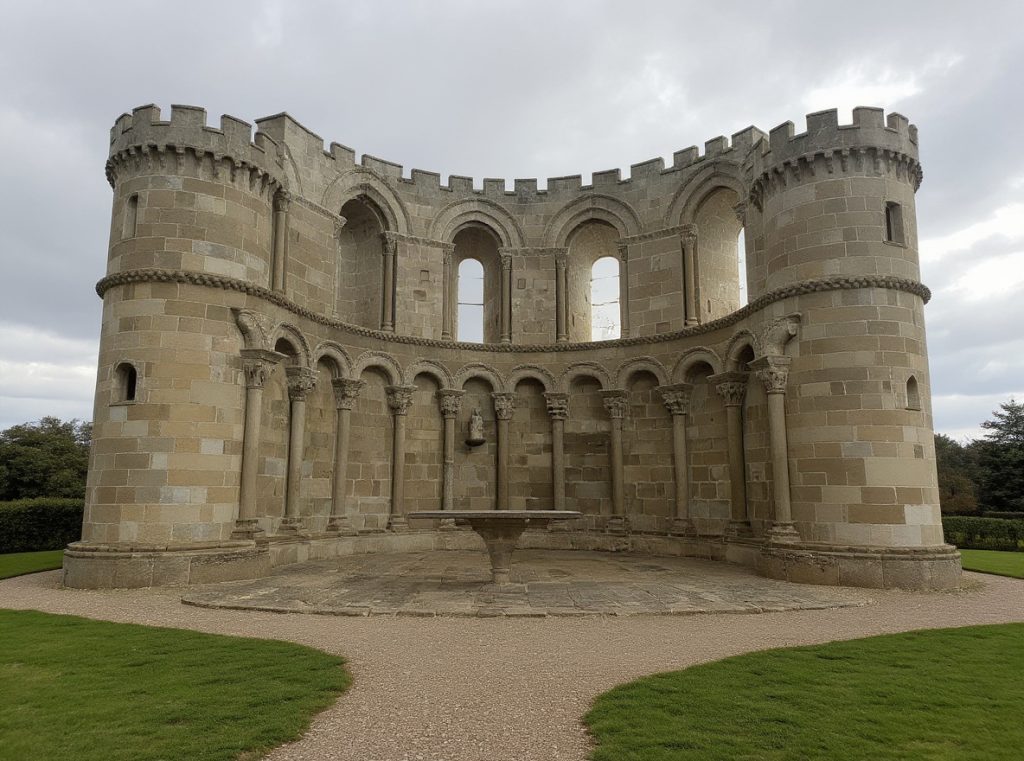
Builders constructed the church in pure Romanesque style. It features an impressive dome and richly carved capitals depicting biblical scenes and fantastical creatures. The crypt of Santa Quiteria lies beneath it, while the complex includes the Tower of Homage and the Queen’s Tower from the earlier construction phase. When Christian forces finally captured Huesca in 1094, the military importance of Loarre diminished almost immediately. In 1097, King Peter I transferred the monastery’s assets to a new foundation at Montearagón, closer to the newly conquered city. The canons departed, and Loarre became a fortress without a war to fight. Throughout the 13th and 14th centuries, builders added the outer defensive walls and their eight semicircular towers. Local conflicts occasionally brought armies to its gates, yet the castle never faced a major siege. By the 15th century, residents of the small settlement below the fortress had moved to the present village of Loarre. They took castle stones with them for new buildings.
Current status
Spain declared Loarre a National Monument on 5 March 1906, recognising its exceptional preservation and architectural importance. The castle now holds the official status of Bien de Interés Cultural (Asset of Cultural Interest). Conservation work has restored many structures while maintaining their authentic character. The site welcomes visitors year-round, though opening hours vary seasonally, with longer days in summer and shorter periods in winter. The castle typically closes on Mondays during low season. Entry requires paid admission, with options for self-guided visits or expert-led tours that reveal the fortress’s architectural secrets and historical layers.
The official management operates the site through its dedicated team. They offer educational programmes for schools and cultural events throughout the year. Ridley Scott chose Loarre as a filming location for his 2005 epic Kingdom of Heaven, bringing international attention to this remote fortress. Architectural scholars study the church of San Pedro for its exceptional Romanesque craftsmanship and the innovative use of the rocky terrain in the castle’s design. The irregular floor plan, dictated by the limestone outcrop, created a collection of interconnected buildings rather than a unified structure. Visitors walk through the ancient gatehouse and climb stone staircases worn smooth by centuries of use. They explore the chapel, crypt, residential quarters, and defensive towers.
From the ramparts, the view stretches for miles across the Aragonese countryside, just as it did when medieval sentries watched for approaching armies. The castle stands silent now, with its military purpose long forgotten. Yet the stones still speak of kings and canons, of faith and warfare. They recall a time when this remote mountain stronghold shaped the destiny of a kingdom.
Castles near Loarre Castle
Frequently asked questions
What makes Loarre Castle historically significant?
Built in the 11th century by King Sancho Ramírez, Loarre Castle is one of the best-preserved Romanesque fortress-monasteries in Europe. It served as a strategic stronghold during the Christian expansion into Muslim-held territories and later housed a community of Augustinian canons.
Is Loarre Castle suitable for visitors with mobility issues?
The castle features steep medieval staircases, narrow passages, and uneven stone surfaces typical of an 11th-century military fortress. Visitors requiring walking aids may find parts of the castle challenging to access.
Can I visit Loarre Castle without a guided tour?
Yes, self-guided visits are available for €6.80. However, guided tours (€8.80) are recommended as they provide detailed historical context and last approximately one hour, after which you can continue exploring independently.
How do I get to Loarre Castle from Zaragoza?
The easiest option is by car (97 km, approximately 1.5 hours via A-132). Public transport requires taking a bus to Huesca, then bus 405 to Loarre village, followed by a 2 km walk or taxi to the castle entrance.
Was Loarre Castle used as a film location?
Yes, Ridley Scott filmed parts of Kingdom of Heaven (2005) at Loarre Castle. The fortress's exceptional state of preservation and dramatic hilltop setting have made it a popular location for historical films.
Featured listings