
Al-Muqtadir, the second monarch of the Banu Hud dynasty, ordered the construction of Aljafería during the second half of the 11th century in central Zaragoza. The palace represents one of the finest examples of Islamic palatial architecture in Spain outside Andalusia. This ruler built the complex as a symbol of the power the Taifa of Zaragoza achieved during its golden age. The palace received the name Qasr al-Surur, meaning “Palace of Joy”, though it served both as a luxurious residence and a fortified stronghold. Today this remarkable palace functions as the seat of the Cortes of Aragon. In fact, it is the only Islamic palace in the world that houses an active parliament.
Plan your visit to Aljafería
Location of Aljafería
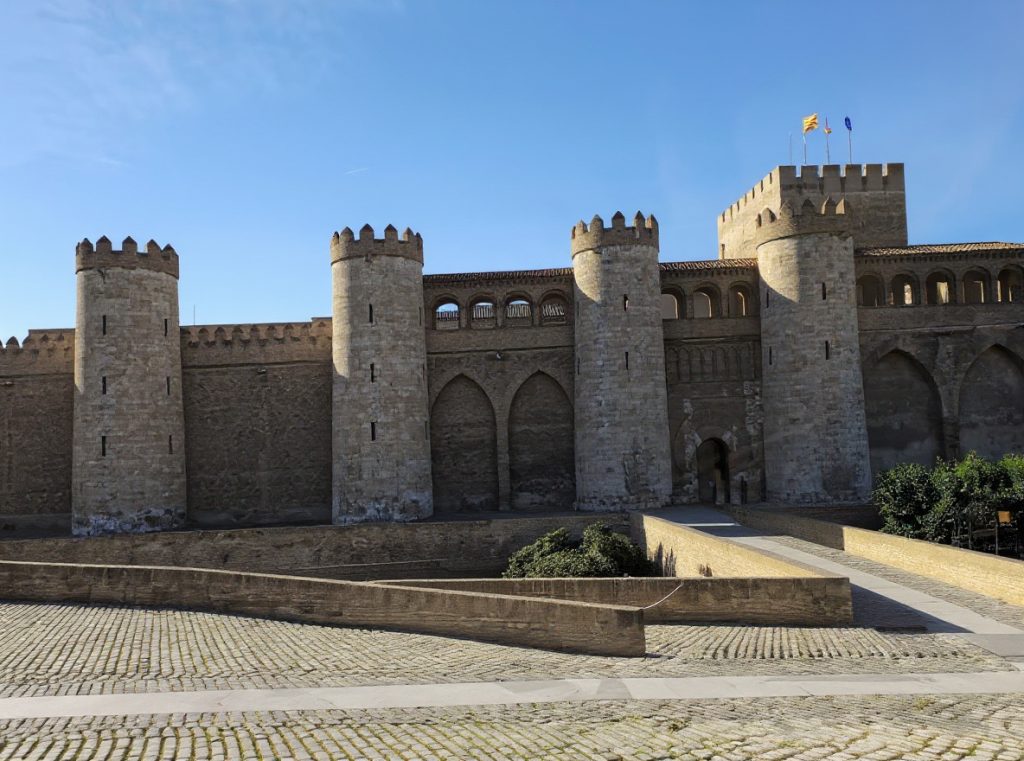
The palace sits in central Zaragoza, capital of the Aragon region in north-eastern Spain. Builders raised it during the second half of the 11th century in the Taifa of Zaragoza in Al-Andalus, outside the city’s original Roman walls. The fortress occupies the confluence of three important neighbourhoods: the historic centre, Almozara and Delicias. Visitors will find it easily accessible from the city centre, within walking distance of Zaragoza’s main attractions. The address is C. de los Diputados, s/n, 50003 Zaragoza. Public transport connects the palace to all parts of the city, so its proximity to the city’s main thoroughfares makes it a convenient stop. The surrounding area includes a pleasant park where visitors can view the palace’s exterior fortifications from different angles.
History of Aljafería
Al-Muqtadir, ruler of the independent Muslim kingdom of Zaragoza, ordered the construction of the palace between 1065 and 1081. The oldest component of the complex is the Troubadour Tower, which builders raised in the late 9th century before incorporating it into the palace’s defensive walls. In 1118, the Christian king Alfonso I the Battler conquered Zaragoza and ended Muslim rule. The Aljafería then became the residence of the Christian kings of Aragon. During the 14th century, Peter IV of Aragon undertook major expansions. He added spectacular Mudéjar-style ceilings and upper floors that blended Islamic artistic traditions with Christian tastes.
The Catholic Monarchs, Ferdinand and Isabella, ordered a significant renovation between 1488 and 1495. They transformed the Aljafería into a royal palace reflecting the Christian monarchy’s authority. This period produced the magnificent Golden Hall, which visitors admire today. Between the late 15th century and early 18th century, the Spanish Inquisition also used the Aljafería as a prison. In the 16th century, Philip II converted it into a military citadel when he added bastions and a moat. The palace served as a military barracks through much of the 19th and 20th centuries. This military use caused considerable damage to its historic fabric. Restoration efforts began in earnest during the 1980s and continued until 2001.
Current status
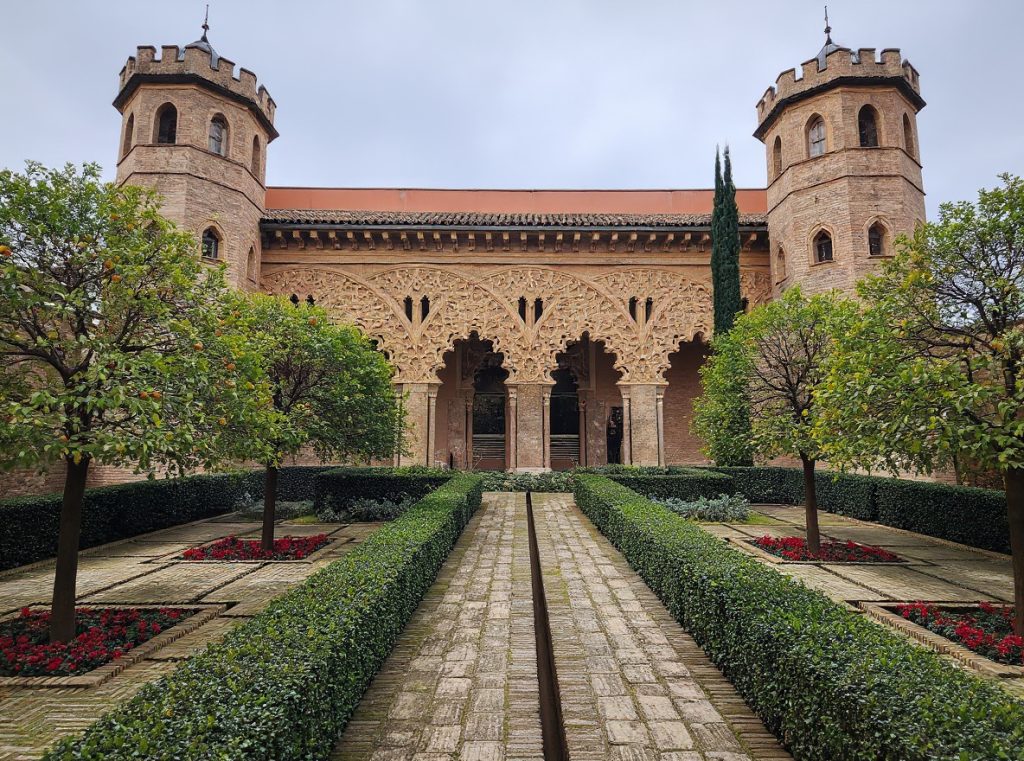
In 2001, UNESCO included the original restored structures of the Aljafería in the Mudéjar Architecture of Aragon, a World Heritage Site. Since 1987, the Aljafería has served as the permanent seat of the Cortes of Aragon, the regional parliament. This dual role as historic monument and working government building gives it unique vitality. The Cortes of Aragon manages the palace and welcomes visitors daily through guided tours and self-guided visits. Visitors can explore the Islamic portico with its delicate interlaced arches, the octagonal prayer room with its mihrab, and the Troubadour Tower. They can also see the Christian-era Golden Hall and the magnificent Mudéjar wooden ceilings that Peter IV added.
The palace charges a modest admission fee, with discounts available for students, seniors and other groups. Visitors must make reservations through the official online booking system. The site has implemented extensive accessibility improvements, including ramps and adapted facilities. Audio guides and tablets are available in multiple languages. More than four million visitors have explored the palace since restoration work commenced. The complex continues to host cultural events, exhibitions and concerts. As a result, it maintains its historic role as a centre of civic and cultural life while preserving the architectural legacy that spans more than ten centuries and three distinct civilisations.
Castles near Aljafería
Frequently asked questions
What is the Aljafería palace?
The Aljafería is an 11th-century fortified Islamic palace built for the Taifa kings. Today it houses the Cortes of Aragon regional parliament whilst remaining open to visitors.
Can you visit the Aljafería without a guided tour?
Yes, self-guided visits are permitted during opening hours. Guided tours in Spanish run at 10:30, 12:30, 13:30, and 15:00; English tours are at 11:00.
How far is the Aljafería from Zaragoza city centre?
The palace is approximately 1.5 km west of the historic centre. It takes about 20–25 minutes to walk from Plaza del Pilar.
Is the Aljafería similar to the Alhambra?
Both are Islamic palaces, but the Aljafería is much smaller and less ornate. It is considered Spain's finest Islamic building outside Andalusia and offers a taste of Moorish architecture.
Are there any restrictions when visiting the Aljafería?
Access ends 45 minutes before closing time. As the palace houses the regional parliament, opening times can occasionally vary due to institutional events.
Featured listings