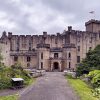

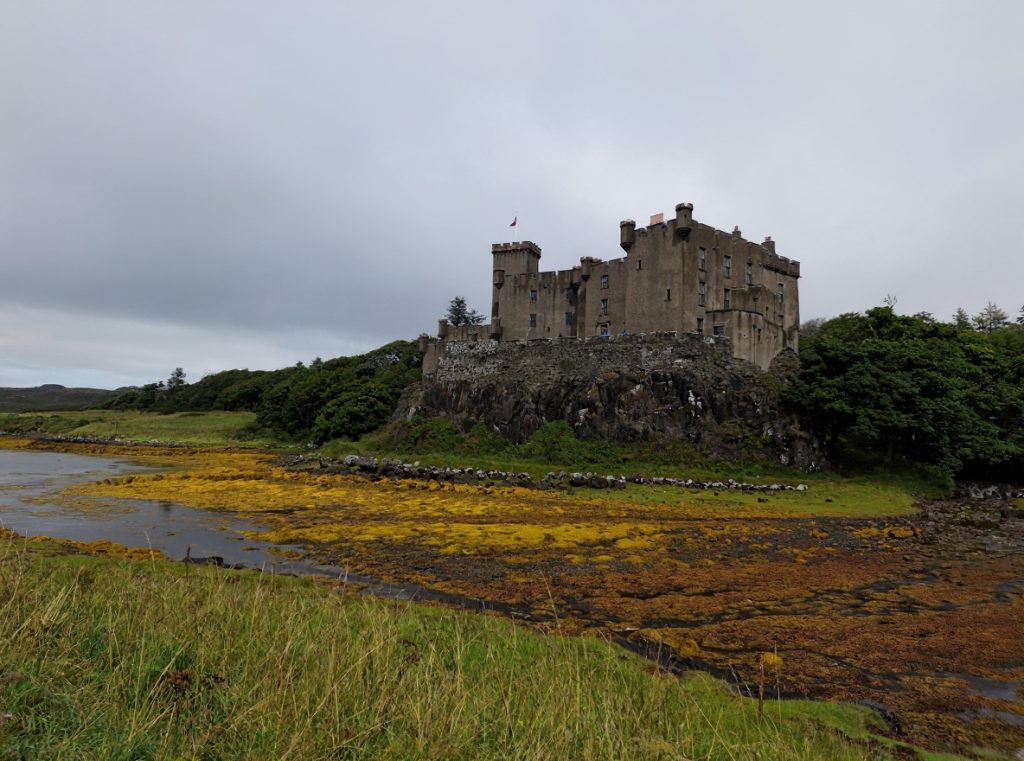
Perched on a dark basalt rock above the calm waters of Loch Dunvegan, Dunvegan Castle commands the northwest corner of the Isle of Skye with quiet authority. For more than eight centuries, this fortress has served as the ancestral seat of the Chiefs of Clan MacLeod. It holds the distinction of Scotland’s oldest continuously inhabited castle. Behind its Victorian battlements and romantic turrets lies a layered story of medieval towers, clan treasures and Highland legend, all set against the dramatic seascape of the Hebrides.
Plan your visit to Dunvegan Castle
Location of Dunvegan Castle
Dunvegan Castle sits approximately one mile north of Dunvegan village on the Isle of Skye’s western coast. The castle occupies an elevated basalt outcrop about fifteen metres above the eastern shore of Loch Dunvegan, a sea loch that opens to the Atlantic. Visitors reach Skye via the A87 road bridge from Kyle of Lochalsh or by ferry from Mallaig. From the island’s main town of Portree, the A850 road leads west for twenty-two miles through moorland and mountains to Dunvegan. The castle’s position commands sweeping views across the loch. Its landward side features an impressive rock-cut ditch that once isolated the fortress from the surrounding terrain.
History of Dunvegan Castle
The MacLeods likely fortified this rocky promontory as early as the thirteenth century, though a Norse stronghold may have occupied the site before them. Around 1266, after Alexander III annexed the Western Isles, builders enclosed the summit with a curtain wall. A sea gate provided the sole entrance until 1748, with stone steps climbing from the water to the castle platform. This early defensive circuit has largely vanished, though fragments remain near the present structure.
In the late fourteenth century, the clan erected a four-storey tower house on the north side of the enclosure. This donjon combined defensive strength with family quarters, so it established the core of the residential castle. Around 1500, Alasdair Crotach, the eighth chief, added a second tower at the southwest corner. The clan knew it as the Fairy Tower because it held their most famous heirloom: a silk banner called the Fairy Flag. Clan members believed the flag held protective powers. Modern analysis suggests the banner may be a Norse relic from centuries earlier.
Sir Roderick MacLeod, the fifteenth chief, connected the two towers with a substantial hall range in 1623. The seventeenth century saw further building, and by 1686 John MacLeod restored sections that had fallen into decay. A Latin inscription from that year celebrates the castle’s ancient occupation and the chief’s restoration work. When Sir Walter Scott visited in 1814, he praised John Norman, the twenty-fourth chief, for plans to medievalise the entrance. Those plans included twin towers and a drawbridge.
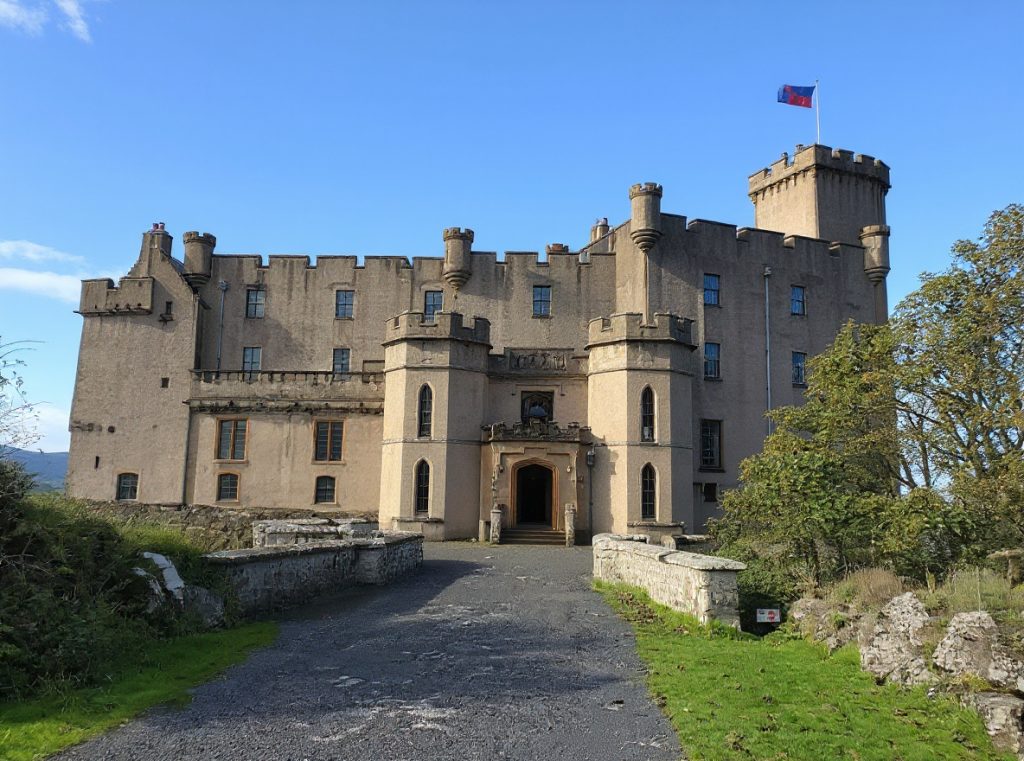
Between 1840 and 1850, Norman MacLeod, the twenty-fifth chief, commissioned architect Robert Brown of Edinburgh to transform the castle. Brown unified the disparate medieval buildings behind a continuous roofline of crenellated battlements and ornamental pepper-pot turrets.
Current status
Hugh MacLeod of MacLeod, the thirtieth chief, maintains Dunvegan as both family home and visitor attraction. Sir Reginald MacLeod first opened the castle to the public in 1933, initially just two days a week for charitable purposes. Since then, annual visitor numbers have grown from hundreds to hundreds of thousands. The castle welcomes guests daily from late March through mid-October, with no advance booking required for admission tickets.
Inside, the state rooms display oil portraits, weaponry, Jacobite keepsakes and the renowned Fairy Flag. Other treasures include the Dunvegan Cup and Sir Rory Mor’s ceremonial drinking horn. The MacLeod Tables Café serves refreshments, while shops offer Scottish gifts. Beyond the castle walls, five acres of formal gardens unfold through woodland glades, waterfalls and ornamental pools. The Water Garden, Rose Garden and Walled Garden provide striking contrast to Skye’s rugged moorland. Boat trips depart from the castle pier so visitors can view the resident seal colony on the rocks of Loch Dunvegan.
The castle operates within a forty-two-thousand-acre estate that includes Glenbrittle Campsite and five holiday cottages. As a Category A listed building, Dunvegan holds national importance for its architectural evolution spanning ten construction periods. The site has featured in films and television productions, cementing its place in popular culture. Yet for all its public role, the castle remains what it has been since the thirteenth century: the living heart of Clan MacLeod. Here stone towers and salt wind still whisper the old Gaelic motto—Hold Fast.
Castles near Dunvegan Castle
Frequently asked questions
What is the Fairy Flag at Dunvegan Castle?
The Fairy Flag is a fragile silk banner housed in the castle, believed to have magical powers to protect Clan MacLeod in battle. Legend says it was given to the clan by fairies and may only be unfurled three times in history.
Can you visit Dunvegan Castle in winter?
No, Dunvegan Castle closes to visitors from mid-October through March. The castle and gardens are open daily only from 1 April to 15 October.
Are the seal boat trips at Dunvegan Castle included in admission?
No, seal boat trips cost £14.50 for adults (with a castle or garden ticket). They run 25 minutes, departing from the castle jetty on a first-come, first-served basis Monday to Friday, April to September.
How long has Dunvegan Castle been inhabited?
Dunvegan Castle has been continuously inhabited for over 800 years and is Scotland's oldest continuously occupied castle. The current chief of Clan MacLeod still lives in part of the castle today.
Is Dunvegan Castle suitable for children?
Yes, Dunvegan Castle offers a special castle key hunt for children and activities in the gardens including a Wild Wood Trail. The seal boat trips are popular with families, and children under 5 ride free.
Popular right now
Featured listings