
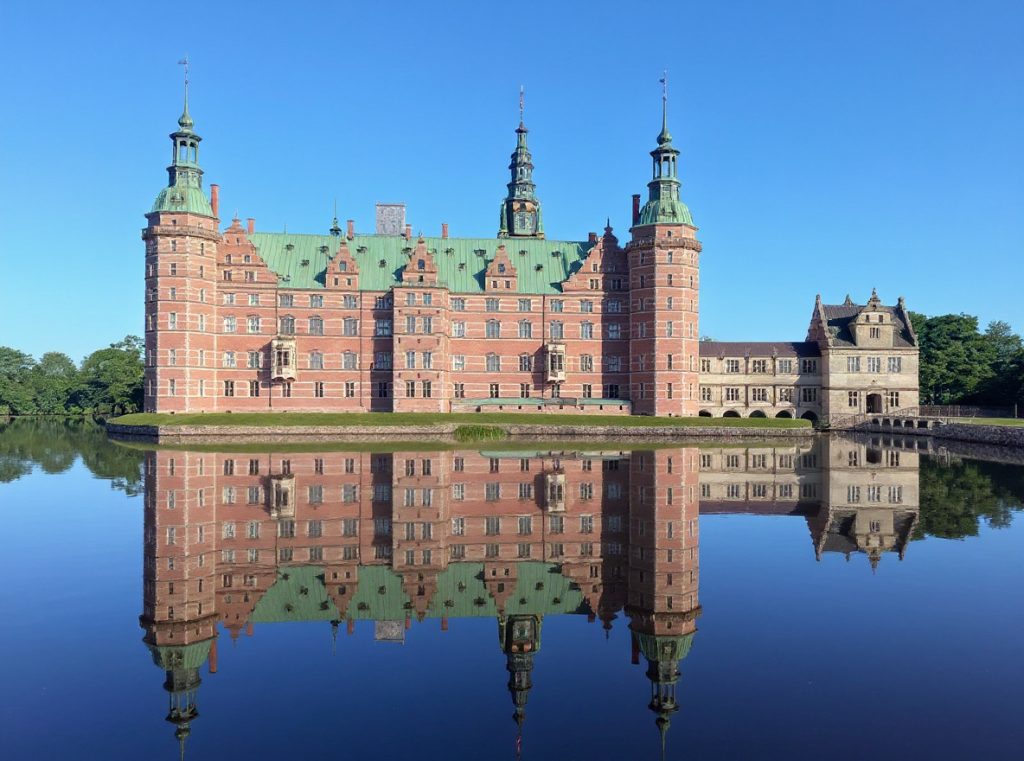
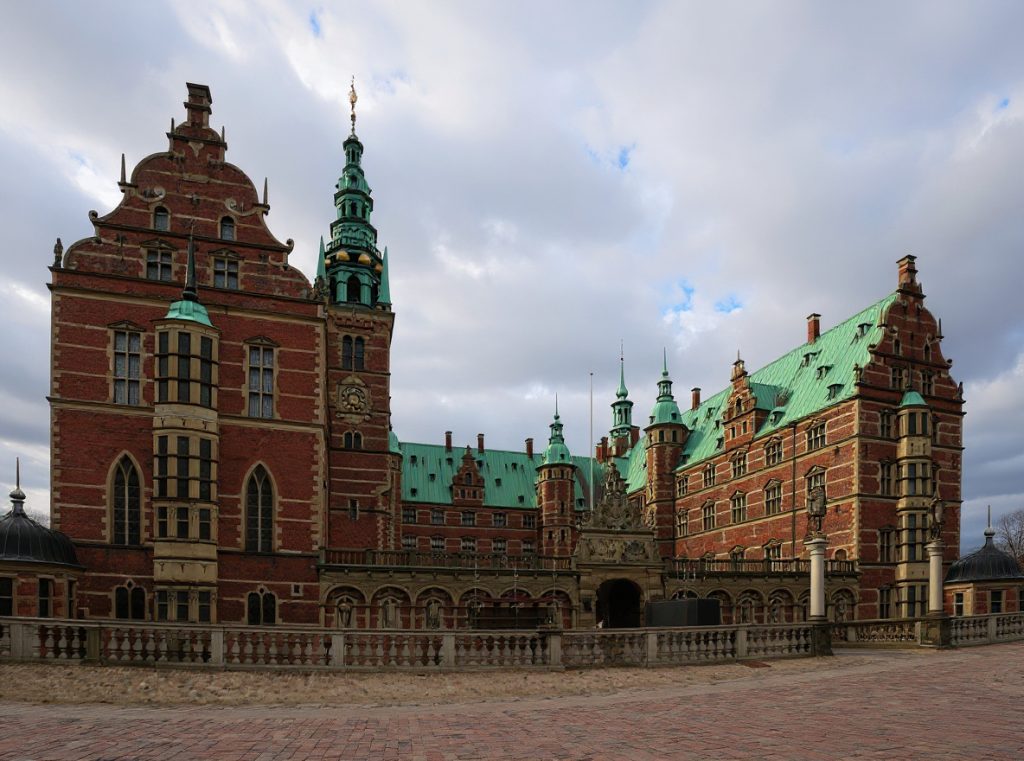
Rising from three small islands on the shimmering Castle Lake, Frederiksborg Castle claims the title of largest Renaissance palace in the Nordic region. King Christian IV built this magnificent complex between 1602 and 1620 when he replaced his father’s hunting lodge with a vision of royal power expressed through architecture. Red brick walls, curved gables, light sandstone decorations, and copper-clad roofs and spires combine Dutch Renaissance elegance with Danish tradition. Since 1878, the palace has housed the Museum of National History. Here, five centuries of Danish heritage unfold through portraits, furniture and decorative arts.
Plan your visit to Frederiksborg Castle
Location of Frederiksborg Castle
Frederiksborg Castle sits in Hillerød, Denmark, roughly 40 kilometres north of Copenhagen. Visitors can drive to the castle in about 40 minutes from Copenhagen. Regular trains also run from Copenhagen Central to Hillerød on S-train line A. The journey takes about 35 minutes. From Hillerød station, a well-signposted 10- to 15-minute walk leads to the castle. Visitors can stroll through the charming old streets of Hillerød or walk along the Castle Lake to reach the entrance. A large formal garden in the Baroque style adjoins the palace, while the surrounding parkland invites exploration before or after touring the castle itself.
History of Frederiksborg Castle
The estate originally known as Hillerødsholm near Hillerød traditionally belonged to the Gøyes, one of Denmark’s noble families. In 1560, Frederik II acquired the castle estate called Hillerødsholm. He transformed it into a hunting lodge, naming it Frederiksborg after himself. His son, Christian IV, arrived at Frederiksborg Castle in 1577 as his birthplace. In 1602, Christian IV ordered most of the old buildings demolished so construction of the current castle could begin.
The entire project reached completion in 1625, with Hans van Steenwinckel the Younger as the final architect. The building aimed to show off and enhance Christian IV’s status as a powerful European monarch. The castle displays rich symbolic and decorative elements throughout. For example, the impressive Neptune Fountain and the Marble Gallery of the King’s Wing demonstrate this ornate approach. The castle sits on three small islands on the western side of the castle lake. The main castle consists of three wings: the northern King’s Wing, the western Church Wing with the chapel and grand banquet hall, and the eastern Princess Wing.
The castle served as a royal residence where Danish kings received their crowns from 1660 to 1840. In 1659, the Swedes captured the castle and took most of its furnishings as spoils of war. It remained a favourite royal residence until 1859, when fire significantly damaged it that year. A major fire destroyed much of the castle, though remarkably, the chapel came out almost intact. Workers saved remnants of the interior and over 300 paintings. King and state funded restoration, as did J. C. Jacobsen of Carlsberg Brewery.
Current status
Thanks to public support and brewer J. C. Jacobsen, workers fully restored the apartments and reopened them to the public as the Danish Museum of National History in 1882. J.C. Jacobsen, the founder of Carlsberg, established the Museum of National History. The Carlsberg Foundation still runs it as a branch. The museum opens throughout the year and contains the largest collection of portrait paintings in Denmark. Here, 500 years of Danish history comes alive through portraits, paintings, furniture, sculptures and decorative art.
Visitors can tour several of the castle’s state rooms. These include the restored Valdemar Room and Great Hall as well as the Chapel and the Audience Chamber. The fire largely spared both the Chapel and Audience Chamber, so they still contain sumptuous decorations. The castle chapel survived the fire and today appears as it did in Christian IV’s time. Danish kings and queens still receive anointing in the chapel at Frederiksborg Castle. The park consists of a formal Baroque garden and a Romantic landscape garden. Workers recreated the Baroque garden in a somewhat modified form in the 1990s, with a water feature cascading down the central axis of the terraced complex.
Frederiksborg Castle draws visitors from across the world who come to walk through rooms where monarchs once lived and ruled. The Neptune Fountain still graces the outer courtyard, while the Marble Gallery gleams in the King’s Wing. Boat tours operate on the surrounding lake during warmer months. These tours offer views of the palace reflected in still waters.
Castles near Frederiksborg Castle
Frequently asked questions
Is Frederiksborg Castle suitable for children?
Yes, children under 18 enter free. During summer, the basement has a children's activity area with Renaissance dress-up and period crafts.
Can I visit the gardens at Frederiksborg Castle without entering the museum?
Yes, the Baroque garden and landscape park are free to enter and open daily. The Baroque garden opens at 10:00 and closes at 21:00.
How do I get from Hillerød station to Frederiksborg Castle?
It's a 15–20 minute walk from Hillerød station to the castle entrance. Follow signs through the town centre or use the scenic route along the lake.
What is the Little Ferry at Frederiksborg Castle?
The Little Ferry sails across the castle lake between Hillerød town square and the Baroque garden during warmer months. The 30-minute trip costs 40 kr for adults, 10 kr for children.
Does Frederiksborg Castle have an audio guide?
Yes, a free digital audio guide is included with admission via a mobile app. The app also allows you to scan artworks for more information.
Featured listings