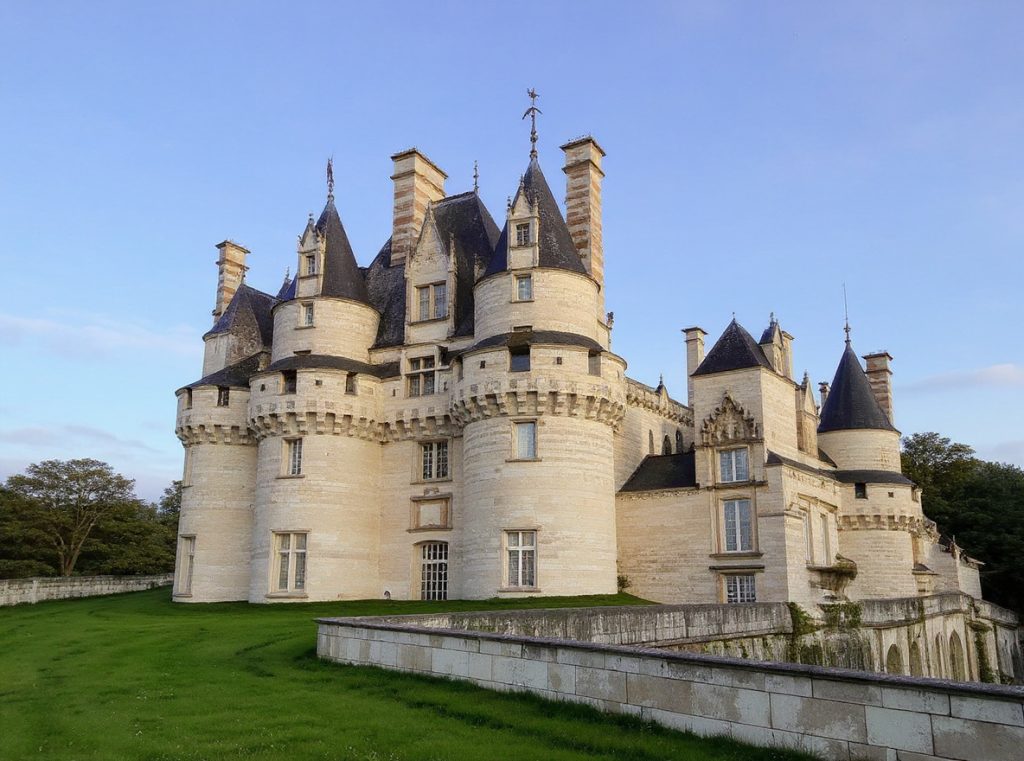
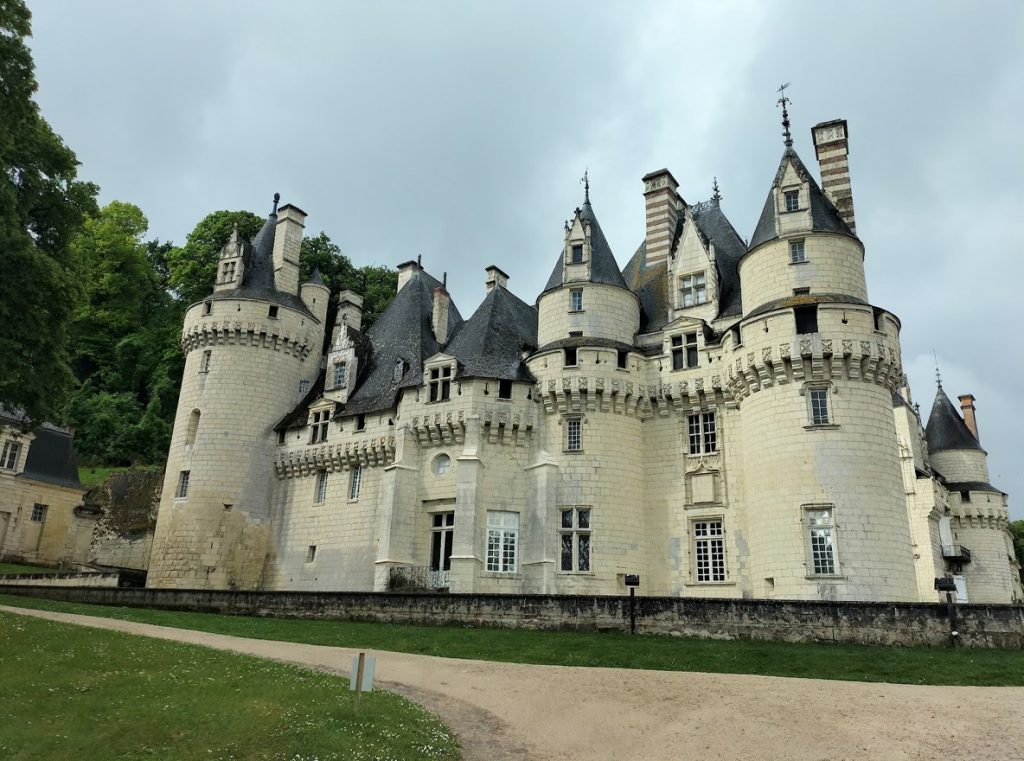
Overlooking the verdant Indre Valley at the edge of the ancient Chinon forest, Château d’Ussé rises with white tuffeau stone walls and soaring towers that seem conjured from the pages of a storybook. Writer Charles Perrault had the castle in mind when writing “The Sleeping Beauty”. The silhouette of this Loire Valley château has captivated visitors for centuries. The structure blends formidable medieval defences with Renaissance elegance. Its terraced gardens sweep down toward the river in graceful tiers. Today the château belongs to Casimir de Blacas d’Aulps the 7th Duke of Blacas. He descends from a family who has owned this estate for more than two centuries.
Plan your visit to Château d’Ussé
Location of Château d’Ussé
Château d’Ussé sits in the commune of Rigny-Ussé in the Indre-et-Loire département, in France. The stronghold at the edge of the Chinon forest overlooks the Indre Valley. The river and surrounding woodland frame the château’s pale façades. Rigny-Ussé sits between the larger Loire Valley towns of Tours and Chinon. This location makes the castle accessible from either direction. The château lies only a 40-minute drive from Saumur. Visitors travelling along the departmental roads will glimpse the towers through gaps in the forest as they approach. The official address is Rue Principale, 37420 Rigny-Ussé. Many sources also cite it as 338 Château d’Ussé. A small bridge crosses the Indre just before the estate entrance. This bridge offers an ideal vantage point from which the full fairy-tale profile appears. Free parking sits across the road from the main gate. This convenience helps those arriving by car. Organised tours from Tours and other valley towns often include Ussé on multi-château itineraries.
History of Château d’Ussé
Around the year 1000 Viking Guelduin I built the first fortress on this strategic site. Gelduin I from Denmark built the fortress during Viking raids along the River Loire and its environs. He joined forces with the Counts of Blois. The site passed to the Comte de Blois, who rebuilt it in stone. The original wooden palisade gave way to masonry walls during the eleventh century. Little of that early structure survives today, though. The second half of the 15th century saw builders replace the wooden castle with stone. This happened during a period of unrest as part of the Hundred Years’ War. Jean V de Bueil, a captain victorious in the Hundred Years’ War under King Charles VII, acquired the ruined medieval stronghold. He then began its transformation. Antoine De Bueil, husband of Louis VI’s daughter, sold the castle in 1485 to Charles of the d’Espinay family.
In 1485 Ussé passed to the d’Espinay family. They transformed it under the influence of the Italian Renaissance. Espinay built the central body of the château, the first part of the right wing, and the chapel. He completed the chapel, finished by his son Charles in 1612. The Flamboyant Gothic style mixed with new Renaissance motifs in this structure. Espinay began the rebuilding process that resulted in the sixteenth-seventeenth century aspect seen today. In 1659 Château d’Ussé passed to Louis Bernin de Valentinay, controller-general of the royal household. Valentinay planned the layout of the apartments in the south gallery. He also oversaw conversion of the west wing and completion of the grand staircase designed by Francois Mansart. Valentinay’s connection to literature proved crucial because he frequently hosted his friend Charles Perrault. Perrault’s stays inspired the famous tale.
Current status
Ussé is a completely private estate owned by the same family for over two centuries. Count Blacas opened the Château to the public in 1975 out of necessity. He balanced the dual imperatives of preservation and public access. Traditional methods are not cheap, yet the Château is entirely self-funded with no government subsidy. The Count can often be seen working around the Château with the help of only a few employees. The château welcomes visitors from mid-February through mid-November each year. It offers access to richly furnished rooms that span centuries without ever leaving the family collection. Mannequins in period costume populate the chambers. Themed exhibitions showcase clothing from 1863 to 1955. The chapel, stables with antique carriages, and terraced gardens all form part of the tour.
The French Ministry of Culture classified Ussé as a monument historique in 1931. Visitors ascend the towers for valley views. They walk the rampart galleries where Perrault once strolled. They also explore the cellars dating from the fifteenth century. The octagonal Knights’ Dungeon features in the Sleeping Beauty tale. A sleeping princess tableau fills the attic above. The gardens extend across 600 hectares. The orangery built in 1664 still houses citrus trees. Each year the château participates in nationwide heritage events such as Rendez-vous aux Jardins in June and European Heritage Days in September. These events draw thousands who come to see where literature and architecture converge.
The white stone glows against the dark forest backdrop as it has for a thousand years. The château remains inhabited and still evolving. Sunlight catches the slate roofs and dormer windows. It casts shadows across courtyards where the Blacas family continues the work of preservation begun generations before.
Castles near Château d’Ussé
Frequently asked questions
What inspired the Sleeping Beauty tale at Château d'Ussé?
Charles Perrault is said to have been inspired by Château d'Ussé's turrets and fairytale architecture when writing 'La Belle au bois dormant' in 1697. The château features waxwork scenes from the tale in its tower attics.
Is Château d'Ussé still inhabited?
Yes, the Duc de Blacas and his family still live in part of the château. Public rooms including the royal apartments, chapel, gardens and Sleeping Beauty displays are open for self-guided visits.
Can I visit Château d'Ussé year-round?
No, Château d'Ussé closes from mid-November to mid-February each year. It is open daily from mid-February to mid-November with varying hours depending on the season.
Are guided tours available at Château d'Ussé?
No, Château d'Ussé does not offer guided tours. Visits are self-guided, with information sheets available in nine languages including English, and optional audio guides for €2.
What other châteaux are near Château d'Ussé?
Château d'Ussé is close to several Loire Valley castles: Azay-le-Rideau and Langeais are both 15 km away, Chinon is 15 km, and Villandry is about 20 km. All can be combined in a day trip.
Featured listings