
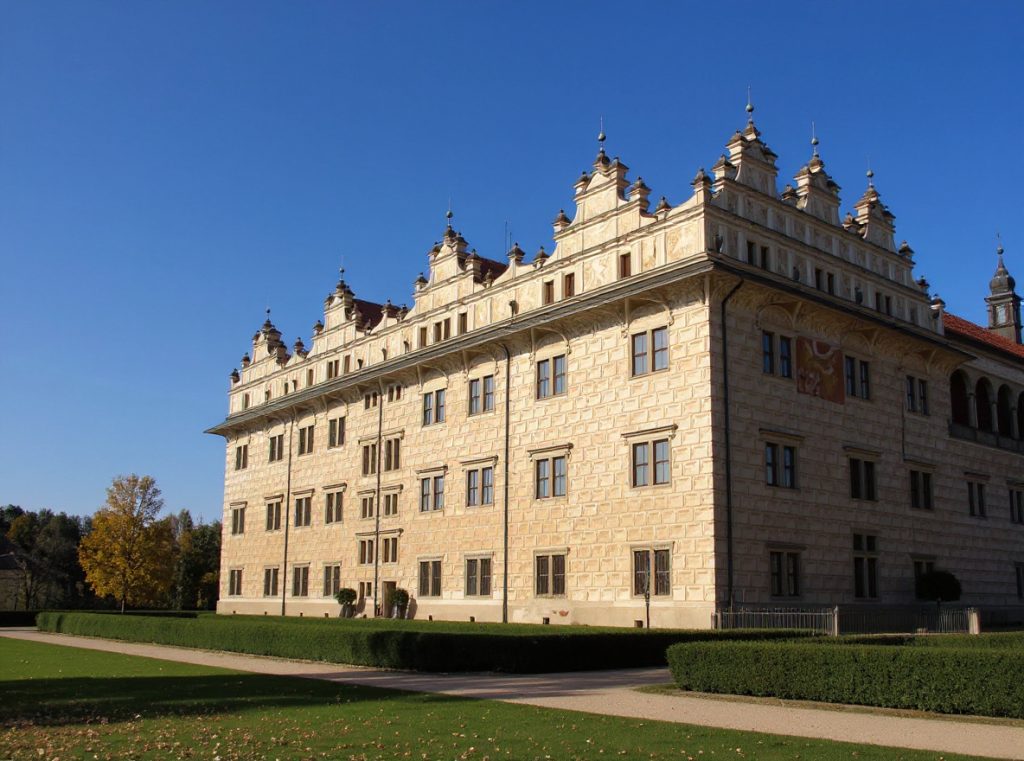
Set on a hill above the historic town of Litomyšl in eastern Bohemia, Litomyšl Castle represents one of Europe’s finest examples of Renaissance arcade architecture. Vratislav of Pernštejn built this UNESCO World Heritage monument between 1568 and 1581 as a gift for his Spanish wife, Maria Manrique de Lara. The castle’s façades display over 8,000 sgraffito decorations in geometric patterns. This technique creates striking visual depth through layered plaster. The arcade castle first developed in Italy, yet architects modified it in the Czech lands to create an evolved form of special architectural quality.
Plan your visit to Litomyšl Castle
Thu–Sat 10:00–14:00
Sun ClosedSeasonal: Apr–Nov variable hours; Nov–Mar Thu–Sat 10:00–14:00 (winter tours); check website for current schedule.
Location of Litomyšl Castle
Litomyšl sits in the centre of the Czech Republic, about 130 kilometres directly east of Prague, and 80 kilometres north of Brno. The castle occupies a commanding position on a slope above Smetanovo Square, one of the longest town squares in the country. Visitors arriving by train find the journey particularly convenient because the town of Litomyšl is quite small. The walk from the train station to the castle takes only a few minutes. The station in Litomyšl has several connections per day from Choceň, where trains from Prague and other major cities stop. By car, the castle lies along the historic route connecting Bohemia and Moravia. This makes it accessible from Hradec Králové and Pardubice within thirty minutes.
History of Litomyšl Castle
Historical documents confirm that a medieval castle stood on the site before Vratislav of Pernštejn acquired the property in 1567. In 1568, building began on the three-storey, four-winged establishment under the supervision of Jan Baptista Avostalis and his brother. These Italian architects brought the arcade style north of the Alps. After 13 years of construction work, workers completed the castle in 1581. The design featured a central courtyard surrounded on three sides by arcades. Columns on the upper floors and distinctive sgraffito covered nearly every external surface.
The aristocratic family of Trauttmansdorffs acquired the castle in 1649 and left their mark on the interiors. They redesigned some of the castle’s interiors in the Baroque style after a fire damaged parts of the structure in 1728. Franz Maximilian Kaňka, a renowned architect, conducted the work. In 1758, the Waldsteins became the new owners. Their contribution was the castle family theatre, a neoclassical jewel built in 1797 that survives with original backdrops and stage machinery. The castle also played a role in Czech cultural history when the famous Czech composer Bedřich Smetana was born in the castle’s brewery in 1824. His father worked there as the court brewer.
Current status
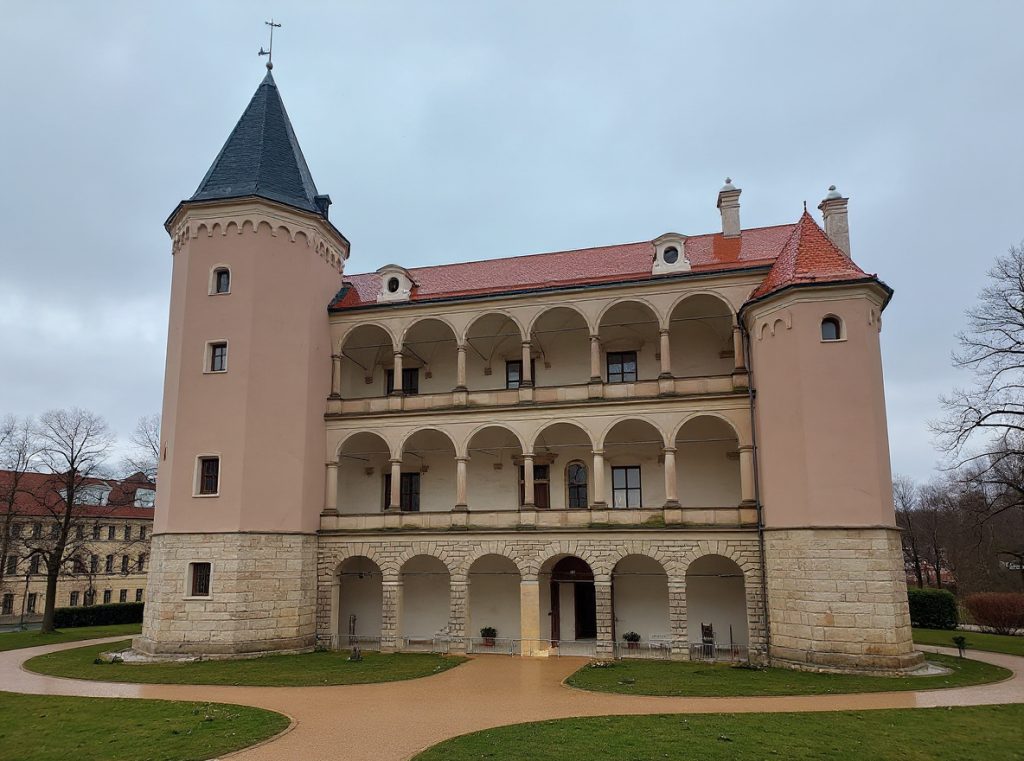
Nowadays, the Czech state owns Litomyšl Castle and the National Heritage Institute runs it. In 1999 UNESCO inscribed the castle on the World Heritage List, recognising its exceptional contribution to Renaissance architecture in Central Europe. Visitors explore the castle through guided tours that reveal ceremonial salons, a grand dining room, private apartments, and the remarkable chapel. The pride of the castle is the theatre from the 18th century with preserved classical scenes. Period performances occasionally take place there during cultural events.
The castle complex extends beyond the main building to include original ancillary structures. The complex also includes the birthplace of Bedřich Smetana, carriage house, stables, riding school, castle brewery, castle park and French-style garden. The English-style landscape park and formal French garden offer peaceful walks among 18th-century statues and pavilions. Since 1949, the castle has served as the venue for the regularly held Smetana’s Litomyšl music festival. This opera festival fills the grounds with music each summer. Recent conservation work completed in 2024 restored roofs, windows, and historical interiors. As a result, the castle remains accessible throughout the year while preserving its Renaissance character for future generations.
Castles near Litomyšl Castle
Frequently asked questions
Is Litomyšl Castle open year-round?
The castle operates seasonally with the main season April to November. From November to March, a limited Winter Tour runs Thursday to Saturday 10:00–14:00.
Can I visit Litomyšl Castle without a guided tour?
Most interiors require a guided tour. However, the 'Why the castle is UNESCO' exhibition can be visited independently with any tour ticket, and the castle grounds and gardens are accessible free of charge.
What makes Litomyšl Castle a UNESCO World Heritage Site?
Litomyšl Castle is an outstanding example of Renaissance arcade castle architecture with unique sgraffito façade decorations. It also houses one of the oldest preserved Baroque theatres in Europe with original 18th-century stage machinery and scenery.
How do I get to Litomyšl Castle from Prague by public transport?
Take a train from Prague Main Station to Choceň, then a regional train to Litomyšl (total journey about 2.5 hours). Alternatively, take a direct bus from Prague Florenc (approximately 3 hours).
Which tour route should I choose at Litomyšl Castle?
The 'Story of the castle theatre' (220 Kč, 50 minutes) includes the unique Baroque theatre. The 'News after reconstruction' tour (180 Kč, 30 minutes) shows newly restored interiors and is shorter for those with limited time.
Featured listings