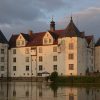
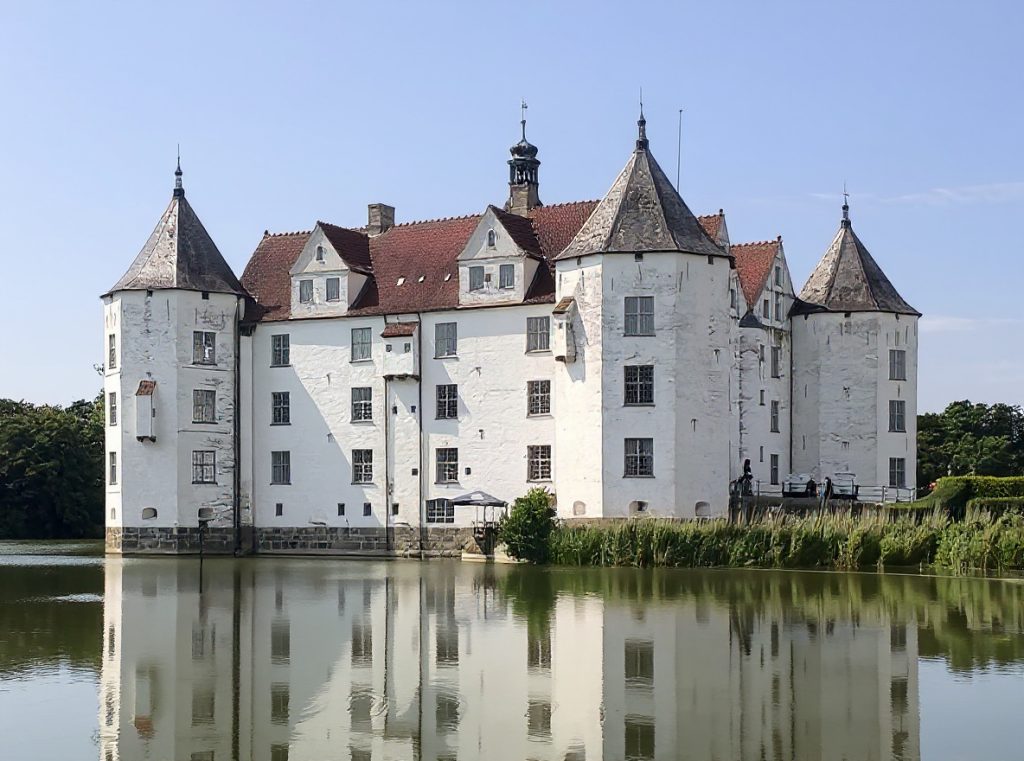
Rising from an artificial lake on the Flensburg Fjord, Glücksburg Castle presents one of northern Europe’s finest Renaissance water castles. Duke John the Younger of Schleswig-Holstein-Sonderburg commissioned the construction between 1582 and 1587. Builders created a masterpiece upon a massive 2.5-metre-high granite base with imposing corner towers and three elegant gabled houses. The ducal house of Glücksburg derived its name from the castle, and its family members became related to almost all European dynasties. Today the white-plastered fortress welcomes visitors who explore centuries of royal heritage within its largely unchanged walls.
Plan your visit to Glücksburg Castle
Sat–Sun 11:00–17:00Apr–Oct daily 11:00–16:00 or 17:00 (varies by month); Nov–Mar Sat–Sun 11:00–17:00; closed 21 Dec–3 Jan
Location of Glücksburg Castle
Glücksburg Castle sits in the town of Glücksburg in northern Germany on the Flensburg Firth. The castle lies 15 kilometres east of Flensburg along the Flensburg Firth. The drive takes roughly 15 minutes. The address is Schloss, 24960 Glücksburg. The castle occupies a unique island setting because water and an extensive park completely surround it. Visitors arriving by car find the castle easily accessible from the main roads of Schleswig-Holstein. Those coming from Denmark cross the nearby border within minutes. The surrounding town of Glücksburg offers a quiet coastal atmosphere on the Baltic Sea, while the castle serves as its unmistakable landmark. As a cultural ensemble, Glücksburg embodies the German and Danish historical identity of Schleswig-Holstein in a special way.
History of Glücksburg Castle
Cistercian monks built a monastery complex on the site in 1209. The monastery shaped the site’s history for over 300 years until the Reformation arrived. In 1538, authorities secularised the building as a result. Duke John the Younger modernised Sønderborg Castle and in 1582 began building Glücksburg Castle where Ryd Abbey used to stand. Master builder Nikolaus Karies completed construction in 1587. Builders reused bricks and granite from the demolished monastery, so they created the castle on historical foundations. Workers flooded the monastery grounds to create a large pond that almost entirely surrounds the castle. The structure rises on its 2.5-metre-high granite foundation from the water.
John’s son Philipp received the castle and the lands of Glücksburg. He then founded the first elder line of the House of Schleswig-Holstein-Sonderburg-Glücksburg. The castle remained the seat of the Dukes of Glücksburg for over 150 years, though the small titular duchy itself remained relatively insignificant. Five generations of the Dukes of Glücksburg lived in the castle between 1622 and 1779. After the elder line died out in 1779, Danish King Frederick VI gave the castle in 1825 to Frederick of Schleswig-Holstein-Sonderburg-Beck. Frederick founded the younger Glücksburg line. Christian IX grew up in parts of the castle before his coronation as King of Denmark in 1863. He managed to place all his six children within other European royal families through marriage. For this reason Glücksburg became known as the cradle of European aristocracy. Prussian troops used the castle as a medical facility during the German-Danish war in 1864 and 1865.
Current status
The family converted the castle into a foundation in 1922 and opened it to the public as a museum. The castle belongs to the Glücksburg Castle Foundation, a private foundation the ducal family of Schleswig-Holstein-Sonderburg-Glücksburg manages. Friedrich Ferdinand, Prince of Schleswig-Holstein-Sonderburg-Glücksburg, has chaired the foundation since 2023. The foundation’s purpose is to preserve and present this unique cultural asset to the public. It shows a living and inhabited house to convey understanding of history and aesthetics, especially to the younger generation. A museum within the castle is open to the public.
Visitors explore ducal apartments, a historic chapel, and the impressive 30-metre Red Hall with its early vaulted stucco ceiling. The 17th-century Flemish leather wall hangings and portrait gallery tell the story of the House of Glücksburg’s connections to virtually every major European royal family. The castle has been preserved unchanged, so visitors experience Renaissance architecture in its original form. The foundation uses its income to maintain the historic castle ensemble and its original furnishings. Special events, weddings, and concerts bring renewed life to the courtyards and halls throughout the year. Persistent moisture, typical of buildings surrounded by water, remains a central conservation concern. Yet the white walls continue to reflect on the castle lake, just as Duke John envisioned more than four centuries ago.
Castles near Glücksburg Castle
Frequently asked questions
What family built Glücksburg Castle?
Duke Johann the Younger of Schleswig-Holstein-Sonderburg built the castle between 1582 and 1587 on the site of a former monastery. The House of Glücksburg descending from him still occupies the thrones of Denmark and Norway today.
Can I visit Glücksburg Castle in winter?
Yes, the castle is open on Saturdays and Sundays from 11:00 to 17:00 between November and March. It closes for the Christmas period from 21 December through 3 January.
Are guided tours available at Glücksburg Castle?
Yes, 90-minute guided tours run on select days (mainly weekends) from April to November at 14:00 or 14:30, priced at €15.50 including admission. Audio guides in multiple languages are also available for self-guided visits.
Is there parking at Glücksburg Castle?
Yes, paid parking is available on site near the castle grounds. Parking fees are separate from castle admission.
What can I see inside Glücksburg Castle?
The castle displays original Renaissance furnishings, ducal living quarters, the ornate castle chapel, and exhibitions about the House of Glücksburg's role in European royal history. The rooms retain their historic character with period furniture and tapestries.
Popular right now
Featured listings