
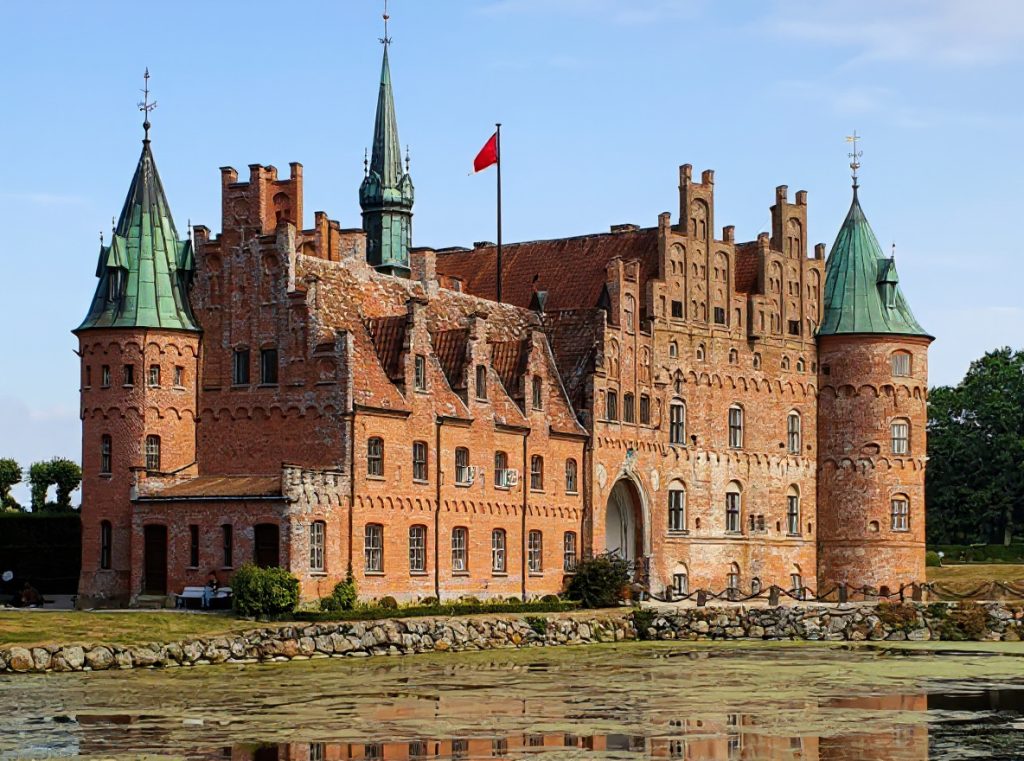
Rising from its watery moat on the island of Funen, Egeskov Castle commands attention as Europe’s finest preserved Renaissance water castle. Danish nobleman Frands Brockenhuus completed this formidable fortress in 1554, when civil wars and religious upheaval swept across Denmark. The castle stands on oaken piles in a small lake with a maximum depth of 5 metres. Legend claims builders felled an entire forest of oak trees for the foundation, so the name Egeskov (oak forest) reflects this.
Plan your visit to Egeskov Castle
Location of Egeskov Castle
Egeskov Castle sits near Kværndrup, in the south of the island of Funen, lying 29km (18 miles) south of Odense. The castle occupies a scenic position because 20 hectares of award-winning gardens and parkland surround it. Visitors can reach the castle 2.5 kilometres from Kværndrup Station. The fortress lies in the Faaborg-Midtfyn Municipality in southern Denmark. The estate extends beyond the moated castle to encompass agricultural land, forests and museums. The property covers approximately 1,137 hectares, including roughly 235 hectares of woodland. Local roads connect Kværndrup to Odense and other Funen towns. As a result, visitors travelling by car find the castle easily accessible from Denmark’s second-largest island.
History of Egeskov Castle
Records first mentioned Egeskov in 1405, when the site held a large farm. Historical records reveal that the farm, Egeskovgaard, belonged to Skinkel Ludeke, a member of an old Holstein noble family. The farm remained in the Skinkel family until 1545, when Frands Brockenhuus married Anne Tinhuus (Skinkel) and inherited the Egeskov estate through her. The Count’s Feud, general civil unrest, and a civil war introduced the Protestant Reformation and caused widespread troubles. Because of this turmoil, most Danish noblemen built their homes as fortifications. Frands transformed the estate into an impregnable fortress to protect his family.
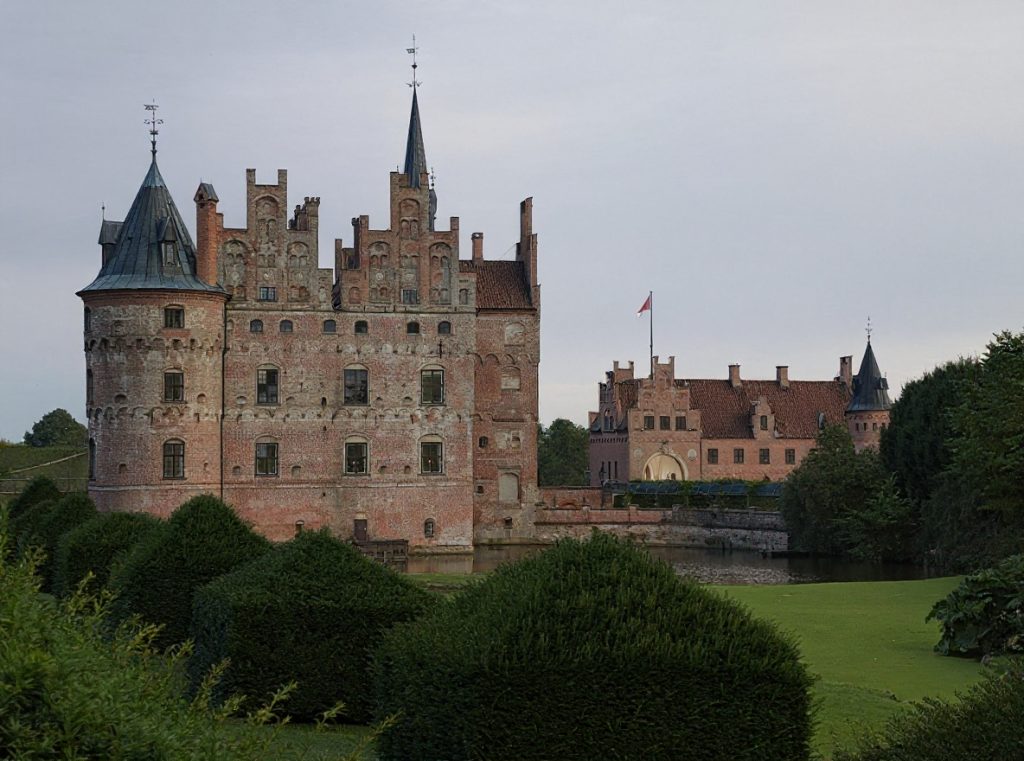
Architectural similarities between Nyborg Castle and Egeskov suggest that royal builder Morten Bussert helped construct Egeskov. Bussert died in 1553, before the castle’s completion in 1554, so another builder finished the work. The castle consists of two long buildings that a thick double wall connects. This design allowed defenders to abandon one house and continue fighting from the other. The double wall measures over one metre thick and contains secret staircases and a well. Defenders could attack an enemy’s flanks from the two round corner towers. Other medieval defences include artillery ports, scalding holes and arrow slits. Originally, a drawbridge provided the only access.
In the 466 years since builders raised the castle, approximately 30 owners have held it. Henrik Bille bought Egeskov in 1784, and his descendants have owned the castle ever since. Julius Ahlefeldt-Laurvig-Bille moved into Egeskov in 1883 and began extensive modernisation and restoration under Swedish architect Helgo Zettervall. Zettervall updated the castle into a model farm with its own dairy, power station and railway line to Kværndrup. Outside, the castle presents Late Gothic architecture, yet inside the original elements already show Renaissance design.
Current status
The Bille-Brahe family has owned the estate since 1784, when they acquired it from descendants of the Brockenhuus family. In 1882 the counts Ahlefeldt-Laurvig-Bille inherited it, and they still own it. Since 1994, Michael Preben Ahlefeldt-Laurvig-Bille has owned Egeskov, with Princess Alexandra of Sayn-Wittgenstein-Berleburg also identified as a co-owner. Count Michael Ahlefeldt and his family live in the castle as their private home, yet they welcome visitors from April to October. The family maintains the castle as both a home and a major tourist attraction.
Today, Egeskov still functions as a farm. The park has opened to the public for many decades, and the grounds have remained more or less unchanged since 1959. Visitors explore furnished rooms displaying antique furniture, grand period paintings and historical collections. The estate includes several museums in converted farm buildings. These museums house collections of vintage cars, motorcycles and agricultural equipment. Europe’s Best Historic Garden award now honours the castle gardens, and experts regard them as one of the world’s most remarkable gardens. Visitors discover beautiful garden rooms, impressive hedges, ancient trees and spectacular views surrounding the castle. The grounds offer mazes, a treetop walk, playgrounds and exhibitions for families.
Water still encircles the red-brick fortress as it did five centuries ago. The moat’s still surface reflects the conical towers. Swans glide past ancient walls that once repelled invaders. Inside, the castle’s 66 rooms preserve centuries of Danish noble life, while its gardens bloom through the seasons for thousands of visitors each year.
Castles near Egeskov Castle
Frequently asked questions
Is Egeskov Castle open year-round?
Egeskov Castle's summer season runs from late March to late October. During winter (December to March) only the play areas and exhibitions remain open; the castle interior and gardens are closed.
Can you visit the interior of Egeskov Castle?
Yes, the castle interior is accessible with a full admission ticket during the summer season. The castle is still privately inhabited by the Count of Ahlefeldt-Laurvig-Bille, but several rooms including the Great Hall, Hunting Room and Rigborg Room are open to visitors.
What is included in an Egeskov Castle ticket?
The full ticket includes the castle interior, 20 hectares of award-winning gardens, multiple museums (vintage cars, fashion, motorcycles), a treetop walk, playgrounds, and exhibitions. Most activities are included except Segway courses and horse carriage rides.
How long does it take to walk from Kværndrup station to Egeskov Castle?
The walk from Kværndrup station to Egeskov Castle is 2.5 km and takes approximately 30 minutes. Alternatively, local bus 920 runs from the station to the castle entrance.
Is Egeskov Castle suitable for families with children?
Yes, Egeskov Castle offers extensive family facilities including large adventure playgrounds, a treetop walk, interactive exhibitions, and 20 hectares of gardens to explore. Children under 4 enter free and discounted tickets are available for ages 4–12.
Featured listings