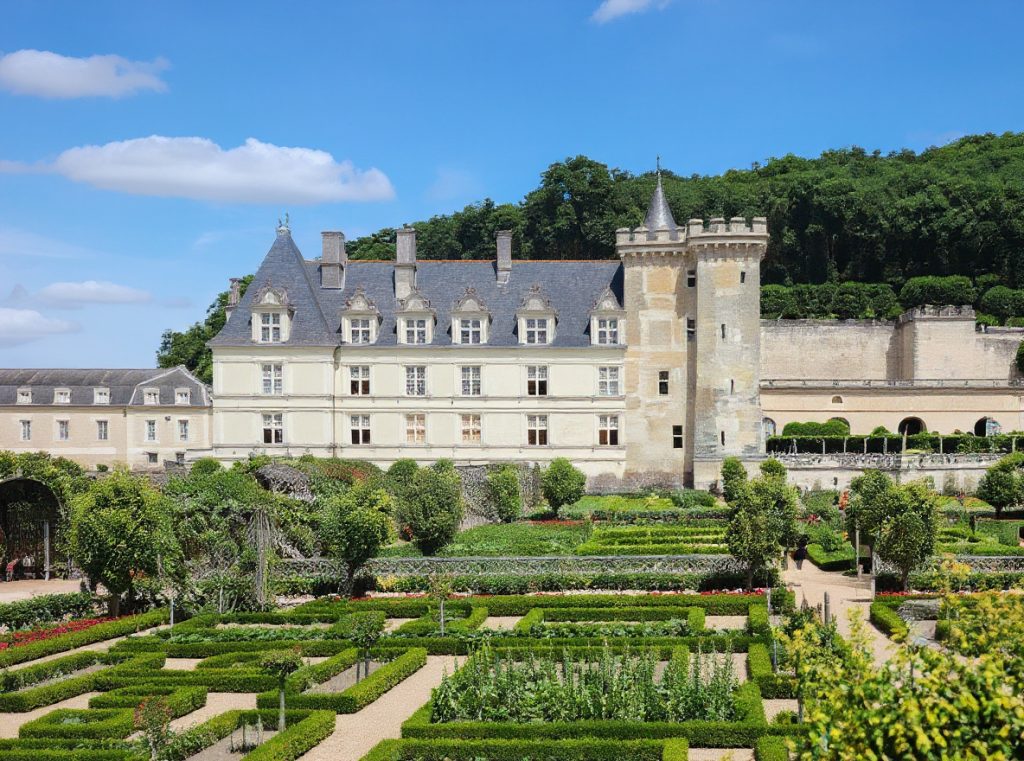
On the banks of the Loire River in central France, Château de Villandry marks the final grand château that builders raised during the Renaissance along this storied waterway. Jean Le Breton, Minister of Finance under King Francis I, built the estate around 1536. He created an architectural masterpiece renowned for harmony between château and gardens. Le Breton constructed his château on the site of an old 12th-century fortress, from which only the keep remains. Today the estate welcomes visitors from around the globe who come to experience its celebrated Renaissance gardens and elegant French architecture.
Plan your visit to Château de Villandry
Location of Château de Villandry
The Château de Villandry sits in the small village of Villandry, in the département of Indre-et-Loire, south-west of Tours. Villandry lies in the Loire Valley, just nine miles from Tours and thirty minutes from Chenonceau. The château occupies a commanding position near the confluence of the Loire and Cher rivers. Visitors arriving by car from Paris follow the A10 motorway to exit 24 at Joué-lès-Tours, then take the A85 towards Saumur to exit 8. The estate welcomes cyclists, as the Loire à Vélo cycle route passes just 500 metres from the entrance. Regional trains serve nearby Tours, where local bus services connect to Villandry village. In 1934 the government designated the estate as a Historic Monument, and it also falls within the Loire Valley World Heritage Site.
History of Château de Villandry
When Jean Le Breton arrived in Villandry in 1532, he razed the old feudal fortress to the ground, except for the keep. This medieval tower bore witness to a pivotal moment in European history. In this original fortress, officials signed “la Paix de Colombiers” on 4 July 1189, when King Henry II of England came to admit defeat before King Philippe-Auguste of France. Construction began in 1532 under the impetus of Jean Le Breton, finance minister to Francis I. Le Breton brought his experience from supervising the construction of Chambord for the king. Though built close in time to other Renaissance châteaux like Azay-le-Rideau, Villandry lacked Italian influences, medieval turrets, or machicolations, giving way to a more straightforward pure French style. The Le Breton family retained ownership for over two centuries.
In 1754, the Marquis de Castellane, the King’s ambassador, purchased Château de Villandry. The Marquis profoundly altered the château both inside and out, adapting it to 18th-century taste. This ultimately distorted the original Renaissance monument. Villandry had a series of owners from 1791, including Jerome Bonaparte, who received the castle from his brother Emperor Napoleon. Workers destroyed the traditional gardens in the 19th century to create an English-style park around the château. By the beginning of the 20th century, the château had fallen into very poor condition and faced demolition. In 1906, Joachim Carvallo bought Villandry and, with the help of 100 builders, restored the Renaissance beauty of the castle’s façade. Dr Carvallo and his American wife Ann Coleman devoted their lives to returning Villandry to its former glory.
Current status
The Château de Villandry remains in the Carvallo family and welcomes the public as one of the most visited châteaux in France. In 2007 the château received about 330,000 visitors. Henri Carvallo, the current owner of Villandry, follows in the footsteps of his ancestors by preserving this heritage site. He opens it for visitors to enjoy year-round, though hours vary by season. Visitors explore the furnished interiors, which reflect the refinement of 18th-century aristocratic life. The ornamental kitchen garden displays vegetables arranged in geometric patterns framed by boxwood hedges. Water gardens, ornamental flower gardens, and sun gardens spread across seven hectares on four terraced levels.
A dedicated team of gardeners maintains the gardens using organic methods because the estate prioritizes environmental stewardship. Educational programmes engage families and school groups with the château’s history and horticultural heritage. A restaurant on the grounds serves regional cuisine, and the gift shop offers garden-inspired products. The Carvallo family’s commitment ensures that Villandry remains a living monument where Renaissance ideals of beauty and harmony continue to flourish. As daylight fades across the Loire Valley, the château’s golden stone walls glow warm against darkening skies. The geometric precision of the gardens softens into evening shadows that have played across these terraces for nearly five centuries.
Castles near Château de Villandry
Frequently asked questions
What makes Château de Villandry famous?
Villandry is renowned for its six terraced Renaissance gardens, particularly the ornamental kitchen garden where vegetables and flowers are planted in geometric patterns. The gardens span four levels and cover seven hectares.
Can I visit the gardens at Château de Villandry in winter?
Yes, the gardens are open every day except 25 December. However, the château interior closes for seasonal breaks from mid-November to early February, and the vegetable garden is dormant in winter with reduced opening hours.
How long does it take to visit Château de Villandry?
Allow 2.5 to 3 hours for a full visit. The château interior takes about 1 hour and the gardens require 1.5 hours to explore properly across their four terraced levels.
Are there guided tours at Château de Villandry?
Daily guided tours of the château in French (approximately 1 hour 15 minutes) are offered from mid-March to November, except Sundays and bank holiday weekends. Audio guides are available for self-guided visits.
Is Château de Villandry suitable for children?
Yes, children under 8 have free admission and the maze is popular with families. The terraced gardens involve stairs and gravel paths, so pushchairs may be challenging in some areas.
Featured listings