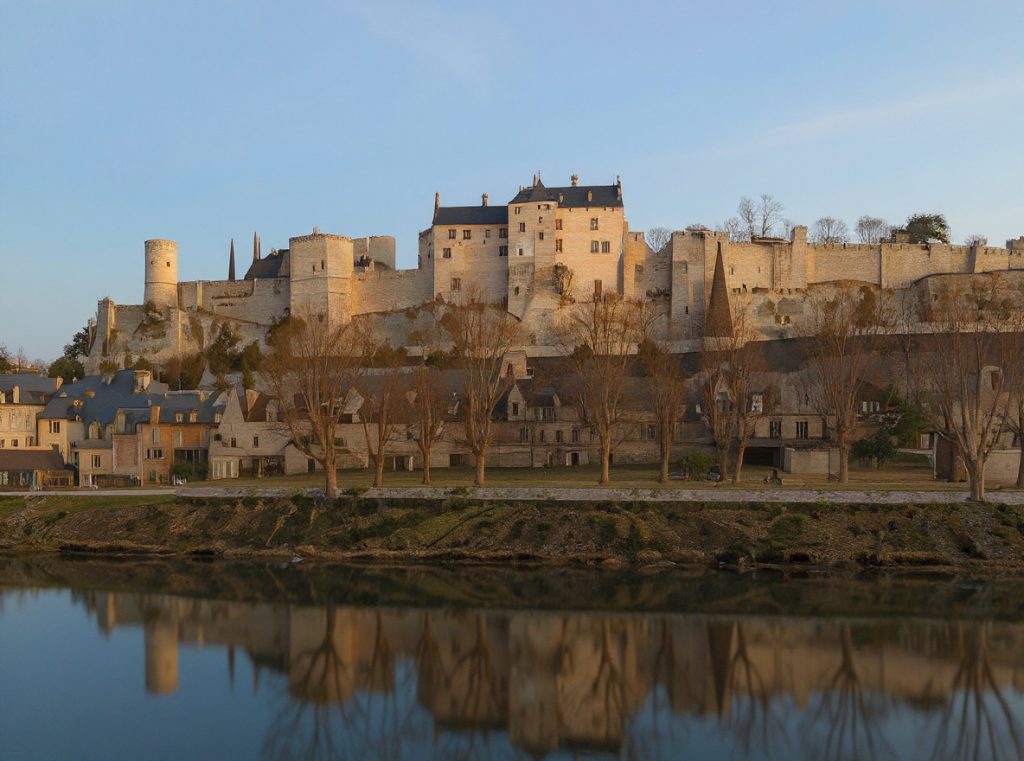
Chinon Castle commands the heights above the Vienne River from a narrow limestone ridge in the Loire Valley. This royal fortress extends nearly four hundred metres along its rocky spur. It encompasses three distinct castle sections separated by deep dry moats. The site witnessed pivotal moments in French and English history, from the death of Henry II Plantagenet to the arrival of Joan of Arc. Today it stands as one of the few genuinely medieval fortresses in a valley where Renaissance châteaux otherwise dominate.
Plan your visit to Chinon Castle
Location of Chinon Castle
Chinon Castle rises above the town of Chinon in Indre-et-Loire, in the Centre-Val de Loire region of France. The fortress overlooks the Vienne River as it flows through the valley before joining the Loire. Chinon sits in the Loire wine country, surrounded by vineyards and whitewashed tufa-stone houses with slate roofs. Visitors reach the castle by climbing the cobbled streets through the medieval town, or by vehicle via the rue du Château. The entrance lies at 4 rue du Château in the town centre. Major cities such as Tours lie about 45 kilometres to the northeast, so the fortress remains accessible yet retains its rural character.
History of Chinon Castle
A Roman fortification stood on the site by the fifth century. Theobald I, Count of Blois, created a stronghold on the Mount of Chinon in the year 954. In the eleventh century the counts of Anjou acquired the castle as their property. In 1156 Henry II of England, a member of the House of Anjou, took the castle from his brother Geoffrey after he had rebelled for a second time. Henry favoured the Château de Chinon as a residence. Most of the standing structure dates from his reign, and he died there in 1189. The king built extensively, so the fortress became one of his principal seats alongside Poitiers and Bordeaux within his vast Angevin empire.
In 1205, after an eight month siege, Philip-Auguste conquered Chinon. France then annexed the province of Anjou. Philippe Auguste built the Coudray Tower after he captured the fortress from King John. Philip strengthened his new prize with fortifications in the French royal style. In August 1308 Philip the Fair, king of France, had guards hold Jacques de Molay, Grand Master of the Knights Templar, and other Templar dignitaries at Chinon. The imprisoned Templars left graffiti still visible on the tower walls. In 1429, the seventeen-year-old Joan of Arc came to Chinon to meet the Dauphin and acknowledge him as the rightful heir to the throne. The meetings in Chinon with the future Charles VII of France and his acceptance of her constituted the turning point of the war. Charles granted her supplies after examining her claims and sent her to join the army at Orléans.
Huguenots held the castle in 1562 and used it as a state prison. In 1631 it passed to the Richelieu family, who owned it until 1789 and let it decay.
Current status
Since 1840, officials have designated the castle a “monument historique”. Today, the Town of Chinon manages Chinon Castle as a major tourist attraction. The Indre-et-Loire departmental council operates the fortress as the Forteresse Royale de Chinon. After a colossal renovation project that lasted six years, workers restored 150 metres of ramparts at the Chinon Royal Fortress. The logis royaux then recovered their fifteenth century Touraine aspect. The site welcomes visitors year-round with varying seasonal hours. Winter months see shorter opening times from 10:00 to 17:00, while summer extends hours from 9:30 to 18:00 or 19:00.
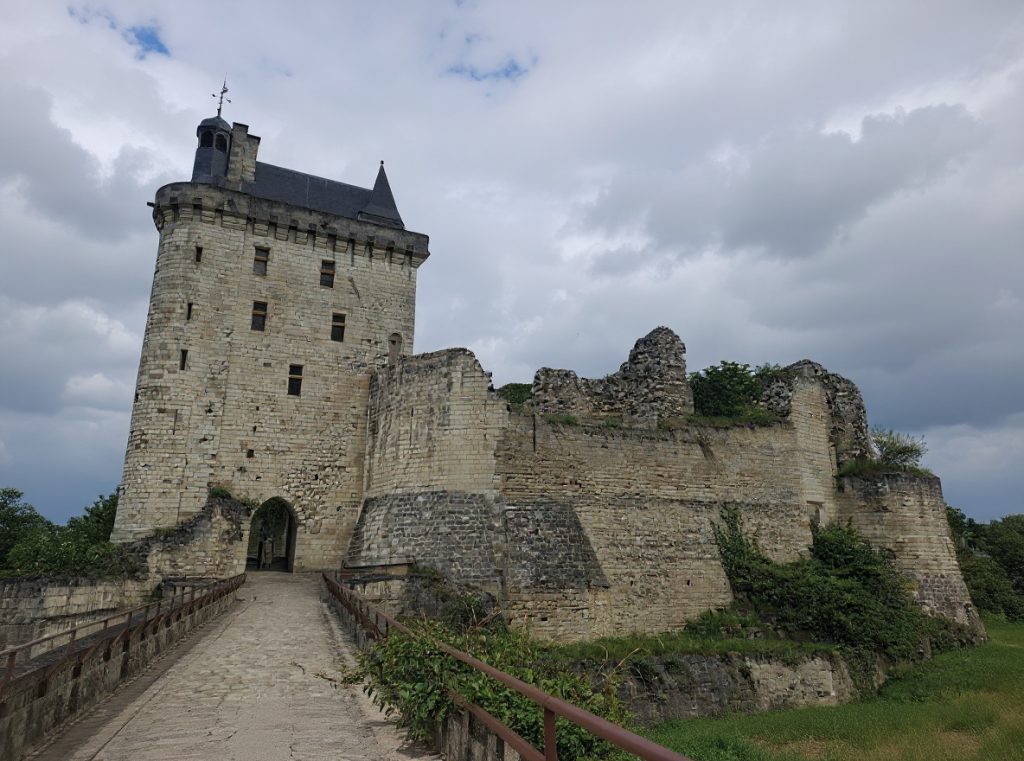
The fortress offers an interactive visitor experience with Histopad augmented reality tablets available in eight languages. These tablets reconstruct royal chambers and historical scenes at different points throughout the complex. The three castle sections remain distinct. Fort Saint-Georges to the east contains reception facilities and gardens where Henry II’s palace once stood. The Middle Castle at the centre holds the royal quarters and the fourteenth-century Clock Tower, which serves as the main entrance. Fort Coudray to the west displays the round tower that Philippe Auguste built. A Joan of Arc museum occupies the Clock Tower, while Templar graffiti remains preserved in the Coudray dungeon. An escape game allows families to explore the fortress through interactive storytelling about the imprisoned Templars.
The fortress stands as one of the Loire Valley’s rare medieval sites amid a sea of Renaissance châteaux. UNESCO has recognised the Loire Valley as a World Heritage landscape, so Chinon contributes its military heritage to the region’s cultural significance. The ramparts offer sweeping views across the Vienne valley, the town below, and the surrounding vineyards that produce the renowned Chinon wines.
Castles near Chinon Castle
Frequently asked questions
What is the historical significance of Chinon Castle?
Chinon Castle was a key royal fortress where Joan of Arc met the future King Charles VII in 1429, a pivotal moment in French history. It also served as a residence for Plantagenet kings including Henry II and Richard the Lionheart.
What is included in the Chinon Castle entry ticket?
Entry includes access to the three fortress sections and a Histopad tablet that offers augmented reality experiences and historical reconstructions. The site features ramparts, towers, royal lodgings and panoramic views over the Vienne valley.
Are guided tours available at Chinon Castle?
Free guided tours lasting 50 minutes are offered year-round in French and English, included in the entry price. Special activities such as underground passage tours and medieval events run during school holidays.
Can I visit Chinon Castle with reduced mobility?
Parts of the site are accessible to visitors with limited mobility, though the fortress sits on a rocky promontory with some uneven medieval terrain. Contact the castle in advance to discuss specific accessibility needs.
Is there a discount for visiting Chinon Castle by train or bicycle?
Yes, visitors presenting a TER Centre train ticket stamped on the day of visit receive a reduced rate. Cyclists who show a photo of themselves with their bike in front of the fortress pay €11.50 instead of €12.50.
Featured listings