
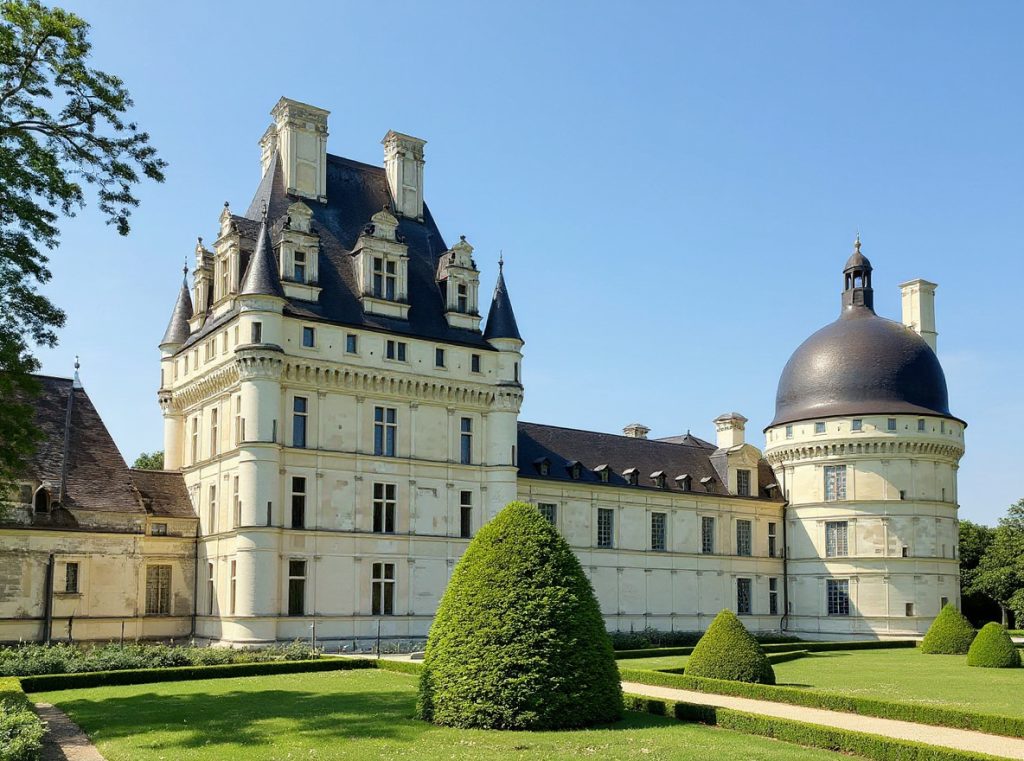
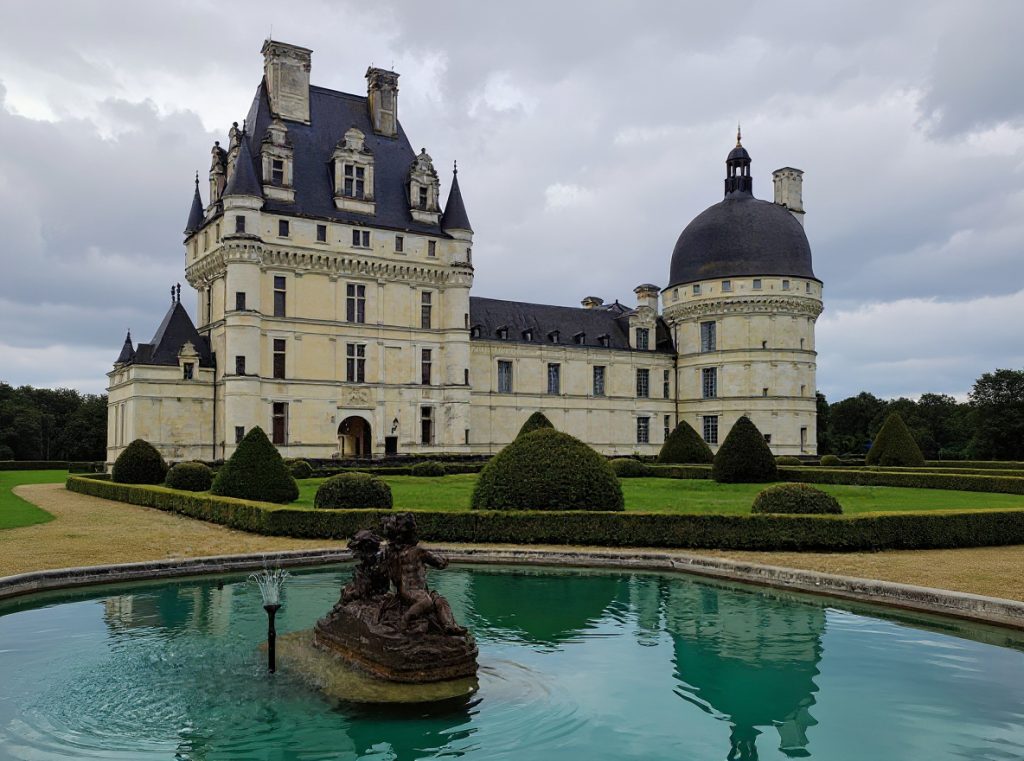
Overlooking the Nahon River valley from a dramatic plateau, Château de Valençay rises with distinctive domed towers and ornate Renaissance stonework. Louis d’Estampes triggered construction around 1520, launching a project his family pursued for two centuries. Charles Maurice de Talleyrand-Périgord, also known as the Prince of Benevento, purchased the château in 1803. Its architecture invites comparison with the Renaissance châteaux of the Loire Valley, notably the Château de Chambord.
Plan your visit to Château de Valençay
Thu 11:00–18:00
Fri–Sun 11:00–20:0028 Mar–27 Nov: 10:00–18:00 (park until 19:00 Jun–Sep); 28 Nov–3 Jan: 11:00–20:00. Closed 25 Dec & 1 Jan.
Location of Château de Valençay
Château de Valençay sits in the commune of Valençay, in the Indre department of France, at 2 Rue de Blois, 36600 Valençay. The château occupies an exceptional position overlooking the Nahon valley. Though located in the historic Berry province, the castle forms part of the greater Loire Valley cultural landscape. Visitors from Paris can reach Valençay in about two and a half hours by car. The château sits accessible from major cities like Tours and Orléans. Orléans lies about 1.5 hours away via the A71 and A85, while Blois takes around one hour via the D956. Free parking awaits outside the château grounds. The local train station at Valençay provides pedestrian access within ten minutes.
History of Château de Valençay
Documents attest to the seigneurie of Valençay from the 13th century, though only the lower medieval hall survives from this era. The fiefdom passed to Robert II d’Estampes in 1451. Builders raised the château on the site of a razed 12th-century manor house. The château displays Renaissance styling with ornate stone adorned with symmetrical windows. A 12th-century castle existed on this site before construction of its replacement began in 1520. The builders completed the large northwest tower first, then half of the west facade and two bays of the north gallery. Workers added other wings in the 17th and 18th centuries. The d’Estampes family bought the manor in 1451 and transformed the château over time, influenced by Renaissance style. They built the north tower, entrance pavilion and two wings. The family extended their ambitious construction through careful marriages and financial alliances.
The owners sold the château in 1747 to Jacques-Louis Chaumont de La Millière. He sold it in 1766 to Philippe-Charles Legendre de Villemorien. This farmer-general invested heavily in restoring and embellishing the estate. The turning point arrived when Napoleon ordered his Foreign Minister to acquire a suitable residence for receiving foreign dignitaries. Talleyrand acquired this château in 1803 on the orders of Napoleon. Napoleon wanted his minister of foreign affairs to receive dignitaries in style. The period of Talleyrand’s occupancy marked the golden age in the history of Valençay. Twenty-three communes reportedly answered to the ruling prince during this time. Spanish princes spent six years confined at the château between 1808 and 1814 as Napoleon’s high-ranking prisoners.
When Talleyrand died in 1838, as he had no known legitimate son, the estate reverted to his great nephew Napoleon-Louis de Talleyrand-Périgord.
Current status
The Syndicat mixte du château de Valençay manages the castle. The château opens daily to visitors throughout most of the year, though it closes on December 25 and January 1. Tickets cost €14.50 for adults, €11.50 for children aged 7-17, EU students, and job seekers, and €5 for children aged 4-6. The fully furnished apartments display Empire, Louis XV and Louis XVI styles across their rooms. The apartments feature sumptuous furnishings, mostly in Empire style but with Louis XV and Louis XVI trappings. A star-footed table in the main drawing room is said to be the one on which diplomats signed the final agreement of the Congress of Vienna in June 1815. Visitors can explore a hidden theatrical gem within the outbuildings, where period instrument concerts sometimes fill the First Empire décor.
In the park, covering more than 50 hectares, visitors can stroll through the French garden, the Duchess’s garden, the Grande Perspective and the Forêt des Princes. Families discover Napoleon’s Great Maze, a mini-farm, and scent games scattered through the gardens. Featuring Renaissance and Classical architecture, it ranks as one of the great sites of the Loire Valley, like its close neighbors Chenonceau and Cheverny. The château hosts regular cultural events including the Talleyrand Festival, paranormal evening tours, and equestrian spectacles throughout the season. Ramps provide ground-floor access for wheelchair users, and adapted facilities serve all visitors. The estate offers a living monument where centuries of French history, diplomacy, and refined taste converge beneath slate domes and Renaissance towers.
Castles near Château de Valençay
Frequently asked questions
What is Château de Valençay famous for?
Château de Valençay was the residence of Talleyrand, Napoleon's minister and diplomat, from 1803. The Renaissance and Classical château hosted illustrious guests and Spanish princes held by Napoleon, and contains Empire furniture and a small theatre built in 1810.
How long does it take to visit Château de Valençay?
Allow 2 to 3 hours for a full visit including the château interiors, museum of automobiles, formal French gardens and the Napoleon labyrinth. Last admission is 45 minutes before closing.
Is Château de Valençay suitable for children?
Yes, children enjoy the large park with French gardens, the Napoleon labyrinth and theatre. Under-4s enter free, ages 4–6 pay €5 and ages 7–17 pay €11.50; pushchairs are allowed in the park.
Can I buy tickets online for Château de Valençay?
Yes, online booking is available at chateau-valencay.tickeasy.com and gives you skip-the-line access at the entrance. Tickets are valid all day and reduced rates apply for students, children and jobseekers.
How do I get to Château de Valençay from Paris?
Drive 247 km via A10 then A85 (about 2.5 hours); free parking on site. By train, travel to Châteauroux station then take bus line LR04 to Valençay, or use the narrow-gauge Train du Bas-Berry line from Romorantin.
Popular right now
Featured listings