

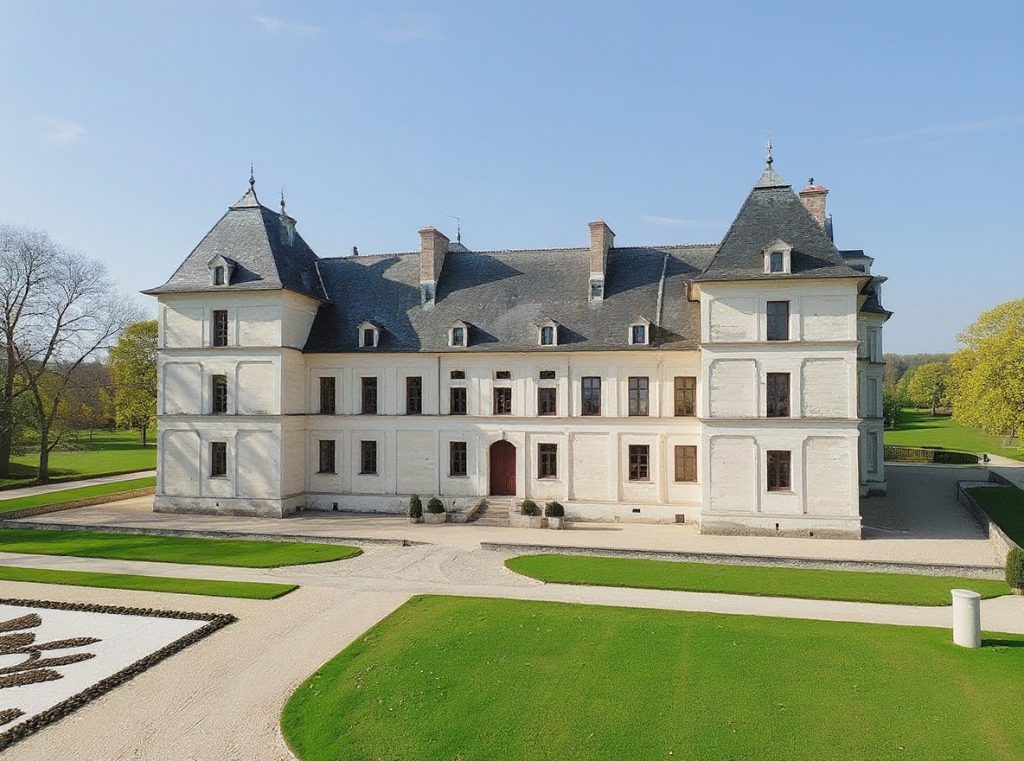
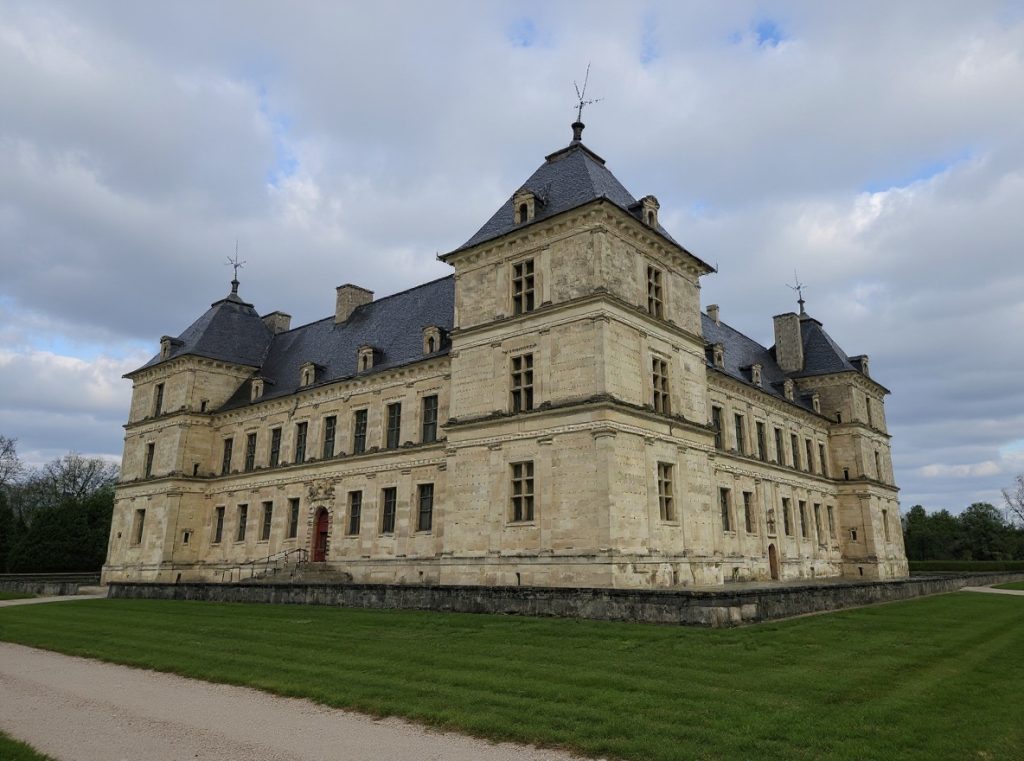
On a flat site in Burgundy’s Yonne department, Château d’Ancy-le-Franc presents a perfectly symmetrical Renaissance palace of exceptional purity. Italian architect Sebastiano Serlio designed this palace on a square plan around a magnificent rectangular courtyard. As a result, he created an architectural landmark that changed French building traditions. The château houses one of the largest collections of wall paintings currently preserved in France. In fact, its frescoes rival those at Fontainebleau. Builders raised this palace between 1542 and 1550 for Antoine III of Clermont-Tonnerre, brother-in-law of Diane de Poitiers. It remains an outstanding example of Italian Renaissance principles adapted to French soil.
Plan your visit to Château d’Ancy-le-Franc
Tue–Sun 10:00–12:30, 2:00–18:00Open 7 Feb–15 Nov 2026, Tues–Sun; hours vary: low season 10:00–12:30, 14:00–17:00; Easter–Oct 18:00 close; Jul–Aug 10:00–18:00
Location of Château d’Ancy-le-Franc
The château stands at 18 Place Clermont-Tonnerre in the town of Ancy-le-Franc, a small commune in the Yonne department of north-central France. It sits between Auxerre and Dijon along the Burgundy Canal and not far from Chablis. The palace occupies an accessible position within the historic lands of the Dukes of Burgundy. It rests in the centre of a large park on the banks of the canal, a few hours from Paris by high-speed train. Visitors travelling by car can reach the palace easily from the A6 motorway. The Burgundy Canal provides a scenic backdrop and allows barge tourists to moor nearby. The surrounding parkland extends across 50 hectares. It blends Renaissance heritage with later classical and romantic garden styles.
History of Château d’Ancy-le-Franc
A 12th-century fort originally occupied the site until the end of the sixteenth century. Antoine III de Clermont inherited the grounds after the death of his mother, Anne de Husson, Comtesse de Tonnerre. He chose to build on blank terrain rather than adapt the old fortifications. At the court of François I this French Lord, Lieutenant General and Grand Maître des Eaux et Forêts, met the renowned Italian architect Sébastiano Serlio. Building started in 1542 and workers completed it in 1550. After Serlio’s death in 1554 at Fontainebleau, architect Pierre Lescot took over the work while respecting the original plans. Francesco Primaticcio, who worked at Château de Fontainebleau at the time, created the interior design.
Antoine de Clermont died in 1578 and his grandson Charles-Henri de Clermont completed the interior. The château hosted prestigious guests including Henry III, Henri IV in 1591, Louis XIII in 1631 and Louis XIV in 1674. In 1683 the Clermont-Tonnerre family sold the château to François-Michel Le Tellier, minister of Louis XIV. Louvois then employed landscape architect André Le Nôtre to create pathways and gardens within the grounds. In 1844 sellers transferred Ancy-le-Franc to Louis Aimé Gaspard de Clermont-Tonnerre, a descendant of Antoine III. The château then passed between various hands, including the princes of Merode. Since 1999 the property has belonged to Société Paris Investir SAS, which has undertaken extensive restoration projects.
Current status
The private company which owns the château undertook its restoration and secured recognition as a national historical monument. Authorities designated the property as a historic monument in 1983, with reaffirmation in 2003. Visits to the estate run from 7 February to 15 November, Tuesdays to Sundays and all public holidays. The château opens to the public for self-guided, guided or audio tours. Visitors can explore more than twelve principal rooms, including the famous Chambre des Nudités and Chambre de Diane. The 32-metre Pharsale Gallery displays a dramatic ancient battle scene. The château regularly hosts art exhibitions, classical concerts, and cultural events throughout the season.
The formal gardens, partially restored since 2016, echo the palace’s geometric precision. Renaissance costumes and games are available for children during tours. Four equal wings rise around the sculpted Cour d’Honneur, where arcades, niches and ribbed columns demonstrate Serlio’s mastery. The plain limestone exterior gives way to richly decorated apartments inside. There, coffered ceilings, marble floors and mythological frescoes transport visitors through five centuries of aristocratic life. This palace continues to reveal why Serlio’s radical symmetry influenced French architecture for generations.
Castles near Château d’Ancy-le-Franc
Frequently asked questions
What makes Château d'Ancy-le-Franc architecturally significant?
Château d'Ancy-le-Franc is a Renaissance masterpiece designed by Italian architect Sebastiano Serlio for King François I's court. It houses one of the largest collections of 16th- and 17th-century wall paintings currently preserved in France.
Can I visit Château d'Ancy-le-Franc without a guided tour?
Yes, self-guided visits are available with brochures in 11 languages or audio guides (€3 extra). Guided tours are also offered at set times for those who prefer a commentary.
What are the opening months for Château d'Ancy-le-Franc?
The château is open to individual visitors from 7 February to 15 November 2026, Tuesday to Sunday and public holidays. It is closed Mondays (except bank holidays) and from mid-November through early February, though group visits can be arranged year-round by appointment.
Are the gardens at Château d'Ancy-le-Franc worth visiting?
Yes, the 50-hectare park includes French and English gardens, an 18th-century folly, ponds, century-old trees, and two new parterres that won awards at the Victoires du Paysage 2018. A combined ticket for château and park is recommended.
How do I reach Château d'Ancy-le-Franc by public transport?
The nearest railway station is Montbard (27 km), served by TGV trains from Paris and regional TER services. From Montbard, you need a taxi to reach the château, as there is no direct bus service.
Featured listings