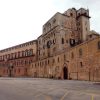
Rising from the highest point in Palermo, Palazzo dei Normanni holds the distinction of being Europe’s oldest royal residence. The original fortress, known as al-Qasr, took shape in the ninth century under the Moorish Emirate of Sicily. After the Norman conquest of Sicily in 1072, the Normans established Palermo as capital and chose the palace as their main residence. Layer upon layer of history converges within these walls, from Phoenician-Punic foundations through Byzantine, Arab, Norman, Spanish and modern eras.
Plan your visit to Palazzo dei Normanni
Sun 08:30–12:30
Location of Palazzo dei Normanni
The palace sits at the exact centre of Palermo’s first urban site, on the highest point of the city. Visitors find it at Piazza del Parlamento, 1, 90134 Palermo, within the historic centre. It stands at the western edge of the old city, next to Porta Nuova. The cathedral and the Quattro Canti crossroads lie a short walk east. Multiple bus routes serve the area, so public transport connections make access straightforward for visitors exploring Sicily’s capital.
History of Palazzo dei Normanni
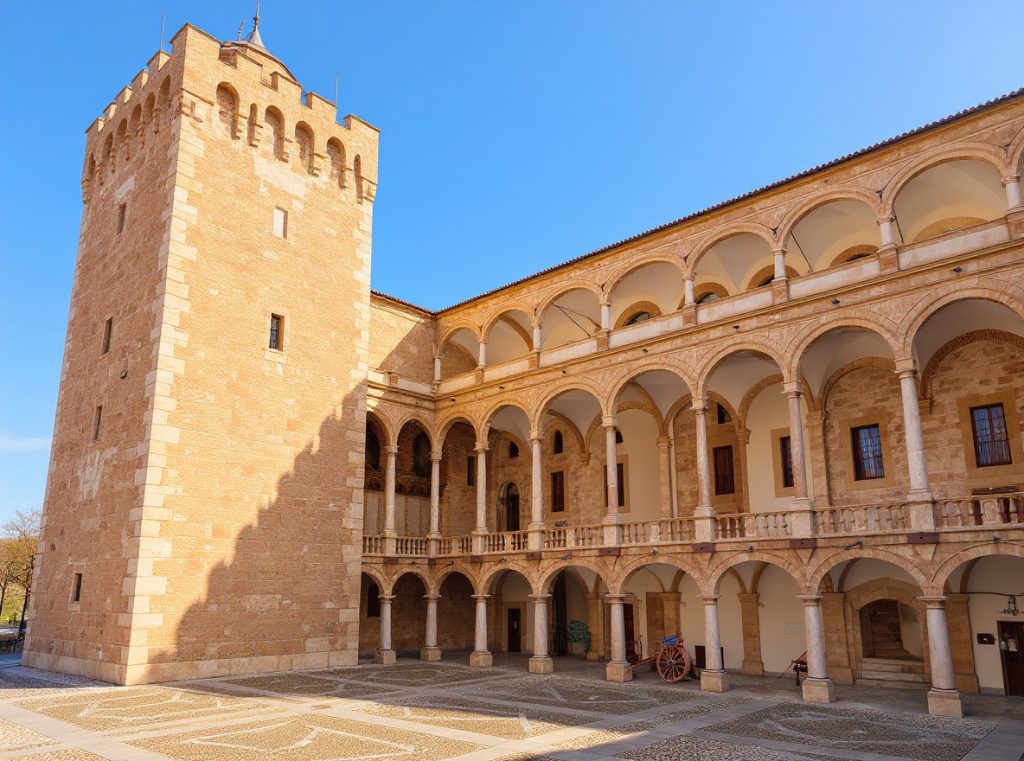
Arab rulers built the earliest structure during the ninth century when Sicily lived under Islamic rule. The Emir of Palermo started the first building, the Qasr, which means castle or palace in Arabic. Typical Arabian vaults still remain visible in the foundations and basements. In 1130, the first Norman king of Sicily, Roger II, decided to use the building as his residence. As a result, work began to adapt the defensive fortress for its new purpose. In 1132 Roger II constructed the central section of the palace. This section included the large Rogerian Apartment, the Palatine Chapel, and the Joharia Tower. Workers completed the famous chapel in 1140.
The Norman kings transformed the former Arabian palace into a multifunctional complex with administrative and residential aims. They linked all buildings via arcades and enclosed them with gardens. The best gardeners of the middle east designed these gardens. This period of splendour continued under Emperor Frederick II, whose court played a leading cultural role in Italy and Europe. Once the Normans abandoned the palace, it remained untouched until the sixteenth century when restorers revived it. After centuries of neglect, in 1555, the palace became the residence of the Spanish viceroys. Workers dismantled the military structures and built magnificent porticoed inner courtyards. In 1616 they added the Renaissance-style facade that looks onto Piazza del Parlamento.
The Spanish viceroys undertook significant reconstructions to meet their representational and military needs. They added a system of bastions as part of these changes. The House of Bourbon built additional reception rooms in the eighteenth century. In the nineteenth century, restorers plastered the exterior in the pseudo Arab-Norman style visible today. After Italian unification, the palace became property of the army corps command.
Current status
Since 1946 the palace has served as the seat of the Sicilian Regional Assembly. The Sicilian Regional Assembly operates from the Sala d’Ercole, so the building functions as a living political centre as well as a historical landmark. Arab emirs fortified the site around the tenth century. Norman kings adapted it into a royal seat in the twelfth century. Spanish viceroys restructured it in the sixteenth and seventeenth centuries. The palace has housed the Sicilian Regional Assembly since 1947. The palace and its chapel form part of the UNESCO World Heritage Site “Arab-Norman Palermo and the Cathedral Churches of Cefalù and Monreale,” which gained inscription in 2015.
Opening hours vary by day and season, with shorter hours on Sundays. Because of this, checking the official website or contacting the site directly at +39 091 7055611 makes sense. Visits to the royal apartments, which close from Tuesday to Thursday, take in the mosaic-lined Sala dei Venti and King Roger’s twelfth-century bedroom, Sala di Ruggero II. The palace contains the Cappella Palatina, by far the best example of the Arab-Norman-Byzantine style that prevailed in twelfth-century Sicily. The chapel displays wonderful mosaics, a wooden roof elaborately fretted and painted, and marble incrustation of the lower walls and floor. The palace continues to fulfil its ancient role as a seat of governance while welcoming visitors from across the globe. These visitors come to witness the remarkable fusion of cultures etched into its stones and mosaics.
Castles near Palazzo dei Normanni
Frequently asked questions
What are the opening hours for Palazzo dei Normanni?
Monday to Saturday 08:30–16:30 (last entry), Sunday and public holidays 08:30–12:30. The palace is closed 25 December and 1 January.
Can I visit the Royal Apartments at Palazzo dei Normanni every day?
No, the Royal Apartments are closed on Tuesdays and Wednesdays when the Sicilian Regional Assembly meets. On these days, only the Palatine Chapel and Royal Gardens are accessible at a reduced ticket price.
Is the Palatine Chapel inside Palazzo dei Normanni?
Yes, the 12th-century Palatine Chapel is located inside the palace and is included in the ticket. It is renowned for its exceptional Byzantine golden mosaics and is a UNESCO World Heritage Site.
Should I book tickets for Palazzo dei Normanni in advance?
Online booking is strongly recommended from May to October and on public holiday weekends. Queues of 30 to 60 minutes are common in high season without a reservation.
What is the best time to visit Palazzo dei Normanni to avoid crowds?
Arrive right at opening time (08:30) on a weekday morning to avoid tour groups. Sunlight enhances the chapel mosaics before midday, and the site becomes busier after 10:00.
Popular right now
Featured listings