
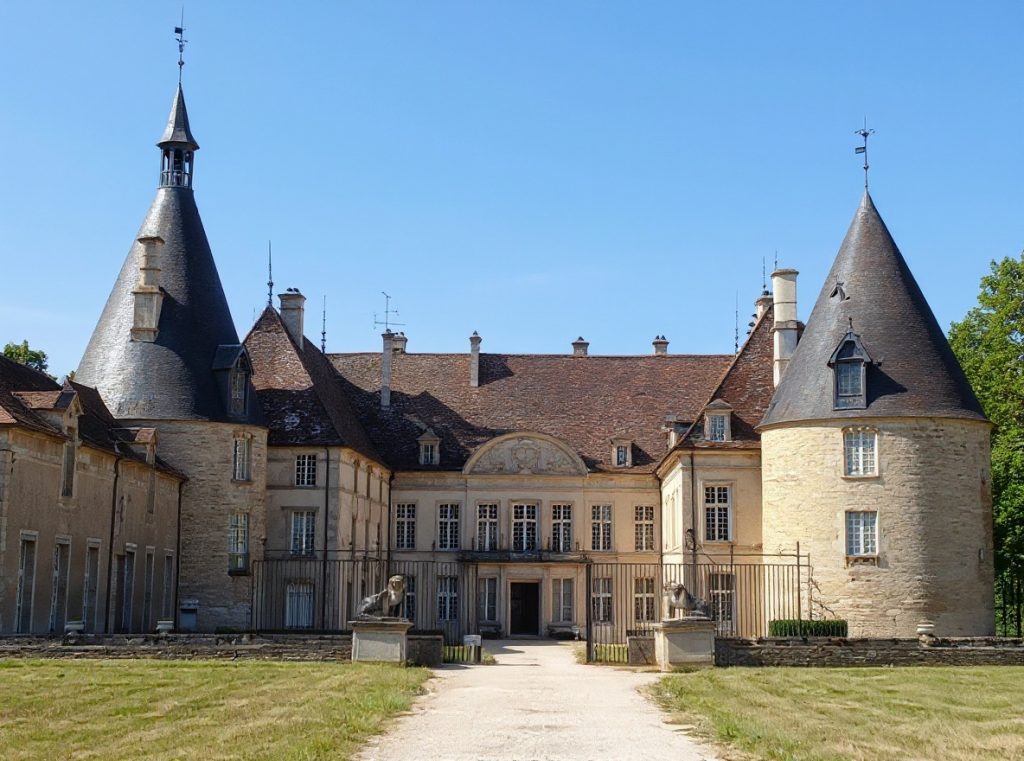
Wide water-filled moats surround Château de Commarin in Burgundy, where it ranks among France’s most authentic historic estates. The same family has owned this remarkable château for 26 generations since the 13th century, so no one has ever sold or looted it. Its harmonious blend of medieval towers, Renaissance wings and classical symmetry tells a story of architectural evolution across seven centuries.
Plan your visit to Château de Commarin
Tue–Wed Closed
Thu–Sun 10:00–18:00Open from 28 March to end of October half-term 2026, Thu–Mon 10:00–18:00 (closed Tue–Wed, except 14 July)
Location of Château de Commarin
The château sits in the commune of Commarin in Côte-d’Or, eastern France. It lies in the south of the Auxois region, 40 kilometres west of Dijon and four kilometres from Châteauneuf. Visitors can reach the estate via Route Départementale 977b. The château stands equidistant from Dijon and Beaune, and from Montbard and Semur-en-Auxois. The site occupies a commanding position in the countryside, where its elegant facades reflect in the broad moat waters that isolate it from the surrounding park.
History of Château de Commarin
Though the site probably began as a Gallo-Roman villa, Commarin first appears in a document of 1214 as a maison forte. Its lords descended from cadets of the lords of Sombernon, who came from the first line of the Dukes of Burgundy. Jean de Cortiamble inherited the estate in 1346, then rebuilt the castle at the century’s end. His son Jacques extended it by adding two round towers and the chapel. Jacques accompanied John the Fearless to the crusade of Nicopolis and spent two years raising ransom money after his captors seized him.
When Jacques died in 1427, his son-in-law Jean de Dinteville inherited the castle through marriage to Jacques’ daughter. Later, Commarin passed to the Vienne family. In the 16th century, builders transformed Commarin with many new buildings. The chapel received decorative sculptures and a terracotta tomb, while weavers created heraldic tapestries around 1515–22 that alternated family armorials with alchemical symbols.
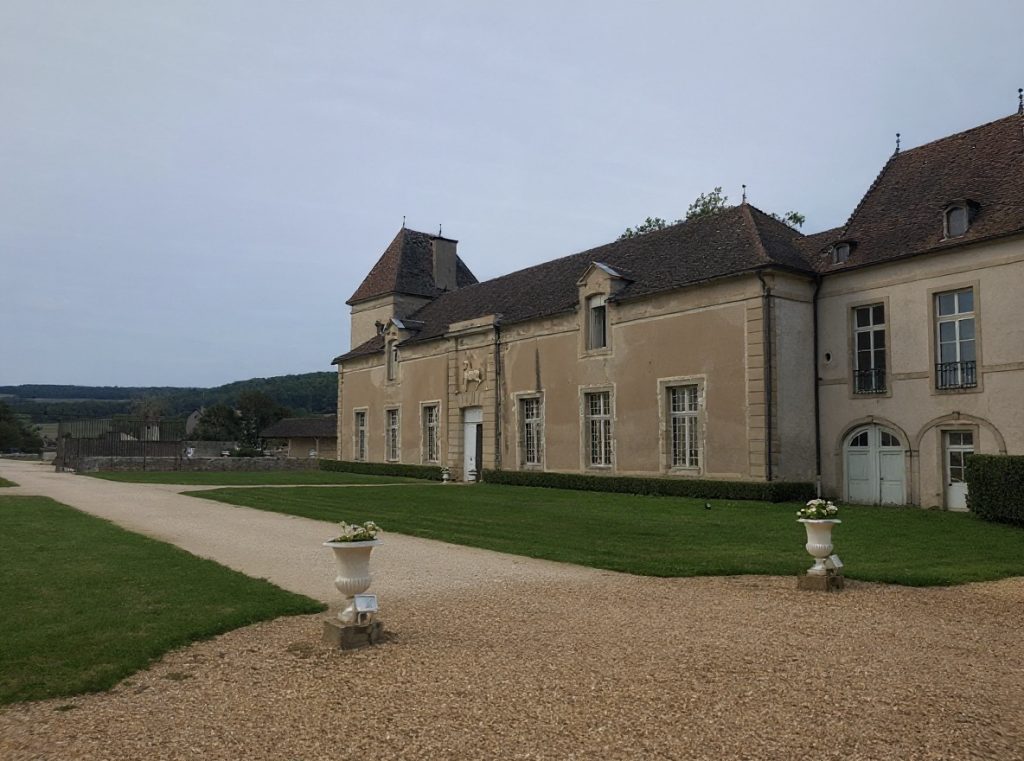
In the 17th and 18th centuries, owners rebuilt parts of the castle within its ancient moat-surrounded walls. Charles de Vienne rebuilt the east wing at the century’s start, then demolished the north wing to create a U-shaped house enclosing a north-facing courtyard. Philippe Paris, a Dijon architect, reconstructed the central corps and west wing between 1702 and 1713 after a tower collapsed. Marie-Judith de Vienne, Marquise d’Antigny and grandmother of Talleyrand, furnished the château in the 18th century. Her apartments remain intact today. Magnificent stables rose on the site of a former jeu de paume.
The estate survived the French Revolution protected from pillage, so it retained its contributions from all generations and its magnificent parquet floors and tapestries. In the 19th century, the formal French gardens gave way to a fashionable English landscape park.
Current status
Officials classified the château as a Monument Historique in 1949. It has passed through 26 generations in the same family and today serves as a seat of the comte de Vogüé. The estate holds membership in the Route Historique des Ducs de Bourgogne and the Association des Châteaux de Bourgogne Franche-Comté. Still inhabited, Commarin offers visitors the experience of a living château elegantly furnished in 18th-century style.
Commarin displays a unique set of family heraldic tapestries from the early 16th century, alongside fine furniture and rich 17th- and 18th-century decoration. The collection includes paintings from Italian and French schools and a 16th-century terracotta Entombment. The symmetrical building of classical inspiration presents a central residence flanked by two wings—a Louis XIII wing to the east and a Louis XIV wing to the west—each terminated by a large round medieval tower. This remarkable architectural blend preserves towers and a magnificent 14th-century chapel among later developments.
The château opens to visitors seasonally, when guided tours reveal the furnished apartments, stables and kitchens. Water still fills the moat that encircles this graceful residence, where centuries of unbroken family stewardship have preserved an exceptional window into Burgundian noble life.
Castles near Château de Commarin
Frequently asked questions
Has Château de Commarin always been owned by the same family?
Yes, the château has belonged to the same family for over 900 years and has passed through 26 generations. It has never been sold and was not looted during the French Revolution, which is extremely rare for French castles.
Can I visit the interior of Château de Commarin without a guided tour?
The interior is typically visited by guided tour, which runs regularly throughout the day. Tours are conducted in French, but printed guides are available in English and other languages.
What can I see in the grounds of Château de Commarin?
The 5-hectare park features century-old trees, moats with carp, and water features. You can visit the park separately or combine it with the castle tour, and dogs on leads are welcome for a €1 contribution.
Is Château de Commarin open year-round?
No, the château is seasonal. For 2026 it opens from 28 March until the end of October half-term, Thursday to Monday from 10:00 to 18:00, and is closed on Tuesdays and Wednesdays (except 14 July).
What makes Château de Commarin historically significant?
The château was redecorated in the 18th century by the Marquise d'Antigny, grandmother of Talleyrand, Napoleon's foreign minister. It retains exceptional original furnishings, 16th-century heraldic tapestries, and a 14th-century chapel, offering an authentic glimpse into French noble life.
Featured listings