
Rising from a rocky promontory above the Auxois plain, Château de Châteauneuf commands sweeping views across the valley where the Burgundy Canal now winds through fertile lowlands. This vast stone fortress measures 75 metres in length and 35 metres broad. It sits within one of France’s most beautiful villages. The fortress ranks as one of the last medieval fortifications preserved in this condition. For more than eight centuries, the castle has watched over the southern marches of Auxois. Its powerful walls and towers reflect the ambitions of dukes, knights and noble families.
Plan your visit to Château de Châteauneuf
Tue–Sun 09:45–12:30, 2:00–17:30July–August 09:45–12:30, 14:00–18:00; rest of year closes 17:30.
Location of Château de Châteauneuf
The castle stands in the commune of Châteauneuf, 43 kilometres from Dijon, in the Côte-d’Or département. The fortress sits on a rocky outcrop 475 metres above the surrounding plains. It dominates the valley of the Canal de Bourgogne. Visitors travelling by car can reach the village via regional roads that climb from the canal valley to the castle. Cyclists can take the Burgundy Canal cycle path and exit at Rèpe, between Pont de Bois and Vandenesse-en-Auxois. The medieval village spreads below the fortress walls. Its stone houses and narrow lanes create an atmospheric approach to the castle gate. Free parking serves visitors near the village entrance, while a bicycle rack sits at the site entrance.
History of Château de Châteauneuf
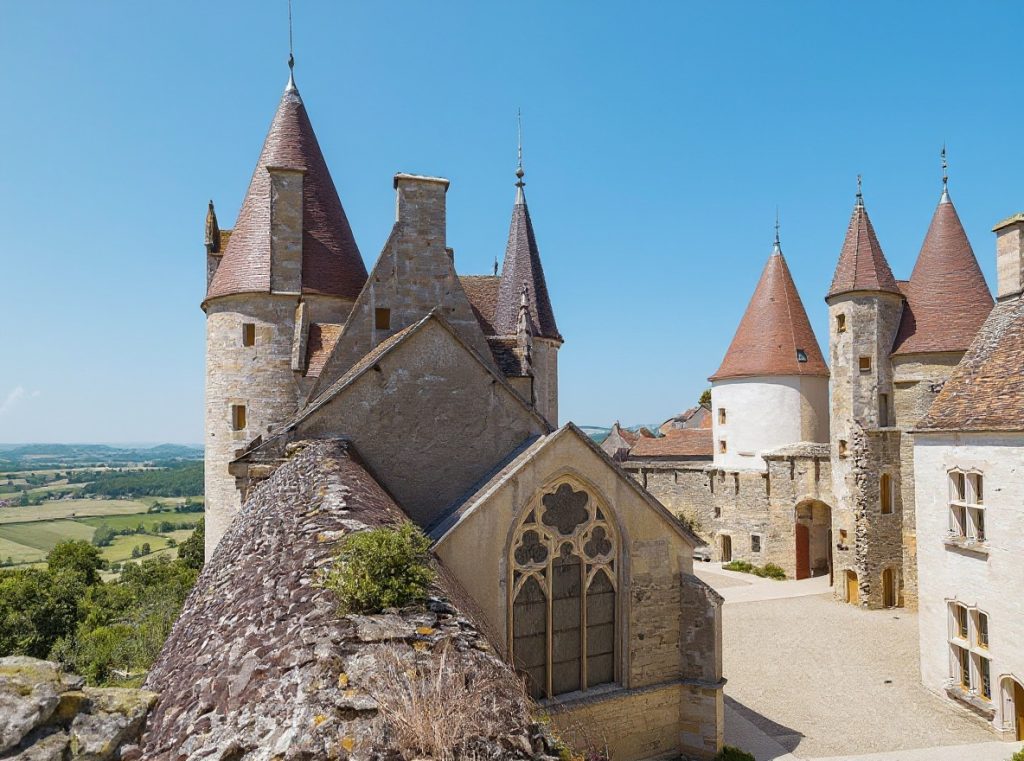
The castle’s history begins in 1175 when builders raised a keep on this promontory. Jean de Chaudenay built the castle for his son Jehan. Jehan took possession in 1175 and became Jean I de Châteauneuf. Builders raised a sumptuous chapel in the 13th century. Wooden buildings gave way to stone construction as the keep took its permanent form. In the 14th and 15th centuries, builders fortified the castle with powerful walls and five defensive towers. The threat of the Hundred Years’ War loomed over the region then.
After nine generations, the Châteauneuf line ended in tragedy when Catherine de Châteauneuf died in 1456. Executioners burnt her alive for poisoning her second husband. Around 1460, Philippe Pot, Seigneur de la Roche, became the owner. He served as private adviser to Duke Philip the Good of Burgundy and belonged to the Order of the Golden Fleece. Philippe Pot rebuilt the fortress, refurbished the chapel, and decorated it entirely with 15th-century murals depicting Christ and the apostles. The Great Hall’s monumental fireplace still bears his motto “Tant L Vault”, dedicated to the Virgin Mary.
From the 16th century onwards, prominent families including the Montmorency and Vienne families owned the château. In the 18th century, classical alterations partially changed the medieval structure. The castle received Historic Monument status in 1894. Then Georges de Vogüé gave it to the state in 1936. Collections grew with fine additions, notably a suite of seven 17th-century tapestries depicting episodes in the life of Moses.
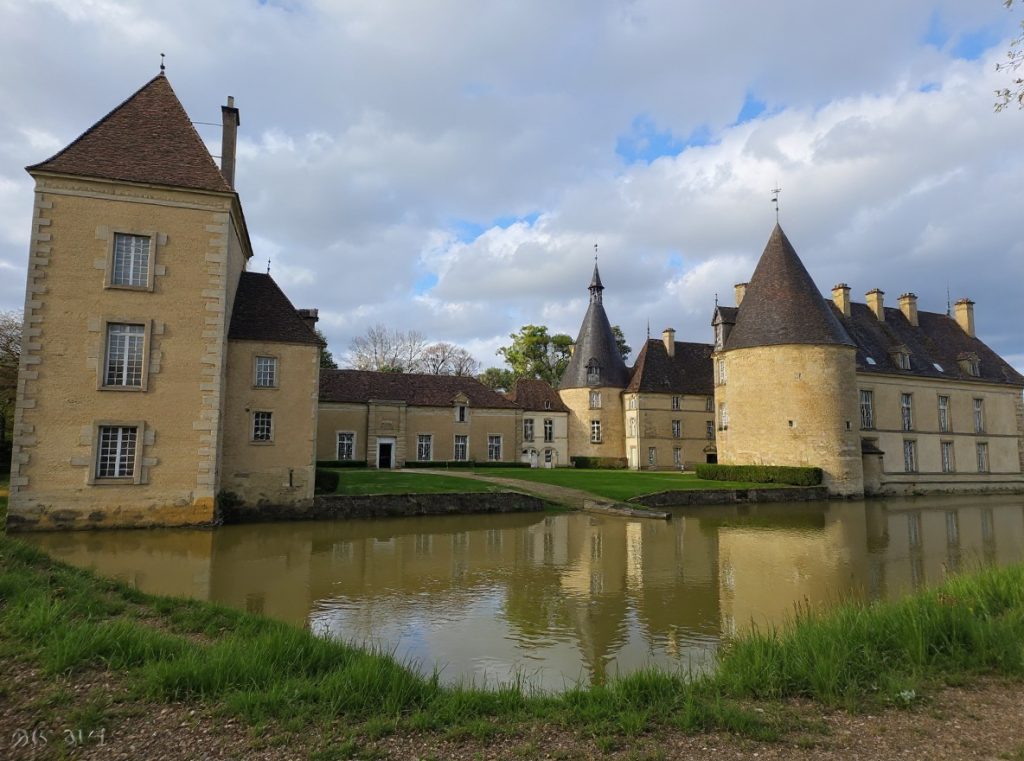
Current status
In 2008, the Burgundy-Franche-Comté Region volunteered to continue restoring the château. This made it the centrepiece of a heritage and cultural project. An unprecedented restoration campaign ran from 2022 to 2024. This work resulted in improvements to the visitor experience, including a new reception area and shop. Disabled access now covers most of the site, and new museum areas have opened. The castle opens to visitors all year round, yet closes on Mondays and select holidays. From September to June it opens from 9.45am to 12.30pm and from 2pm to 5.30pm. July and August hours extend to 6pm.
The castle offers guided tours in French and English. Visitor brochures come in German, Dutch, Spanish, Italian, Russian, Japanese, Polish, Portuguese, Czech, Chinese, Hebrew and Arabic. Beyond tourism, the château forms part of the region’s identity and collective memory through visits, activities, summer events, exhibitions and archaeological research. Apart from interior alterations over the centuries, the château has retained its medieval character. From the ramparts, visitors gaze across the vineyards and rolling hills of Burgundy. The canal traces its course through the valley far below. Stone and history blend here, where restoration breathes new life into ancient walls while honouring the fortress. This castle has stood watch for more than 800 years.
Castles near Château de Châteauneuf
Frequently asked questions
What can I see inside Château de Châteauneuf?
The castle features a 15th-century chapel with murals depicting Christ and the apostles, the Grand Logis with furnished medieval apartments, a collection of seven 17th-century Flemish tapestries showing the life of Moses, and a replica of Philippe Pot's tomb. The interpretation centre in the restored Logis des Hôtes uses multimedia displays to explain the castle's history.
Who was Philippe Pot at Château de Châteauneuf?
Philippe Pot became owner of the castle in 1456 after the Duke of Burgundy granted it to him. He was a Knight of the Golden Fleece and advisor to Duke Philip the Good, and he transformed the fortress by adding luxurious Gothic decorations, the chapel, and residential buildings that are still visible today.
Is Château de Châteauneuf suitable for visitors with mobility issues?
The ticket office, courtyard, Logis des Hôtes interpretation centre, Philippe Pot tower, and medieval garden are wheelchair accessible following 2024 renovations. However, the belvedere and flamboyant tower are not accessible, and the Logis de Philippe Pot is only partially accessible (ground floor only).
Can I visit the village of Châteauneuf-en-Auxois without entering the castle?
Yes, the village itself is free to explore and is listed as one of the most beautiful villages in France. The medieval streets feature fine stone houses from the 15th and 16th centuries, artisan shops, restaurants, and the 16th-century church of Saint-Jacques et Saint-Philippe.
Are guided tours available at Château de Châteauneuf?
Yes, guided tours are available including 'L'Essentielle' (45 minutes), tours of the castle and gardens (60 minutes), and tours of the castle and attic spaces (60 minutes). Reservations are required for all guided tours, and various themed tours and family activities are offered throughout the year.
Featured listings