In Dresden’s old town, Dresden Castle rises from centuries of Saxon royal history as one of Germany’s most architecturally diverse palace complexes. This former residence of the powerful Wettin dynasty blends Romanesque origins with Renaissance grandeur and Baroque opulence. Today the castle serves as a magnificent museum complex because it showcases treasures that once belonged to Saxon electors and kings. The castle stands among Dresden’s most significant landmarks and draws visitors to its treasure chambers and historic halls.
Plan your visit to Dresden Castle
Tue Closed
Wed–Sun 10:00–17:00
Location of Dresden Castle
Dresden Castle sits at Taschenberg 2 in Dresden’s Innere Altstadt district. The castle occupies a central position near other famous landmarks including the Zwinger palace and the Semperoper opera house. Visitors can reach the complex easily from Dresden’s main railway station, located about 1.5 kilometres away. Tram lines converge on the nearby Altmarkt and Theaterplatz stops. Dresden lies along the Elbe River in eastern Germany, and the castle forms part of the city’s reconstructed historic core. The surrounding Altstadt streets offer pedestrian-friendly access to the castle gates. Public transport connections throughout Dresden make the castle accessible from all city districts. The castle’s central location allows visitors to combine their visit with walks through Dresden’s baroque quarter.
History of Dresden Castle
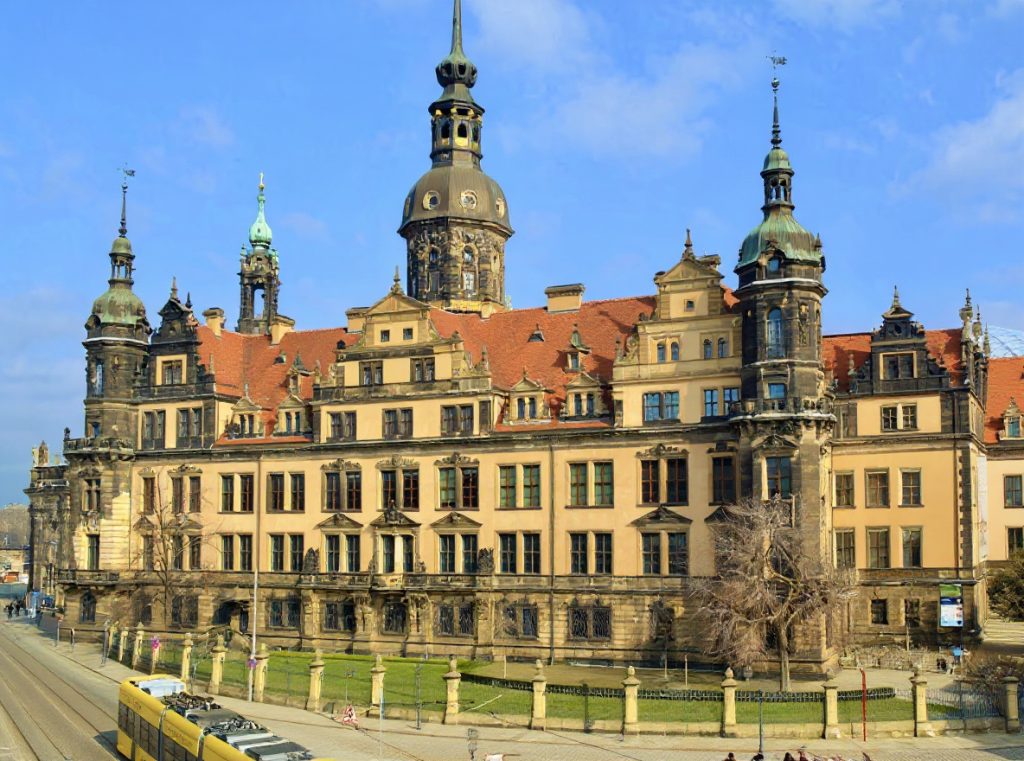
Builders raised the original castle as a Romanesque keep around 1200. In the 13th century the site functioned as a fortress with five towers, serving as the residence of Saxony’s rulers. Between 1468 and 1480 the master builder Arnold von Westfalen extended the keep into an enclosed four-wing construction. In the middle of the 16th century builders added sections in the Saxon Renaissance style. For almost 400 years the castle served as the residence of the electors from 1547 to 1806 and the kings from 1806 to 1918 of Saxony.
A major fire in 1701 destroyed large sections, after which Augustus II the Strong rebuilt much of the castle in the Baroque style. Augustus created collection rooms in the western wing, including the Silver Room, Heraldic Room and Pretiosensaal from 1723 to 1726. He then added the Jewel Room, Ivory Room and Bronze Room from 1727 to 1729. Between 1889 and 1901 the castle underwent further renovations celebrating the 800th anniversary of the House of Wettin. These renovations gave the exterior its Neo-Renaissance appearance. Modernizations in 1914 brought in-floor heating and electric lights to the complex.
On 13 February 1945 Allied bombing of Dresden reduced most of the castle to a roofless shell. For fifteen years after the war no rebuilding occurred except for a temporary roof installed in 1946. Restoration began in the 1960s with new windows. Comprehensive reconstruction started in 1985 to recreate the complex as a museum centre. Workers completed most work by 2006 for Dresden’s 800-year anniversary.
Current status
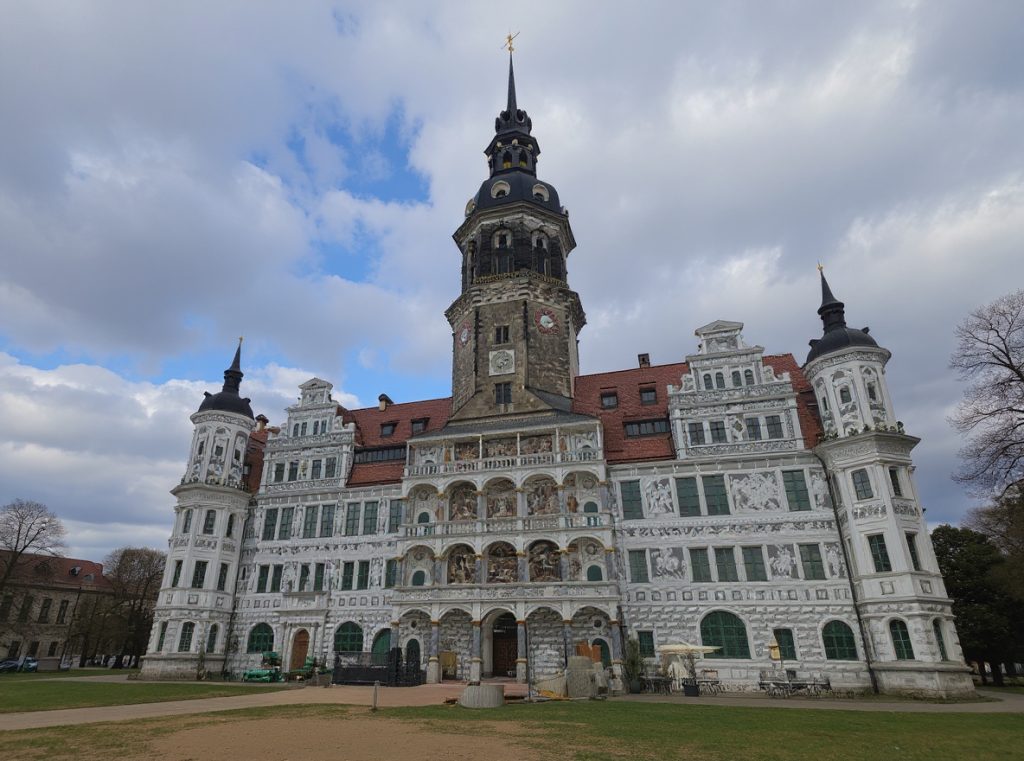
The Free State of Saxony owns Dresden Castle, which forms part of the Dresden State Art Collections. The castle houses five museum sections including the Historic Green Vault and New Green Vault, the Numismatic Cabinet, the Collection of Prints and Drawings, and the Dresden Armoury with its Turkish Chamber. The Historic Green Vault on the ground floor requires advance booking, while the New Green Vault on the second floor allows unrestricted admittance. Standard admission costs 14 euros, with reduced tickets at 10.50 euros. The castle opens Tuesday to Sunday from 10 AM to 6 PM. It closes on Mondays except public holidays. Guided tours run on Fridays, Saturdays and Sundays. Restoration of the castle continues, and State Apartments reopened in September 2019.
The museums display extraordinary collections spanning centuries of Saxon court culture. Visitors explore halls where electors once governed and view ceremonial weapons, coins, prints and priceless treasures. The Hausmannsturm tower offers panoramic views across Dresden’s skyline. The castle connects Saxon history with contemporary museum practice because it preserves the legacy of one of Europe’s most powerful dynasties while welcoming guests from across the world.
Castles near Dresden Castle
Frequently asked questions
What ticket do I need to visit Dresden Castle?
A standard ticket (€18) covers most museums including the New Green Vault, armoury and Turkish Chamber. The Historic Green Vault requires a separate timed ticket (€18) that must be booked in advance due to limited capacity.
What are Dresden Castle's opening hours?
Dresden Castle is open Monday 10:00–17:00 and Wednesday to Sunday 10:00–17:00. It is closed on Tuesdays.
Can I climb the tower at Dresden Castle?
Yes, the Hausmannsturm tower is included in general admission and open from late March to early November. The 327-step climb takes 15–20 minutes and offers views over Dresden's old town.
How do I get to Dresden Castle by public transport?
The castle is centrally located, just 5 minutes' walk from Dresden Hauptbahnhof. Tram lines 1, 2, 4 and 8 stop at Postplatz, a short walk from the entrance.
Is Dresden Castle suitable for children?
Yes, children and young people under 17 enter free. The armoury and treasure chambers can engage children, though the Historic Green Vault requires quiet viewing and may suit older children better.
Featured listings