
Rising from a volcanic basalt outcrop 150 feet above the North Sea, Bamburgh Castle commands one of the most dramatic coastal positions in England. For over fourteen centuries this fortress has stood watch above the windswept beaches of Northumberland. The castle’s massive walls and Norman keep create an unmistakable silhouette visible for miles along the coast. As the ancient seat of Northumbrian kings and witness to countless battles, Bamburgh tells the story of England’s turbulent northern frontier.
Plan your visit to Bamburgh Castle
Location of Bamburgh Castle
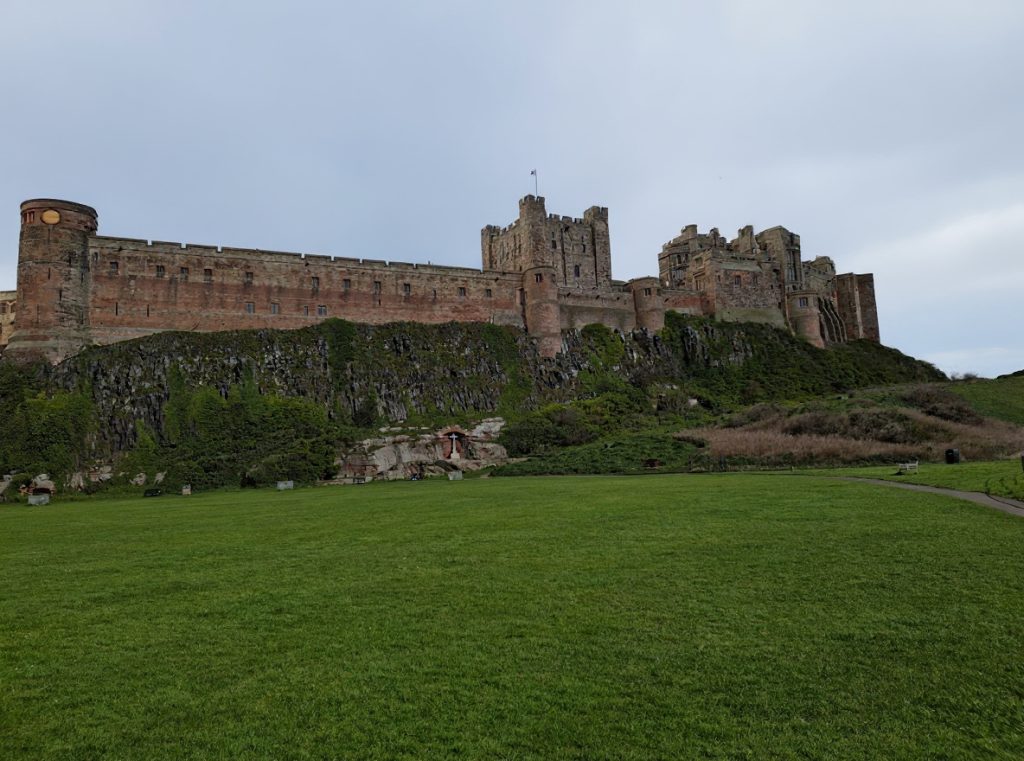
Bamburgh Castle sits atop a massive dolerite crag in the village of Bamburgh, Northumberland, on England’s northeast coast. The outcrop forms part of the Whin Sill, the same volcanic ridge that carries Hadrian’s Wall inland. From this natural fortress, views extend north to Holy Island and Lindisfarne Castle, while the Farne Islands lie offshore to the east. The Cheviot Hills roll westward across the landscape.
The castle stands within the Northumberland Coast Area of Outstanding Natural Beauty. Bamburgh village lies immediately below the castle on its landward side. Expansive sandy beaches stretch north and south along the shoreline. The site sits approximately 30 minutes by car from Alnwick, 10 minutes from Seahouses, and about an hour from Newcastle. The A1 road provides the main access route to the region. The castle’s elevated position makes it visible from considerable distances across both land and sea.
History of Bamburgh Castle
Celtic Britons first fortified this crag around 420 CE, creating a stronghold known as Din Guarie. The site may have served as the capital of the kingdom of Bernicia for over a century. In 547, King Ida of Bernicia captured the fort and built a timber palisade, establishing it as his royal seat. This marked the first written reference to the castle and the beginning of its role as a major Anglo-Saxon power centre.
Around 600, King Æthelfrith gave the fortress to his wife Bebba, and it became known as Bebbanburh. King Oswald of Northumbria used Bamburgh as his base in the seventh century when he invited Saint Aidan to preach nearby. This brought Christianity to the kingdom. A basilica stood within the castle walls, housing relics of the venerated King Oswald after his death. The fortress changed hands between Britons and Anglo-Saxons several times before Anglo-Saxon control became permanent in 590.
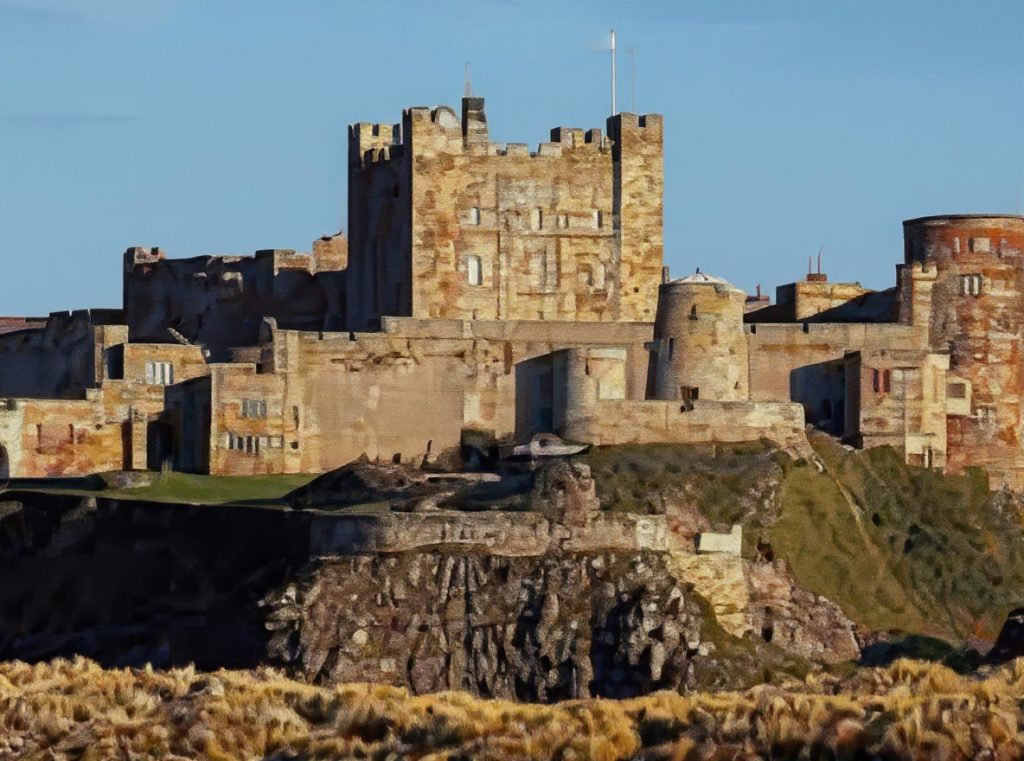
The Normans recognized Bamburgh’s strategic value after 1066 and began transforming the timber fort into a stone castle. In 1095, construction of the massive Norman keep began under the new rulers. The great keep rises 69 feet above the courtyard with walls up to 11 feet thick. Workers completed it around 1164 during the reign of Henry II. This rectangular tower became the architectural centrepiece of the medieval fortress. After a 1095 revolt, the English monarchy took control of the castle.
Bamburgh served as both residence and prison for Scottish nobility during the medieval period. In 1464, during the Wars of the Roses, the castle became the first in England to fall to artillery fire. Richard Neville, Earl of Warwick, besieged the Lancastrian stronghold for nine months. The bombardment with gunpowder and cannon marked the end of an era when castle walls had seemed impregnable.
Current status
In 1704, Lord Crewe, Bishop of Durham, purchased Bamburgh Castle under an Act of Parliament. Trustees established by Crewe began restoration work, and his descendants continued refurbishment efforts through the eighteenth century. In 1894, the Victorian industrialist William Armstrong bought the castle and undertook an extensive restoration programme. Armstrong commissioned architect C.J. Ferguson to complete the work, which finished in 1905. The restoration respected the medieval massing while adding Victorian interiors of exceptional quality.
The Armstrong family still owns and manages Bamburgh Castle today. The fortress remains a private family home while welcoming visitors year-round. Fourteen state rooms open to the public, filled with artwork, furniture, ceramics, and family heirlooms spanning centuries. The King’s Hall showcases a magnificent false hammerbeam ceiling carved from teak. Builders constructed it on the medieval Great Hall’s foundations. The medieval keep houses an armoury with battle-scarred weapons from medieval and early modern periods. An archaeology museum displays Anglo-Saxon treasures discovered on site.
The castle operates as a major visitor attraction, drawing hundreds of thousands of guests annually. It hosts events throughout the year, from historical tours to outdoor cinema screenings. The site has appeared in numerous films and television productions, including Transformers: The Last Knight and the Netflix series based on Bernard Cornwell’s Saxon Stories. Visitors pay admission fees, and the castle maintains tearooms and a shop. Dogs are welcome in the grounds. The fortress continues its centuries-old tradition as a coastal landmark, now serving cultural and educational purposes while preserving its remarkable architectural heritage.
Castles near Bamburgh Castle
Frequently asked questions
Is Bamburgh Castle open all year?
Bamburgh Castle is open year-round but with seasonal variations. From November to early February it operates weekends only, and it closes for a few days in November for Christmas installation and on Christmas Day and Boxing Day.
How much does it cost to visit Bamburgh Castle?
Adult admission is £21, children aged 5–16 are £10.50, and under-fives enter free. A family ticket (2 adults and up to 3 children) costs £61.50.
Can I buy tickets on the day at Bamburgh Castle?
Yes, tickets are available at the gate subject to capacity. However, advance online booking is strongly recommended as it provides fast-track entry and guarantees admission during busy periods.
What can you see inside Bamburgh Castle?
Visitors can explore fourteen rooms including Victorian staterooms, the medieval King's Hall, and exhibitions on archaeology and the Armstrong family. The ticket also includes access to nine acres of grounds with coastal views.
Is there parking at Bamburgh Castle?
Yes, on-site parking costs £6 per car for the day. A free shuttle buggy service operates from the car park to the castle entrance for visitors with mobility needs.
Featured listings