The Oldest Castles in Ireland: Ancient Strongholds That Shaped a Nation
Ireland’s oldest castles stand as powerful reminders of the island’s turbulent medieval past, when Norman invaders established stone strongholds to control territory won through conquest. These ancient fortifications, many dating from the late 12th and early 13th centuries, replaced earlier wooden structures and Viking defences with imposing stone walls that still dominate the landscape today. Visiting these castles offers a direct connection to the dramatic events that shaped Ireland’s history over eight centuries ago.
What are the oldest castles in Ireland?
The oldest stone castles in Ireland date from the late 12th century, built by Norman invaders following their arrival in 1169, with Trim Castle, Dublin Castle and Carrickfergus Castle among the earliest surviving examples. These fortifications replaced the earlier Irish ringforts and Viking defences, introducing Norman military architecture to Ireland and establishing patterns of control that would last for centuries.
While earlier fortifications existed, including Viking earthworks and Irish defensive structures, the castles described here represent the oldest substantial stone fortifications still visible today. Most were built in the decades immediately following the Norman invasion, when control of key strategic locations needed permanent, defensible structures rather than temporary wooden palisades.
Trim Castle: Ireland’s largest Norman fortress
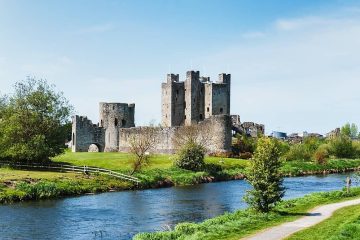
Trim Castle in County Meath is the largest Norman castle in Ireland and one of the oldest. Construction began in 1172 under Hugh de Lacy, just three years after the Norman invasion, on a strategic site overlooking the River Boyne. The massive cross-shaped keep, with twenty corners and unique in Ireland and Britain, rose over the following decades, along with a substantial curtain wall and several towers. King John visited in 1210, and later the castle served as a royal mint. The fortification saw action during various conflicts, including the wars of the 14th century, before gradually declining in importance.
Today the castle stands largely intact, its grey limestone walls dominating the town of Trim. You can explore the great keep with its cruciform design, walk sections of the curtain wall, and visit the remains of the chapel and great hall. The castle’s film appearances, including in Braveheart, have raised its profile, but the real draw is the sheer scale and completeness of this 12th-century fortress. The visitor centre provides context for what you see, and guided tours bring the medieval history to life.
Dublin Castle: Built on Viking foundations
Dublin Castle traces its origins to 1204, when King John ordered construction of a defensive fortress at the junction where the River Poddle flows into the Liffey. The site had been a Viking settlement and earlier Irish fortification, and the Normans recognised its strategic value. The original castle featured four circular corner towers connected by thick curtain walls, forming a roughly rectangular enclosure. One tower, the Record Tower, survives from this medieval period. Throughout the Middle Ages, the castle served as the centre of English administration in Ireland and a secure treasury.
What you see today reflects centuries of rebuilding, particularly after a fire in 1684 destroyed much of the medieval structure. The Georgian State Apartments now occupy where medieval buildings once stood, though the undercroft preserves sections of the original Viking and Norman walls. The Record Tower remains the most authentic medieval survival, and the excavated undercroft shows the layered history beneath your feet. The castle functions as a government complex and ceremonial venue, but regular tours allow visitors to explore both the medieval remains and later additions.
Carrickfergus Castle: Overlooking Belfast Lough
Carrickfergus Castle in County Antrim dates to 1177, when Anglo-Norman knight John de Courcy began construction following his conquest of Ulster. Built on a rocky promontory jutting into Belfast Lough, the castle controlled the approach to the region and served as de Courcy’s stronghold until King John’s forces took it in 1210. The massive keep, completed first, was followed by defensive walls that enclosed the promontory. The castle endured numerous sieges over the centuries, including a long siege by Edward Bruce’s Scottish army in 1315 and its capture by a French force in 1760. It remained a military garrison into the 20th century, an unusually long active life for a medieval castle.
The castle survives in excellent condition, its walls rising directly from the rocky shore. You can climb through the great keep, walk the battlements, and explore the various defensive additions made over eight centuries of military use. The location, with waves lapping at the base of the walls, creates a dramatic setting. Information panels throughout explain the castle’s long history, and the completeness of the structure gives a clear sense of how Norman fortifications functioned.
King John’s Castle: Guarding the Shannon
King John’s Castle in Limerick city dates from 1200, when construction began on a fortress to control the strategic crossing of the River Shannon. The location had earlier Viking significance, and the Normans built their stone castle on this established defensive site. The fortification features a large courtyard enclosed by thick curtain walls with projecting round towers at the corners and gatehouse. These towers, relatively advanced for their time, allowed defenders to cover the base of the walls with crossbow fire. The castle saw extensive action during various Irish conflicts and sieges over the following centuries.
Today the castle stands in the heart of Limerick, its stone walls contrasting with modern buildings nearby. Recent archaeological excavations within the courtyard have uncovered Viking houses and artefacts, now displayed in the excellent visitor centre. You can walk along sections of the walls, climb the towers for views over the Shannon, and explore the excavated areas that reveal pre-Norman occupation. The castle combines genuine medieval architecture with modern interpretation that explains both the Norman conquest and earlier Viking settlement.
Ashford Castle: Medieval origins of a luxury hotel
Ashford Castle near Cong in County Mayo began as a Norman fortification built by the de Burgo family in 1228. This early castle was a relatively modest stone structure controlling territory in Connacht, the western province that resisted Norman control longer than other regions. The original medieval fabric survives within the much-enlarged structure you see today. Over subsequent centuries, particularly in the Victorian era, extensive additions transformed the medieval castle into a grand country house. The Guinness family’s 19th-century ownership brought the most dramatic expansions and the surrounding designed landscape.
The castle now operates as one of Ireland’s most prestigious hotels, so the interior is reserved for hotel guests and diners, although the grounds can usually be visited. However, the medieval tower remains visible within the later additions, and the estate’s setting on Lough Corrib creates an impressive approach. The property represents how Ireland’s oldest castles often evolved, with medieval military structures adapted and absorbed into later residential buildings rather than abandoned as ruins.
Maynooth Castle: A powerful family’s seat
Maynooth Castle in County Kildare dates from the early 13th century, built by the FitzGerald family who became Earls of Kildare and one of Ireland’s most powerful Norman dynasties. The castle’s massive keep and gatehouse survive from the medieval period, when it served as the family’s principal residence and administrative centre. The FitzGeralds held enormous power in medieval Ireland, and Maynooth Castle reflected their status. The castle fell to English forces in 1535 during the rebellion of Silken Thomas FitzGerald, and the castle was abandoned in the 17th century, after which it fell into ruin.
The castle ruins stand adjacent to Maynooth University, freely accessible to visitors. The great keep, though roofless, rises to an impressive height, and you can explore the keep and the exhibition about the FitzGeralds. The gatehouse and sections of curtain wall show the castle’s original extent. Information panels explain the FitzGerald family’s role in Irish history and the castle’s violent end. The proximity to the university creates an interesting contrast between medieval ruins and modern education.
Athenry Castle: A Norman keep in Connacht
Athenry Castle in County Galway was built around 1235 by Meiler de Bermingham as part of a fortified Norman settlement. The castle’s design features a tall rectangular keep within a walled enclosure. The town of Athenry grew around the castle, protected by stone walls that survive partially today. The castle and town represented Norman efforts to establish defended colonial settlements in Connacht. De Bermingham’s victory over Irish forces at the Battle of Athenry in 1316 was fought nearby, securing Norman control of the region temporarily.
The castle keep stands three storeys high, restored and accessible to visitors. You can climb through the different levels, seeing the hall, private chambers and defensive features. The banner-hung interior gives some sense of medieval atmosphere, though the furnishings are modern reconstructions. From the top floor, views extend across Athenry town and the surrounding countryside. The nearby town walls and churches create a cohesive medieval townscape, making Athenry one of Ireland’s best-preserved Norman settlements.
Practical tips for visiting Ireland’s oldest castles
Most of these ancient castles lie within reasonable driving distance of Dublin, making a castle-focused tour feasible over several days. Trim, Maynooth and Dublin Castle all sit within an hour of the capital, while Athenry and Ashford lie further west in Galway. Carrickfergus requires a journey north to County Antrim, and King John’s Castle sits in Limerick city on the western side of Ireland. Public transport serves the larger sites like Dublin Castle and King John’s Castle, but a car provides more flexibility for reaching places like Trim and Athenry.
Spring and autumn offer the best visiting conditions, with fewer crowds than summer and more reliable weather than winter. Many sites charge modest admission fees, with Dublin Castle and King John’s Castle commanding higher prices due to their extensive visitor facilities. Trim Castle and Athenry Castle require guided tours at certain times, so check current arrangements before visiting. Allow time to explore the surrounding towns, particularly at Trim and Athenry, where medieval streetscapes and walls complement the castle visits.
Frequently asked questions about the oldest castles in Ireland
Which is the very oldest castle still standing in Ireland?
Trim Castle, begun in 1172, and Carrickfergus Castle, started in 1177, compete for this distinction among substantial stone fortifications. Both preserve extensive medieval fabric from the decades immediately following the Norman invasion of 1169.
Did the Vikings build any castles in Ireland?
The Vikings established fortified settlements and earthwork defences in Ireland, particularly in Dublin, but did not build stone castles as later understood. The Normans built many of their castles on earlier Viking sites, incorporating some foundations into their stone structures.
Can you stay overnight in Ireland’s oldest castles?
Ashford Castle operates as a luxury hotel where you can stay in a building incorporating medieval fabric, though heavily altered. Most of Ireland’s oldest Norman castles function as monuments or ruins without accommodation, but numerous later tower houses have been converted into hotels.
Why are most of Ireland’s oldest castles associated with the Normans?
The Normans introduced stone castle building to Ireland following their invasion in 1169, replacing earlier wooden and earthwork fortifications. These stone structures proved far more durable than previous defensive buildings, which is why Norman castles dominate among Ireland’s oldest surviving fortifications.