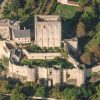
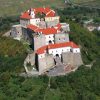
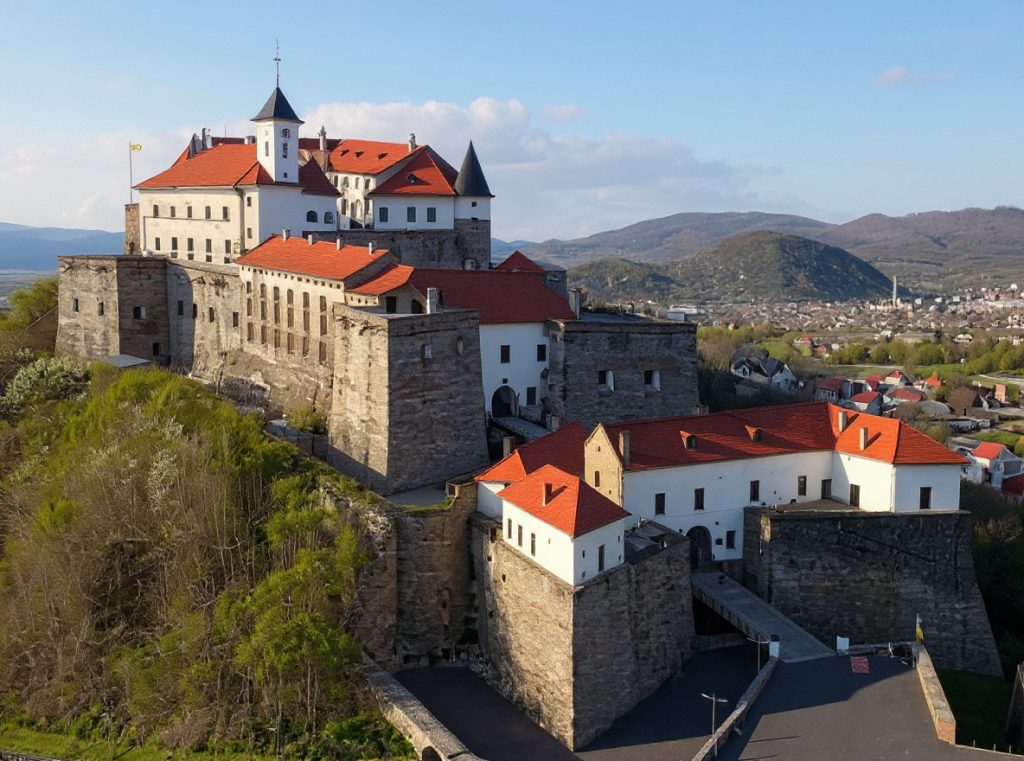
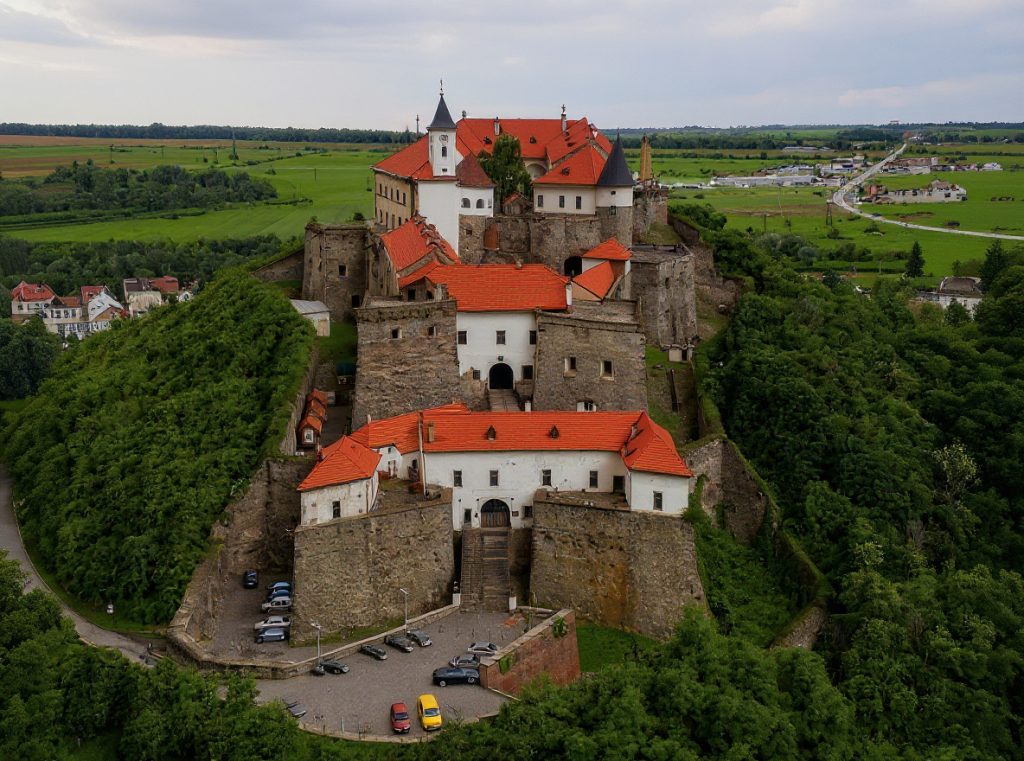
Rising from a 68-meter volcanic hill above the Transcarpathian plain, Palanok Castle commands the approaches to Mukachevo with three cascading levels of fortifications. This medieval stronghold blends architectural styles across five centuries, since documents first mentioned it in the 11th century. The fortress spreads across nearly 14,000 square meters and divides into the high, middle, and low castle. Builders constructed each level during different periods of expansion. Today the complex serves as a museum while offering sweeping views across western Ukraine toward the Carpathian Mountains.
Plan your visit to Palanok Castle
Location of Palanok Castle
Palanok Castle sits in Mukachevo, a historic town in Zakarpattia Oblast in far western Ukraine. The fortress occupies an extinct volcanic hill on the western edge of the town center. Visitors reach Mukachevo by road approximately 250 kilometers from Lviv. From Mukachevo’s center, local buses 2 and 3 stop at the base of Castle Hill. The walk up then takes about 15 minutes. The town lies close to the borders with Poland, Slovakia, Hungary, and Romania, because Transcarpathia marks the southwestern corner of the country. The castle overlooks trade routes that once connected the Middle Danube Valley with Eastern Europe through the Veretsky Pass.
History of Palanok Castle
Archaeological evidence shows people inhabited this volcanic hill since prehistoric times, though the exact founding date remains unknown. Written records first mentioned the site in the 11th century when Hungarian kings strengthened its walls. The noble Aba family laid the cornerstone for the stone fortress sometime in the 14th century. As a result, it became an important fortification of the Kingdom of Hungary. Prince Fedir Koriatovych owned it from 1396 to 1414 and transformed the wooden palisade into a stone citadel. He commissioned an 85-meter-deep well cut through volcanic rock to supply water during sieges.
During the 13th century the castle grew into one of Hungary’s largest and best-protected fortresses. Armies besieged it repeatedly yet rarely captured it. In 1629 castle captain János Balling repaired and strengthened the defenses. Transylvanian Prince George I Rákóczi acquired it in 1633 and hired French engineers to rebuild it. His widow Zsuzsanna Lórántffy later added the middle and lower terraces with massive Italian-style angular bastions. Croatian-Hungarian princess Ilona Zrínyi held off the Austrian Emperor’s army here for three years before she capitulated in 1688. Emperor Charles VI granted the castle and 200 surrounding villages to Elector Lothar Franz von Schönborn in 1726. The estate then remained in that family well into the 20th century.
From 1796 to 1897 the castle functioned as a political prison of the Austrian and Austro-Hungarian Empires. More than 20,000 prisoners passed through its cells during that century, including Hungarian national poet Sándor Petőfi. After authorities closed the prison in 1897 the fortress deteriorated. Following World War II the Soviet authorities established a vocational school in the buildings. Restoration began in 1960 when the castle became a museum.
Current status
Since 1993 the Mukachevo Historical Museum occupies Palanok Castle and manages it for public visits. The museum displays the Lehoczky collection alongside folk costumes, archaeological finds, medieval weaponry, and restored chambers. These chambers recreate the life of former inhabitants. Exhibition halls fill once-derelict spaces, so visitors explore multiple wings across the three levels. A small cinema screens animated films about the castle’s history. Admission costs approximately 150 UAH for adults, though prices may vary. The castle opens daily from 9:00 to 18:00.
Each of the three terraces offers distinct features. The Upper Castle contains the oldest part with residential quarters, a chapel, and three surviving towers. The Middle Castle holds former administrative and commercial buildings. The Lower Castle showcases 17th-century bastions and deep dry moats that guarded the main entrance. Visitors climb through interconnected courtyards and explore 130 rooms linked by underground passages. An observation tower provides panoramic views across Mukachevo and the Carpathian foothills. The castle remains one of the Seven Wonders of Ukraine. It draws thousands of travelers annually to this corner of Transcarpathia, where stone and legend intertwine above the plain.
Castles near Palanok Castle
Frequently asked questions
What is the history of Palanok Castle?
Palanok Castle was first mentioned in the 11th century as a wooden fortification. It became a stone fortress in the late 14th century under Prince Fedir Koriatovych and later served as the seat of Transylvanian princes, notably the Rákóczi family in the 17th century.
Can I visit the museum inside Palanok Castle?
Yes, the Mukachevo Historical Museum has been housed in the castle since 1989. The museum displays over 8,000 items including archaeological finds, weapons, armour, ethnographic exhibits, and a picture gallery.
How do I reach Palanok Castle from Mukachevo centre?
Take bus number 3 from the city centre to the foot of the castle hill (10–15 minutes). From the bus stop, it's a 10–15 minute uphill walk to the castle entrance; taxis are also available.
Are guided tours available at Palanok Castle?
Yes, guided tours can be arranged at the ticket desk for an additional fee. Tours typically last about one hour and provide detailed historical context about the fortress and its famous inhabitants.
What can I see from Palanok Castle?
The castle offers panoramic views over Mukachevo and the surrounding Transcarpathian lowlands from its observation decks. Inside, you can explore three defensive levels, the Upper Castle, courtyards, museum halls, a chapel, and an 85-metre-deep well.
Popular right now
Featured listings