Baroque Castles in Europe
Baroque castles are less about defence and more about display. Between roughly 1600 and 1750, kings, princes and bishops across Europe built palaces designed to impress: long symmetrical facades, grand staircases, painted ceilings and formal gardens laid out on a central axis. Below are the baroque castles and palaces we cover, with tickets, opening hours and practical tips for each.



What makes a castle baroque?
Baroque architecture started in Italy and spread north in the 17th century. Where a Renaissance castle aimed for balance, a baroque palace aimed for drama: a strong central axis, rooms laid out in long suites, ceilings painted to look like open sky and gardens that continue the lines of the building into the landscape with parterres, fountains and terraces.
France set the model. Château de Vaux-le-Vicomte was built from 1658 to 1661 for Nicolas Fouquet, the finance minister of Louis XIV, by the architect Louis Le Vau, the painter Charles Le Brun and the garden designer André Le Nôtre. The king was so struck by it that he put the same team to work at Versailles.
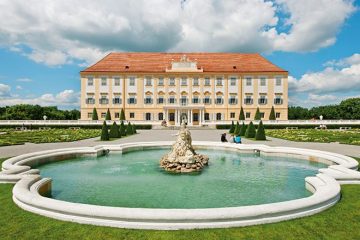
In the Habsburg lands the style arrived a little later. Schloss Hof, east of Vienna, was bought by Prince Eugene of Savoy in 1725 and expanded by Johann Lucas von Hildebrandt, with a garden that steps down to the river March on seven terraces. In 1755 it passed to the imperial family of Maria Theresa. In Salzburg, Mirabell Palace was rebuilt in baroque style by the same Hildebrandt in the 1720s, and Bratislava Castle was turned into a royal residence under Maria Theresa in the 18th century. In the Netherlands, Amerongen Castle was rebuilt in the 1670s after French troops burned it in 1673.
Planning a baroque castle trip
Two baroque castles sit very close together on the border between Austria and Slovakia: Schloss Hof is about 18 km from Bratislava, so it combines easily with Bratislava Castle in one day, or makes a day trip from Vienna. In France, Vaux-le-Vicomte and Versailles are both day trips from Paris, and in Salzburg the Mirabell gardens are in the city centre and free to walk through.
Gardens are a big part of every baroque visit, so spring to early autumn is the best time to go. Some palaces open only part of the year or have shorter winter hours, so check the opening hours on each castle page before you travel.
Baroque castles by country
 Germany
 Austria
 The Netherlands
 Slovakia
 England
 France
Frequently asked questions
What is a baroque castle?
A baroque castle is a palace built roughly between 1600 and 1750 in the baroque style, with symmetrical facades, grand staircases, richly decorated interiors and formal gardens on a central axis. It was built for prestige and court life rather than defence.
What is the most famous baroque palace in Europe?
Versailles is the best known, but it was inspired by Château de Vaux-le-Vicomte, built a few years earlier by the same architect, painter and garden designer.
What is the difference between Renaissance and baroque castles?
Renaissance castles, mostly from the 16th century, aim for balance and harmony and often keep towers and moats as decoration. Baroque palaces from the 17th and 18th centuries are larger, more theatrical and built around a central axis that runs into the gardens. See our Renaissance castles for comparison.
Which baroque castles can I combine in one day?
Schloss Hof in Austria and Bratislava Castle in Slovakia are about 18 km apart and easy to combine. From Paris, Vaux-le-Vicomte and Versailles can each be visited as a day trip.
Other castle styles
Last updated: 2 November 2026