
On the edge of the Rhineland town of Brühl, Augustusburg Palace, Brühl ranks as one of Germany’s finest examples of early rococo architecture. Construction began in 1725 when Archbishop-Elector Clemens August of the House of Wittelsbach commissioned Johann Conrad Schlaun to begin building on the ruins of a medieval moated castle. Balthasar Neumann designed the grand staircase, creating what many regard as the palace’s crowning glory. Together with the nearby Falkenlust hunting lodge and surrounding gardens, this complex earned UNESCO World Heritage status in 1984.
Plan your visit to Augustusburg Palace, Brühl
Tue–Fri 09:00–16:00
Sat–Sun 10:00–17:00Closed December–February; Tue–Fri 09:00–16:00, Sat–Sun 10:00–17:00 (last admission), closed Mondays.
Location of Augustusburg Palace, Brühl
Augustusburg Palace sits in Brühl, North Rhine-Westphalia, roughly fifteen kilometres south of Cologne. Visitors can take the train from Cologne to Brühl station, then walk five minutes to reach the palace. Line 18 of the Cologne tram also stops in Brühl, offering another convenient route. The palace forms part of a larger complex with the Falkenlust hunting lodge roughly one mile to the southeast. Brühl itself developed around this residence; in fact, the town became the capital of the county in 1469. After that, the Cologne Archbishops chose it as their residence.
History of Augustusburg Palace, Brühl
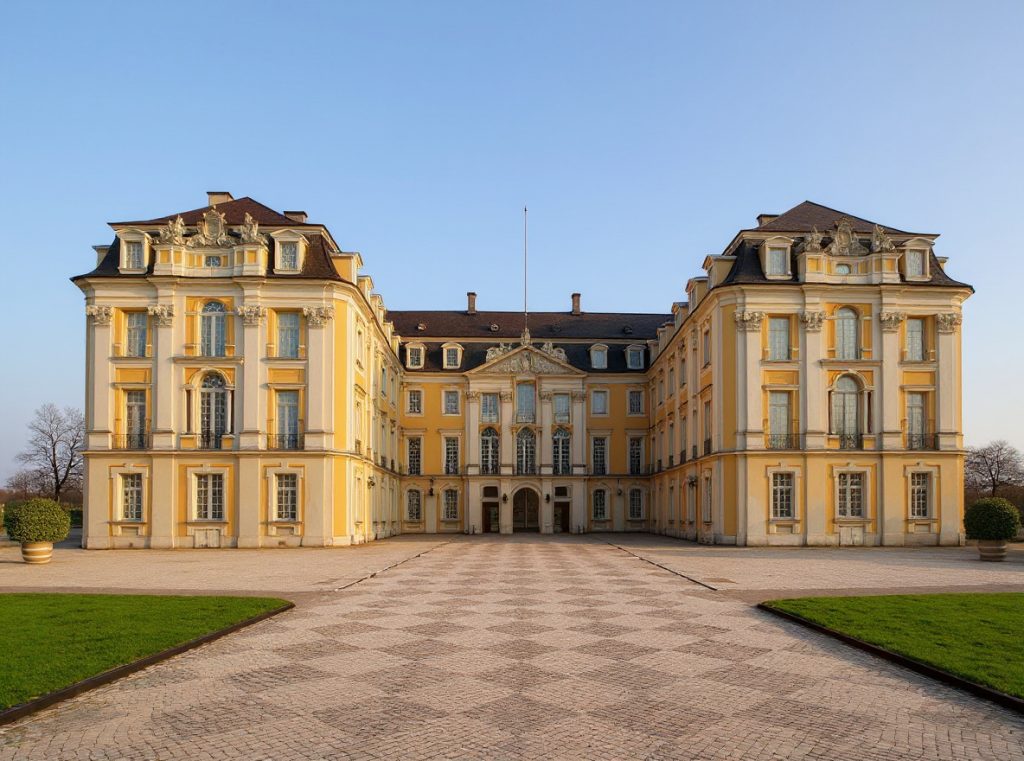
As early as the twelfth century, the archbishops of Cologne maintained an estate and hunting grounds in Brühl. When Clemens August became Archbishop-Elector, he envisioned a summer residence that would display both his wealth and refined taste. Westphalian architect Johann Conrad Schlaun began work in 1725, integrating parts of the original castle foundations into the new palace structure. In 1728, Bavarian court architect François de Cuvilliés took over and made the palace into one of the most glorious residences of its time.
In 1740, Clemens August commissioned Balthasar Neumann, who had just completed the Würzburg Residenz, to redesign the staircase hall. Neumann’s creation became legendary. Numerous outstanding artists of European renown contributed to the palace’s beauty until its completion in 1768, several years after the elector’s death in 1761. In 1728, Dominique Girard designed the palace gardens according to French models. Constant renovation has since maintained them as one of the most authentic examples of eighteenth-century garden design in Europe.
French troops occupied the palace during the Napoleonic era and pillaged the remaining furniture. In 1815 the palace passed into Prussian ownership. Unlike many German palaces, Augustusburg escaped major damage in World War II, so most of the paintings, floors, and fixtures remain original to the palace. This survival allowed future generations to experience authentic rococo interiors without extensive reconstruction.
Current status
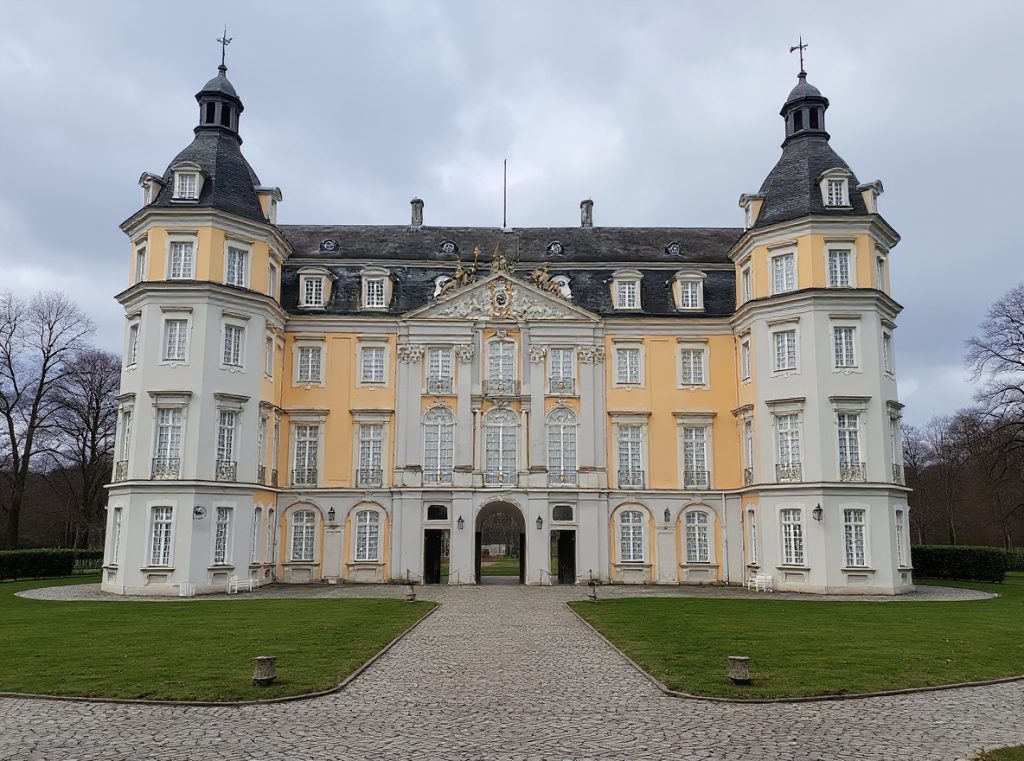
Today, the state of North Rhine-Westphalia owns and maintains the palace as a museum open to the public. Following World War II, the West German federal government adopted Augustusburg as an official state guesthouse. As a result, Chancellor Konrad Adenauer hosted visiting dignitaries here from 1949 onward. Until 1990 the palace received foreign heads of state visiting West Germany. This diplomatic role helped secure funding for preservation through the postwar decades.
Visitors explore the palace through guided tours that showcase the main apartments and Neumann’s celebrated staircase. The palace and its parks also serve as a venue for the Brühl Palace Concerts, bringing classical music into the rococo setting. The palace park now opens to the public, allowing visitors to stroll through the formal parterre gardens and woodland areas. The complex demonstrates how eighteenth-century princely residences integrated architecture, sculpture, painting and garden design into a unified artistic statement.
The palace’s yellow facade rises above manicured lawns and geometric parterres where fountains play beneath lime tree alleys. Inside, gilded stuccowork and frescoed ceilings transport visitors to the world of Clemens August and his court. Each carefully preserved room speaks to the ambition and artistry that flourished here nearly three centuries ago.
Castles near Augustusburg Palace, Brühl
Frequently asked questions
Can I visit Augustusburg Palace without a guided tour?
No, all visits to the palace interior are by guided tour only, included in the ticket price. Tours in German run regularly throughout opening hours, with audio guides available for non-German speakers.
Is there a combined ticket for Augustusburg Palace and Falkenlust?
Yes, a combo ticket costs €17 for adults (€13.50 reduced) and covers both palaces. Falkenlust hunting lodge is located 2.5 km away through the park, a 30–40 minute walk.
What are the opening hours for Augustusburg Palace?
The palace is open March through November, closed Mondays. Hours are Tuesday–Friday 09:00–16:00 (last admission), Saturday–Sunday 10:00–17:00 (last admission); it is closed December, January and February.
How do I get to Augustusburg Palace from Cologne?
Take regional train RB 48, RE 5 or MRB 26 from Cologne Hauptbahnhof to Brühl station (15–20 minutes). The palace is a 5-minute walk from the station; alternatively, tram 18 stops at Brühl-Mitte, an 800-metre walk from the palace.
Are the gardens at Augustusburg Palace free to visit?
Yes, the palace gardens and park are open year-round and free to enter. Garden hours vary seasonally, from 08:00–17:00 in winter to 07:00–21:00 in summer.
Popular right now
Featured listings