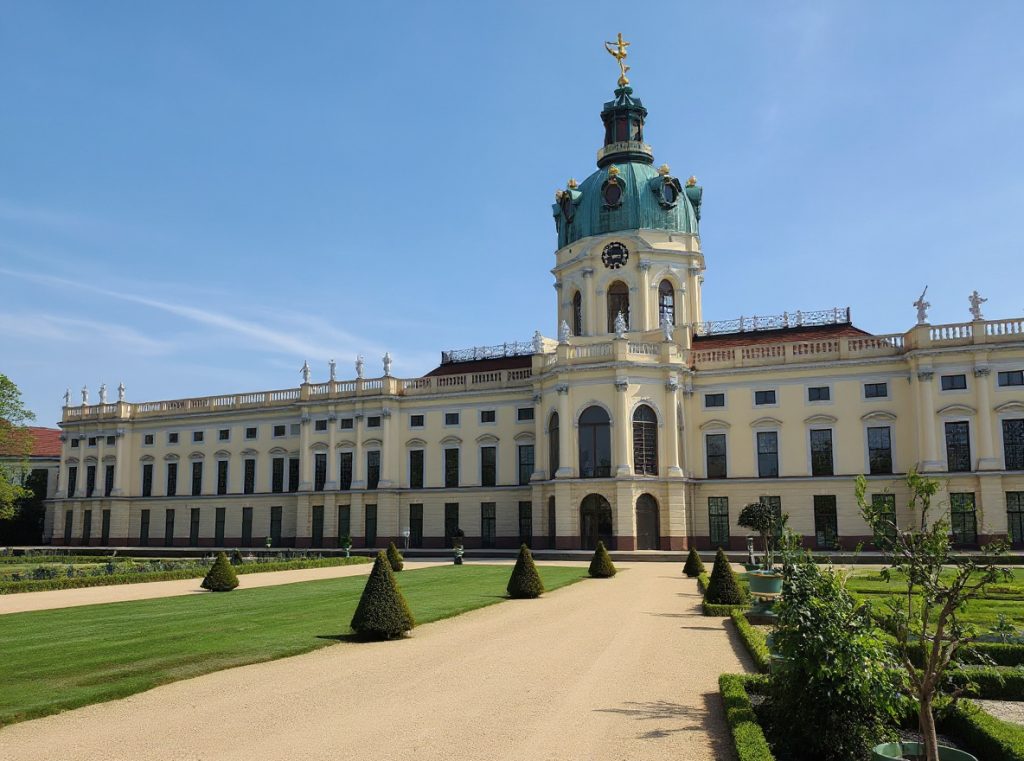
On the western edge of Germany’s capital, Charlottenburg Palace serves as Berlin’s grandest royal residence and its most magnificent Baroque architectural ensemble. This sprawling complex, with its distinctive central dome and symmetrical wings, tells three centuries of Prussian royal history. Queen Sophie Charlotte once used it as her summer retreat, though later seven generations of Hohenzollern rulers shaped European politics from these elegant halls. Today the palace opens its lavish rooms and extensive gardens to visitors from around the world.
Plan your visit to Charlottenburg Palace
Tue–Sun 10:00–17:30
Location of Charlottenburg Palace
Charlottenburg Palace sits in western Berlin, embedded in a beautiful garden within the district that shares its name. The nearest U-Bahn station is Sophie-Charlotte-Platz, while bus routes 309, 109, and M45 serve the palace well. The complex lies at Spandauer Damm, which visitors can easily reach from central Berlin by public transport or on foot. The palace stands close to several museums, including the Brohan Museum and the Berggruen Museum across the street. Queen Sophie Charlotte built the summer palace right by the Spree river, though urban expansion has since transformed the surrounding area. The 55-hectare grounds provide a green sanctuary amid the modern city, while the palace itself anchors the Charlottenburg-Wilmersdorf borough.
History of Charlottenburg Palace
Construction began in 1695 when Sophie Charlotte, wife of Frederick III, Elector of Brandenburg, commissioned the palace in what was then the village of Lietzow. Architect Johann Arnold Nering created designs based on the commission, and builders completed the palace in 1699. The inauguration took place on 11 July 1699, Frederick’s 42nd birthday. German architect Johann Arnold Nering designed it, though Andreas Schlüter and Martin Grünberg completed it after his death. The owners initially knew the palace as Lietzenburg.
Frederick crowned himself Frederick I, King in Prussia, in 1701. He appointed Johann Friedrich von Eosander as royal architect and sent him to study developments in Italy and France, particularly Versailles. As a result, Eosander began extending the palace in 1702. The central building with its eleven window axes gained side wings and a court of honour. The oversized dome, the palace’s most characteristic element, rose during this phase. Sophie Charlotte died in 1705, so Frederick named the palace and estate Charlottenburg in her memory.
Construction halted when King Frederick I died in 1713 but resumed under Frederick the Great in 1740. Architect Knobelsdorff built a new east wing between 1740 and 1746. Different cohorts of the royal family expanded the estate throughout the years, with decoration varying from Baroque to Rococo. Carl Gotthard Langhans added the palace theatre in 1791, marking the end of almost 100 years of construction. Builders added a large formal garden behind the palace, including a belvedere, mausoleum, theatre and pavilion.
In 1943, the palace took a direct bomb hit during World War II, and fire consumed the entire structure. After authorities demolished the Stadtschloss in East Berlin in 1951, fears arose that Charlottenburg would meet the same fate. Director Margarete Kühn led efforts to rebuild it, though.
Current status
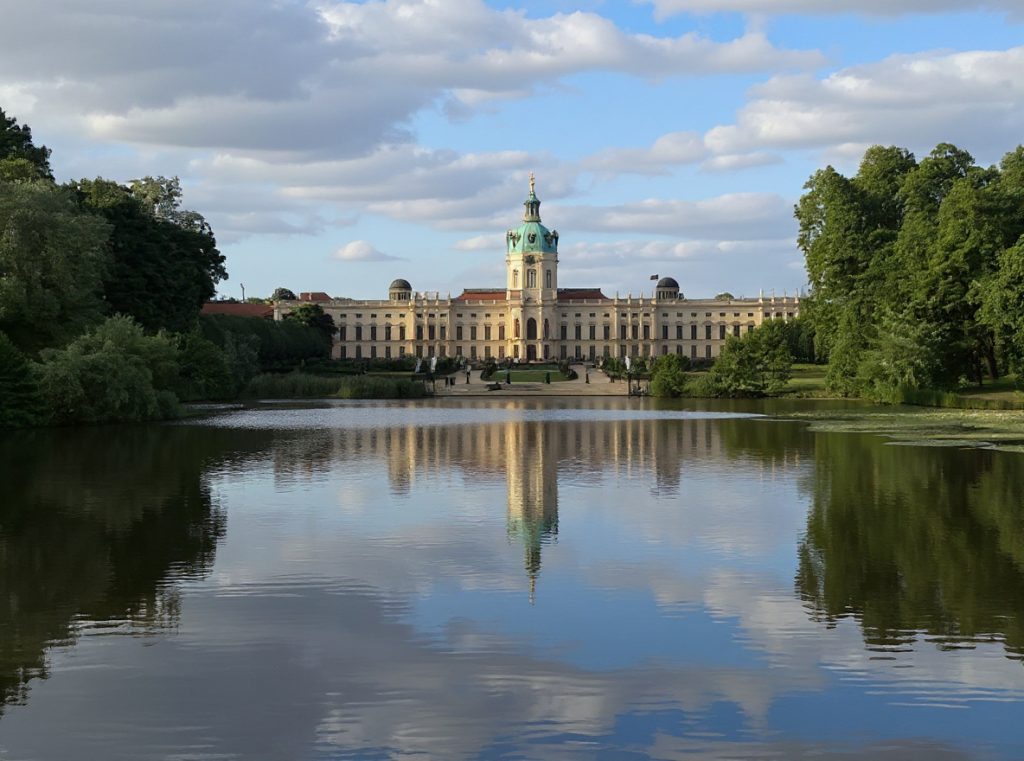
Charlottenburg Palace ranks as the largest and most significant palace complex in Berlin stemming from former Brandenburg electors, Prussian kings and German emperors. The former summer residence now attracts visitors as one of the most important sites in the German capital. The Stiftung Preußische Schlösser und Gärten Berlin-Brandenburg (Prussian Palaces and Gardens Foundation) manages the site and oversees its preservation. The palace offers interiors faithful to the originals, impressive suites and exceptional art collections. Highlights include the Porcelain Cabinet, Palace Chapel and Frederick I’s bedchamber, for example.
Visitors explore two main sections: the Old Palace and the New Wing, each requiring separate admission though combination tickets are available. The palace opens Tuesday to Sunday from 10 am till 4:30 pm November to March, and from 10 am till 5:30 pm April to October. Audio guides accompany tours through the lavish state rooms. The 55-hectare grounds contain three other main buildings: the Belvedere with its porcelain collection, the Mausoleum honouring Queen Louise, and the New Pavilion with works from architect Karl Friedrich Schinkel’s era. The palace regularly hosts concerts and cultural events, particularly in the Orangery.
Designers remodelled the baroque gardens as an English landscape park in the 19th century, then restorers returned them to their original form after World War II. Today visitors can trace the shifting tastes of the palace’s many residents from the Baroque period to the early 20th century. The complex survives as Berlin’s sole remaining major royal residence from the Hohenzollern dynasty. It draws architecture enthusiasts and history lovers to walk through rooms where Prussian monarchs once held court and entertained Europe’s elite.
Castles near Charlottenburg Palace
Frequently asked questions
What is included in the Charlottenburg Palace charlottenburg+ ticket?
The charlottenburg+ ticket (€19) grants same-day access to all buildings in the palace complex: the Old Palace, New Wing, New Pavilion (April–October, Sundays only), Mausoleum (April–October), and Belvedere. The gardens are free year-round.
Can you visit Charlottenburg Palace gardens without a ticket?
Yes, the palace gardens are open daily from 8am until dusk and admission is free. You only need a ticket to enter the palace buildings and museum interiors.
How long does it take to tour Charlottenburg Palace?
Allow 2 to 3 hours for a thorough visit. The Old Palace takes about 1 hour, the New Wing another hour, and you'll want time to explore the baroque gardens and smaller pavilions if open.
Is Charlottenburg Palace open on Mondays?
No, Charlottenburg Palace is closed every Monday. Opening hours Tuesday to Sunday are 10am–5:30pm (April–October) and 10am–4:30pm (November–March), with last entry 30 minutes before closing.
What are the highlights of Charlottenburg Palace?
The must-see rooms include the Porcelain Cabinet with its collection of Chinese and Japanese porcelain, Frederick I's bedchamber, the baroque Palace Chapel, and the opulent Golden Gallery in the New Wing—one of Europe's finest Rococo interiors. The formal baroque gardens and carp pond are also highlights.
Featured listings