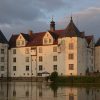
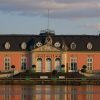
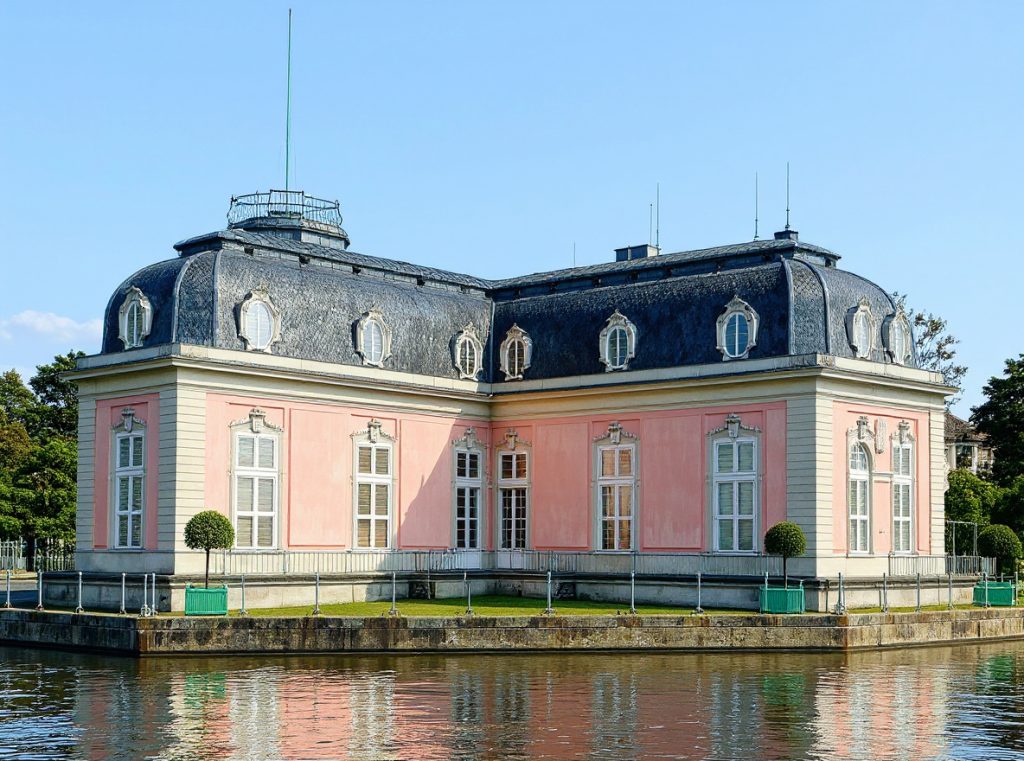
In the southern reaches of Düsseldorf, Benrath Palace, Düsseldorf presents one of Europe’s most perfectly preserved examples of an 18th-century pleasure palace. The soft pink facade rises gracefully above a circular pond. Symmetrical wings spread out across gardens that stretch to the Rhine. Architect Nicolas de Pigage created this architectural masterpiece between 1755 and 1773 for Elector Palatine Karl Theodor and his wife Elisabeth Auguste. The Elector visited his rural retreat only once, though the palace has welcomed countless admirers since Düsseldorf opened it to the public in 2000.
Plan your visit to Benrath Palace, Düsseldorf
Wed–Thu Closed
Fri 2:00–17:00
Sat–Sun 11:00–17:00
Location of Benrath Palace, Düsseldorf
Benrath Palace sits in the Benrath district, around twelve kilometres south of central Düsseldorf in North Rhine-Westphalia. The palace complex occupies a scenic position on the east bank of the Rhine, surrounded by 61 hectares of parkland. Visitors arrive easily via regional train to Düsseldorf-Benrath station, just ten minutes’ walk from the palace gates. The journey from Düsseldorf Hauptbahnhof takes about twenty minutes by S-Bahn lines S6 and S68. Tram line 701 and local buses also serve the area. For those travelling by car, the address Benrather Schloßallee 100-106 leads directly to visitor parking around the park perimeter. The palace foundation manages the entire ensemble today.
History of Benrath Palace, Düsseldorf
When Elector Karl Theodor von der Pfalz inspected his Benrath territories in 1755, he found only a fire-damaged 17th-century moated castle. He commissioned Nicolas de Pigage, his talented French court architect, to design a modern maison de plaisance. Construction commenced that same year. The Seven Years’ War interrupted the building works, yet by 1760 craftsmen had begun the interior decoration. Stuccatori created elaborate ceilings in the Electress’s bedroom while sculptors carved ornamental details throughout the corps de logis. The symmetrical ensemble took shape, with the central palace flanked by eastern and western cavalier wings housing servants’ quarters, all connected by underground passages.
Pigage completed the complex in 1773. He achieved a remarkable illusion through his design. From the courtyard the palace appears to have two storeys, while it actually contains four. The lower service floors remain cleverly hidden from view. Electress Elisabeth Auguste arrived to inaugurate the palace in 1771, though Karl Theodor himself did not visit until fourteen years later. After the Napoleonic Wars ended, the Vienna Congress transferred Benrath to Prussian control in 1815. King Friedrich Wilhelm III visited in 1820, and from 1821 to 1848 the palace served Prussian royals as a summer residence. Throughout the 19th century various aristocratic owners occupied the estate until Benrath merged with Düsseldorf in 1929.
Current status
The Stiftung Schloss und Park Benrath, established in 2000, now administers the palace and its extensive grounds. This foundation transformed the cavalier wings into three distinct museums. The Palace Museum in the main corps de logis displays original Frankenthal porcelain, furniture, clocks and textile wallpapers through guided tours. Visitors wear protective slippers to preserve the historic floors. The Museum of European Garden Art, housed in the eastern wing since 2002, presents 2,500 years of garden history across 41 rooms and 2,000 square metres. The western wing contains a Natural History Museum showcasing regional flora and fauna, including the palace park’s 80 bird species and 300 beetle species.
Nicolas de Pigage designed each interior room to correspond with a specific garden space outside. The English garden to the west, with its rare trees, reflects the Elector’s private chambers. The French parterre garden to the east mirrors the Electress’s apartments. The baroque hunting park features geometric pathways carved through former woodland, crossed by diagonal alleys and a circular route. A protected 45-hectare nature reserve forms part of the broader parkland. Experts have proposed the ensemble for UNESCO World Heritage status, recognising its exceptional preservation. Students from Düsseldorf universities receive free museum admission, while guided tours in multiple languages welcome international visitors year-round.
The palace hosts cultural events, temporary exhibitions and even civil wedding ceremonies in collaboration with Düsseldorf’s registry office. In 1965, Queen Elizabeth II received a state welcome here, arriving in an open-top Mercedes through Benrath’s streets. Queen Silvia of Sweden has visited twice. Today the pink palace serves as a beloved landmark for Düsseldorfers, who affectionately call it their “little Versailles.” The park remains one of the city’s finest green spaces.
Castles near Benrath Palace, Düsseldorf
Frequently asked questions
Can I visit the interior of Benrath Palace without a guided tour?
No, the Corps de Logis main building can only be visited via guided tour to preserve the historic interiors. Your ticket also includes entry to the Museum of Garden Art and Natural History Museum in the side wings.
Is the park at Benrath Palace free to visit?
Yes, the 150-acre palace park is open daily free of charge year-round. Only the palace interior and museums require a paid ticket.
What are the opening hours for Benrath Palace?
The palace and museums are open Monday–Tuesday and Friday–Sunday, closed Wednesday–Thursday. Hours are Monday–Tuesday 11:00–17:00, Friday 14:00–17:00, Saturday–Sunday 11:00–18:00.
How long does it take to reach Benrath Palace from Düsseldorf city centre?
The journey takes 20–25 minutes by public transport. Take the U72 underground directly to Schloss Benrath station, or trains (S6, RE1, RE5) to Benrath station followed by a 15-minute walk.
Is Benrath Palace suitable for wheelchair users?
The palace grounds, park and ground floors of the museums are generally accessible. However, some areas of the historic Corps de Logis may present challenges due to stairs in the 18th-century building.
Popular right now
Featured listings