
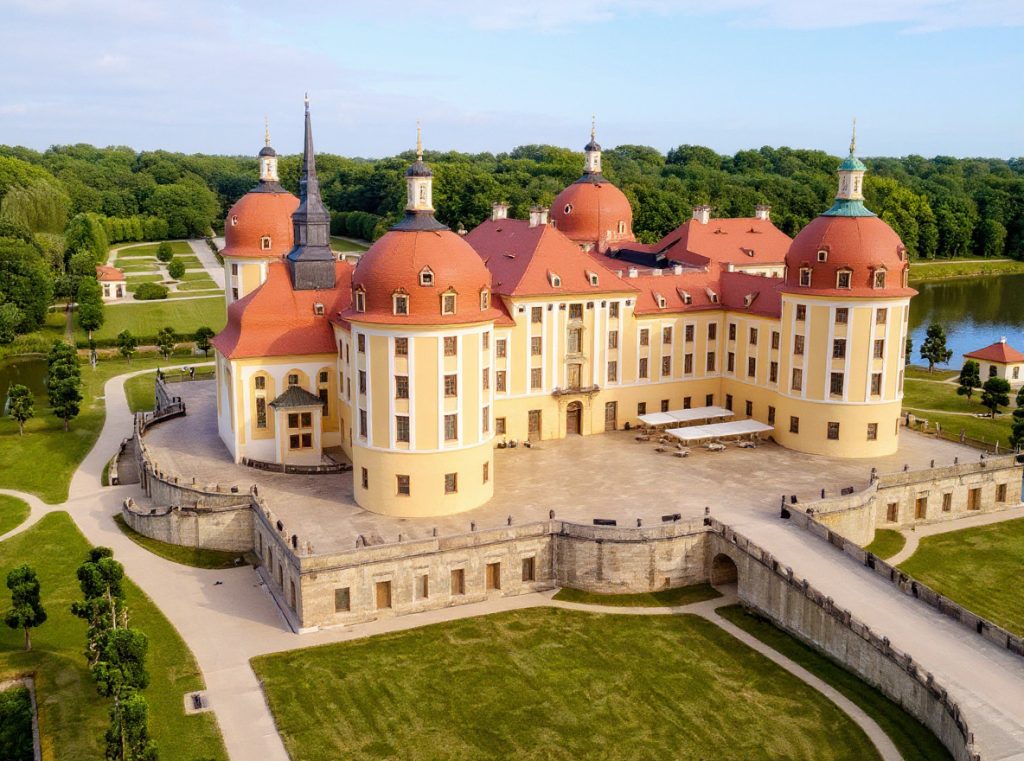
On a symmetrical artificial island surrounded by tranquil waters, Moritzburg Castle rises with four round towers that define one of Saxony’s most photographed palaces. This Baroque hunting residence once hosted the lavish festivities of Augustus the Strong, who transformed a modest Renaissance lodge into a magnificent pleasure palace. Rich collections of hunting trophies, gold leather wallpapers and the celebrated Feather Room await within its opulent halls.
Location of Moritzburg Castle
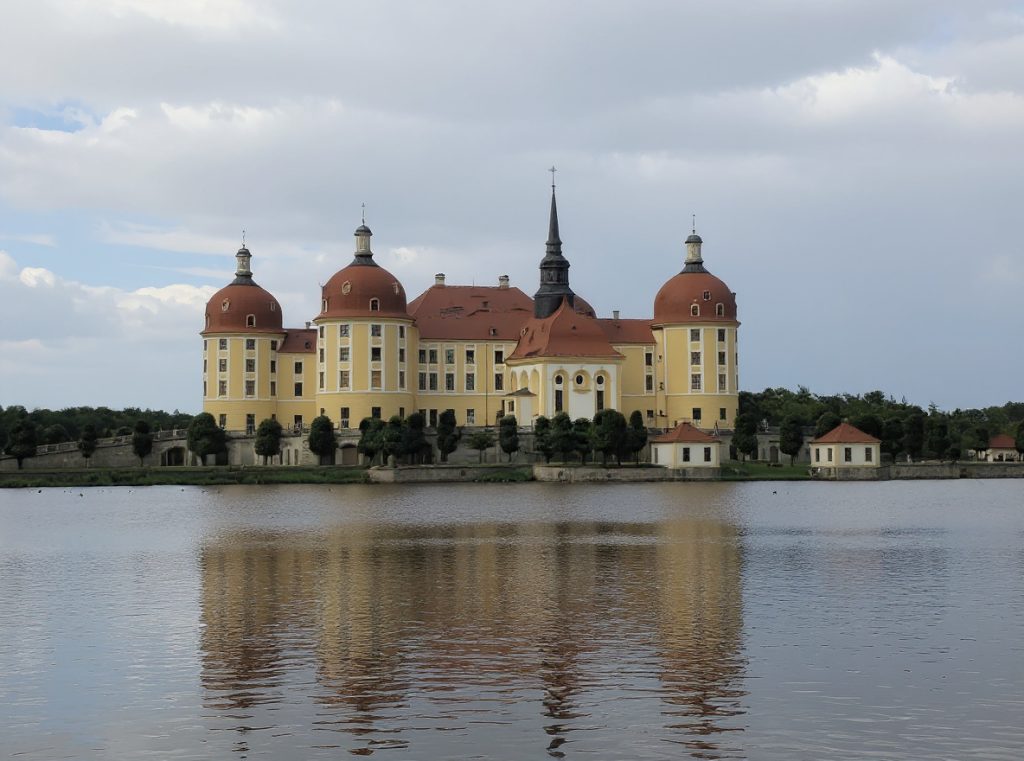
Moritzburg Castle sits in the town of Moritzburg, in the German state of Saxony, about 13 kilometres northwest of Dresden. The palace stands proudly on a man-made island in the middle of a little lake. Visitors approach via an avenue through a vast, idyllic park. The setting combines water, woodland and formal gardens into a landscape that centuries of Saxon electoral taste shaped. The castle sits at coordinates 51°10’3.26″N, 13°40’46.60″E and an elevation of 180 metres. Visitors travel from Dresden by regional train or road, then arrive at a palace that appears to float on its lake. The surrounding parkland extends for kilometres and connects the main residence with satellite buildings. Royal processions once moved along alleys that designers created for these ceremonial events. One alley running directly east visually connects the castle with the Fasanenschlösschen, 2.5 kilometres away.
History of Moritzburg Castle
Duke Moritz of Saxony had a hunting lodge built on this site between 1542 and 1546. This Renaissance structure served the Saxon nobility as a base for their hunting expeditions. Woodlands and wetlands still surround the property today. For more than a century and a half the lodge remained a functional building without particular architectural ambition. Elector John George II commissioned the Castle Chapel in 1661 under his auspices. The chapel became Catholic when Augustus the Strong accepted coronation as King of Poland. Wolf Caspar von Klengel designed the chapel in the 17th century, so it became one of the most impressive examples of early Baroque style in Saxony.
In 1723, major works began to convert Moritzburg from a Renaissance building into a Baroque hunting and pleasure palace. Elector Augustus the Strong directed the transformation, with architectural guidance from Matthäus Daniel Pöppelmann. During the reconstruction phase from 1723 until 1733, builders created the large pond from four smaller ponds. The pond now surrounds the castle’s artificial island. Augustus staged excessive feasts and hunts here, turning the waters into arenas for naval spectacles. In 1728, workers added a park to the castle on the adjacent land to the north. Frederick Augustus III, great-grandson of Augustus the Strong, continued developing the estate. Architects built the Little Pheasant Castle between 1770 and 1776. From 1933 on, Wettin Prince Ernst Heinrich of Saxony used Moritzburg Castle as a residence until 1945, when authorities expropriated the Wettins.
Current status
Since 1946, Moritzburg Palace has operated as a museum of baroque art and culture. The Staatliche Schlösser, Burgen und Gärten Sachsen manages the property as one of Saxony’s premier heritage attractions. Today it houses one of the most important collections of hunting trophies in Europe. Ornate gold leather wallpapers and the feather room also draw visitors. A room decorated with millions of coloured bird feathers won the European Prize for the Preservation of Cultural Heritage. Visitors tour opulent salons where Saxon electors once entertained, examining antler collections and Baroque furnishings. The dining hall displays an astonishing array of trophies that document the hunting culture of Saxon nobility.
The castle gained renewed fame as the backdrop for the beloved fairy tale film “Drei Haselnüsse für Aschenbrödel”. Each winter thousands return to see the palace that played Cinderella’s castle. Its silhouette enchants against snow and ice. The Little Pheasant Castle remains accessible within the park, preserving late Dresden Rococo interiors in miniature perfection. Exhibitions change seasonally, drawing on the castle’s deep collections and exploring themes of courtly life. Art and Saxon history also feature in these rotating displays. The surrounding parkland invites leisurely walks along tree-lined alleys and around ornamental ponds. These paths offer constantly shifting views of the four-towered palace reflected in still waters. Moritzburg continues to captivate visitors who arrive seeking both fairy tale romance and tangible connection to the grandeur of Saxony’s electoral past.
Featured listings