
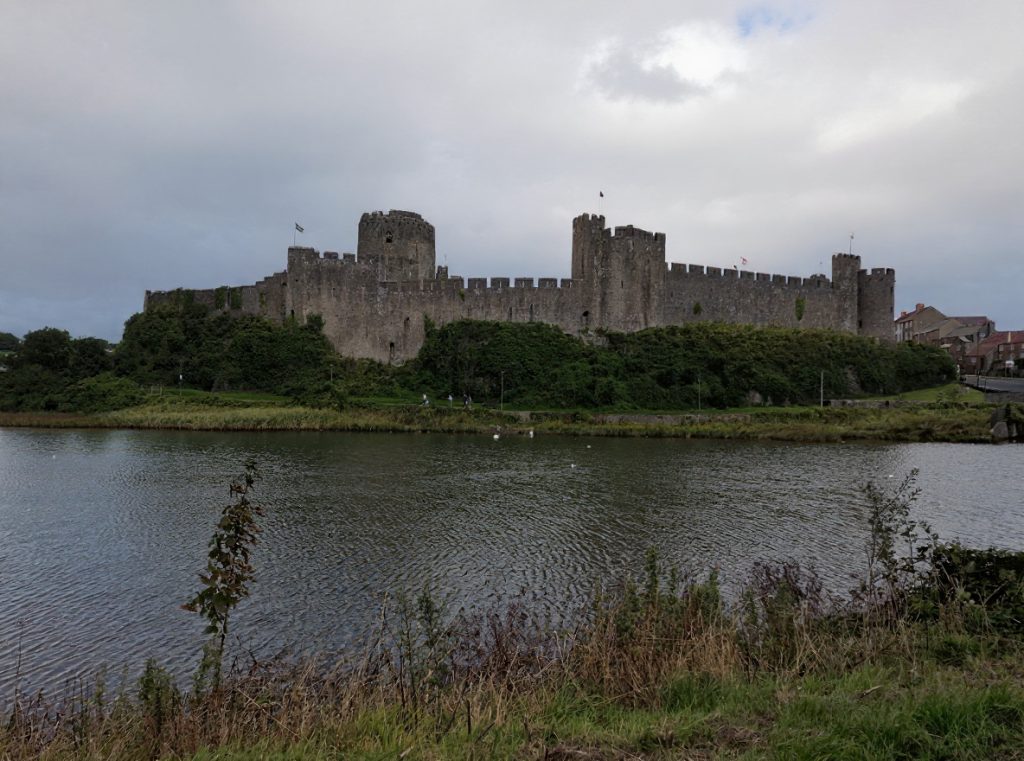
On a limestone ridge above the Pembroke River, Pembroke Castle commands the landscape of southwest Wales with its massive stone walls and towering keep. This Norman stronghold served as the seat of powerful medieval earls and witnessed the birth of a dynasty that would reshape England. The fortress rises from a natural promontory surrounded on three sides by water, a strategic position that helped it withstand sieges for centuries. Today the castle ranks as one of the finest and most complete medieval fortifications in Britain.
Plan your visit to Pembroke Castle
Location of Pembroke Castle
Pembroke Castle sits in the centre of Pembroke town in Pembrokeshire, southwest Wales. The fortress occupies the western tip of a rocky ridge with the tidal Pembroke River flowing around three sides. Visitors reach the town via the A477, while the A4075 and A4139 provide additional access routes into the centre. Pembroke railway station lies approximately fifteen minutes’ walk from the castle entrance. Several public car parks serve the town centre, including The Parade, Commons, West Street and Long Entry. All of these sit within a short walk of the castle gates. The postcode SA71 4LA guides drivers to the castle’s main entrance on Castle Terrace.
History of Pembroke Castle
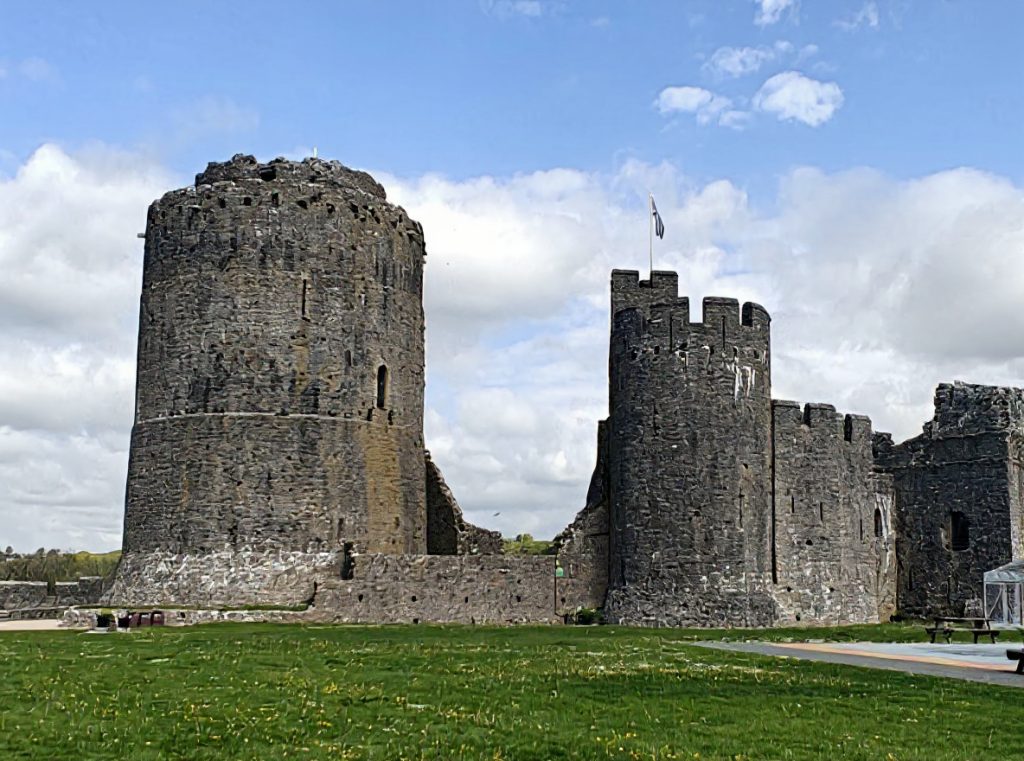
Arnulf of Montgomery founded Pembroke Castle in 1093 during the Norman invasion of Wales. He built a timber and earth fortification on the rocky promontory, which proved remarkably effective against Welsh attacks despite its simple construction. The site became the centre of Norman-controlled territory in southwest Wales. In 1189, Richard I granted the castle to William Marshal, who earned fame as one of medieval Europe’s greatest knights. Marshal transformed the wooden fort into a formidable stone fortress, creating most of the structure visible today. He built the great circular keep, which rises almost twenty-four metres high with walls up to six metres thick at its base. His sons continued the work between 1234 and 1241, adding towers and strengthening the defences.
On a winter day in January 1457, thirteen-year-old Margaret Beaufort gave birth to a son in one of the castle towers. That child, Henry Tudor, would later defeat Richard III at Bosworth Field in 1485 and become King Henry VII, founding the Tudor dynasty. The de Valence family held Pembroke for seventy years from the late thirteenth century, using it as a military base during Edward I’s Welsh campaigns. After John Hastings died in a jousting accident in 1389, the castle reverted to the Crown. When Owain Glyndŵr led his Welsh rebellion around 1400, Pembroke escaped attack because the constable paid him off in gold.
The castle played a crucial role during the English Civil War. In 1642, Pembroke declared for Parliament, the only town in Wales to do so. Mayor John Poyer garrisoned the castle and held it for four years. Yet in 1648, Poyer switched his allegiance to the Royalists. Oliver Cromwell himself besieged the castle for seven weeks before Poyer finally surrendered.
Current status
Pembroke Castle Trust, an independent registered charity, manages the castle today. This makes it the largest privately owned castle in Wales. The Philipps family and representatives of Pembroke Town Council administer the trust. The fortress opens to the public year-round except for Christmas Eve, Christmas Day, Boxing Day and New Year’s Day. Visitors explore the endless passages, tunnels and stairways that wind through the complex. They climb to the top of the great keep for views across Pembrokeshire, or descend into the Wogan Cavern. This natural cave lies beneath the castle. Archaeologists discovered evidence in the cavern of human habitation dating back over forty thousand years. As a result, it ranks as one of Britain’s most ancient dwelling sites.
The castle hosts exhibitions about medieval life and the stories of the powerful figures who shaped its history. Free guided tours run daily, included with admission. Educational programmes bring school groups to learn about Norman military architecture and the Wars of the Roses. The fortress serves as a venue for special events throughout the year, from historical reenactments to concerts. The castle earned Grade I listed status in 1951 and designation as a Scheduled Ancient Monument. This recognises it as one of the outstanding medieval castles in Britain. The massive fortifications, circular towers and intact gatehouses offer visitors an authentic experience of medieval military power. Stone walls rise from the rocky promontory where Norman invaders first planted their standard over nine centuries ago. The fortress remains as impressive today as when William Marshal rebuilt it in the thirteenth century.
Castles near Pembroke Castle
Frequently asked questions
What is special about Pembroke Castle?
Pembroke Castle is the birthplace of Henry VII, the first Tudor monarch, born there in 1457. The castle features a rare 5-storey circular keep with an intact stone dome and sits above Wogan Cavern, a large natural cave currently being excavated.
Is Pembroke Castle suitable for children?
Yes, children enjoy exploring the towers, tunnels and dungeons. Free guided tours run daily and help bring the history to life, though young children will need supervision on steep spiral staircases.
Can I visit Pembroke Castle in winter?
Yes, Pembroke Castle is open year-round except 24–26 December and 1 January. Winter opening hours are shorter (10:00–16:00 from November to February), but the castle is less crowded.
Is there parking at Pembroke Castle?
There is no on-site parking at the castle. The Parade and Commons public car parks are within a 5-minute walk, and a drop-off point is available directly outside the entrance for visitors with mobility needs.
How long does a tour of Pembroke Castle take?
Allow 2 to 3 hours to explore the keep, towers, exhibitions and Wogan Cavern at a comfortable pace. Free guided tours run daily at set times (typically 11:00, 13:00 and 15:00) and last approximately one hour.
Featured listings