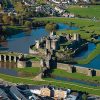

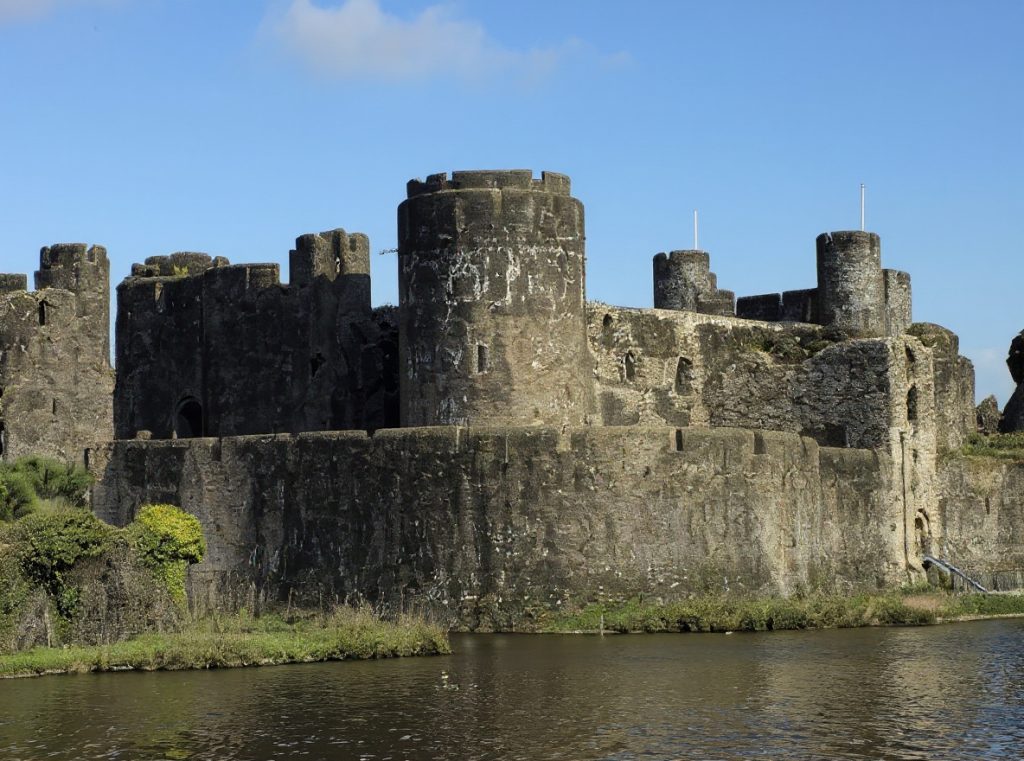
Surrounded by extensive artificial lakes on a thirty-acre site in South Wales, Caerphilly Castle commands attention as the largest medieval fortress in Wales and the second largest in Britain after Windsor. This formidable concentric stronghold introduced revolutionary defensive design to Britain when Gilbert de Clare built it in 1268. The castle’s elaborate water defences and massive gatehouses still evoke the turbulent era when English Marcher lords fought to control Glamorgan against the last native Welsh princes.
Plan your visit to Caerphilly Castle
Location of Caerphilly Castle
Caerphilly Castle sits in the centre of Caerphilly town in South Wales, approximately seven miles north of Cardiff. The fortress occupies a low-lying site where the Rhymney Valley opens onto the plain. Gilbert de Clare chose this position for its strategic value. Two streams, the Nant Gledyr and Nant yr Aber, drain into the River Rhymney and feed the castle’s extensive moat system. Visitors travelling by car can reach the castle via the A469 from Cardiff or the M4 motorway. Caerphilly railway station lies a short walk from the fortress, with regular services connecting to Cardiff Central. The castle stands at Castle Street, Caerphilly CF83 1JD, surrounded by the modern town that grew up around this medieval monument.
History of Caerphilly Castle
Gilbert de Clare, Earl of Gloucester and one of England’s wealthiest nobles, began building Caerphilly Castle in 1268 after he occupied northern Glamorgan. De Clare needed a powerful fortress because Llywelyn ap Gruffudd, the last native Prince of Wales, opposed his expansion into Welsh territory. Llywelyn attacked the unfinished castle twice, destroying temporary defences in 1270, yet de Clare persisted. Construction advanced rapidly between 1268 and 1271. De Clare added further fortifications until around 1290. The castle cost a considerable sum and showcased cutting-edge military architecture with its concentric walls and elaborate water defences. These innovations later influenced Edward I’s castles in North Wales.
After Llywelyn died in battle in 1282, Caerphilly transformed from a frontier fortress into a palatial residence. The de Clare family made it their administrative centre for Glamorgan, complete with hunting parks and a northern lake. Eleanor de Clare inherited the castle in 1317 when she married Hugh le Despenser, the ruthless favourite of King Edward II. Despenser renovated the Great Hall in ornate style during the 1320s, creating lavish accommodation for entertaining. When Edward II fell from power in 1326, he and Despenser fled to Caerphilly before abandoning it. William la Zouche then besieged the castle and captured it in 1327.
The castle declined over the following centuries as its military importance faded. By the fifteenth century it had fallen into disrepair. By the sixteenth century local builders were taking stone for other projects. During the English Civil War in the seventeenth century, forces may have damaged the south-east tower. This left it at a precarious angle that now exceeds the lean of Pisa’s famous tower. The Marquesses of Bute acquired Caerphilly in 1776 and began restoration under the third and fourth Marquesses.
Current status
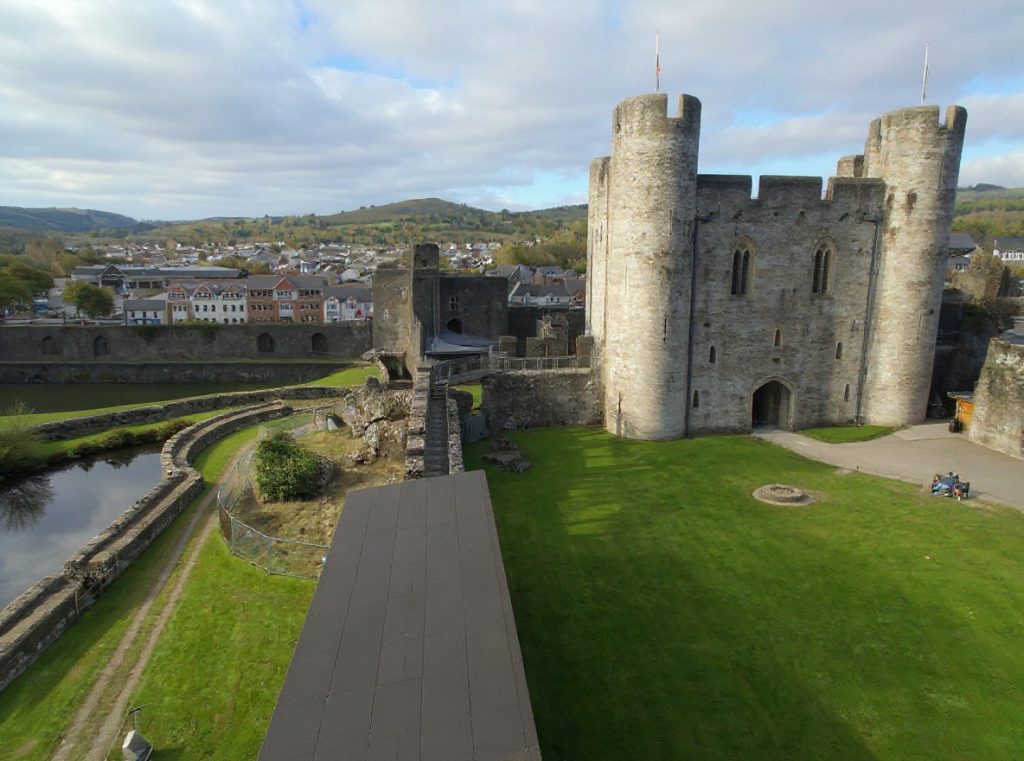
The Bute family gave Caerphilly Castle to the state in 1950. Cadw now manages the site as one of Wales’s premier heritage attractions. Following extensive conservation completed in recent years, the castle has reopened with restored interiors in the Great Hall and inner ward. State-of-the-art digital exhibits bring medieval life to vivid reality. The reflooded moat system recreates the imposing water defences that made this fortress nearly impregnable. Visitors can explore towering gatehouses, walk the concentric walls, and climb to viewpoints offering panoramas across the thirty-acre site. The castle hosts educational programmes, medieval reenactments, and seasonal events throughout the year.
Cadw maintains the fortress as a Grade I listed building and Scheduled Ancient Monument. This preserves its significance as the finest example of thirteenth-century concentric castle design in Britain. Working replicas of siege engines demonstrate medieval warfare, while exhibitions in the towers explain the castle’s role in Welsh history. The site attracts historians, families, and film-makers drawn to its authentic medieval atmosphere and famous leaning tower. Caerphilly Castle opens to the public with paid admission. Visitors can experience how one of Europe’s great medieval fortresses actually functioned, from its defensive lakes to its palatial Great Hall. All this stands within sight of the town that has grown around this sleeping stone giant.
Castles near Caerphilly Castle
Frequently asked questions
How much does it cost to visit Caerphilly Castle?
Adult tickets cost £12.90 (1 September–31 March) or £16.30 (1 April–31 August), with family tickets and concessions available. Children under 5 and Cadw members enter free, and a 5% discount applies when booking online.
What are Caerphilly Castle's opening hours?
The castle opens daily at 9:30 (10:00 in winter) and closes at 17:00 (18:00 in July–August, 16:00 November–February). Last admission is 30 minutes before closing, and the castle is closed 24–26 December and 1 January.
How do I get to Caerphilly Castle from Cardiff?
Trains depart every 20 minutes from Cardiff Central or Queen Street and take 15–20 minutes to Caerphilly station. The castle is a 5-minute walk from the station down the main street.
What is special about Caerphilly Castle?
Caerphilly Castle is the largest castle in Wales and one of Britain's biggest medieval fortresses. It features massive concentric defences, extensive water systems with artificial lakes, and a tower that leans at 10 degrees—outleaning the Tower of Pisa.
Is Caerphilly Castle suitable for children?
Yes, the castle welcomes families and offers free entry for children under 5. Children can explore replica siege engines, look for seasonal animatronic dragons, walk the battlements, and enjoy the large open courtyards and surrounding parkland.
Featured listings