
Rising more than 110 metres above the Wupper River on a commanding hilltop, Schloss Burg, Solingen ranks as the largest reconstructed medieval castle in North Rhine-Westphalia. Count Adolf II of Berg founded this fortress around 1130 as the ancestral seat of the Counts and later Dukes of Berg. These rulers gave the entire Bergisches Land its name. Today the castle complex combines authentic medieval architecture with careful late-19th-century reconstruction. The Bergisches Museum now occupies the historic rooms, so visitors can experience centuries of regional history within its massive stone walls.
Plan your visit to Schloss Burg, Solingen
Tue–Fri 10:00–16:00
Sat–Sun 11:00–17:00
Location of Schloss Burg, Solingen
Schloss Burg sits in the Burg an der Wupper district of Solingen. The fortress perches dramatically on a bergsporn that drops sharply toward the river below. The castle lies roughly 30 kilometres east of Düsseldorf and north of the Ruhr area. Visitors from major cities can reach it within half an hour as a result. Public transport serves the site well because trains connect Solingen to surrounding cities. Buses run from Solingen, Remscheid and Wermelskirchen directly to the castle area. Drivers use the A1 motorway and exit at Wermelskirchen. Others approach via the Burger Landstraße from central Solingen. A cable car operates from Unterburg in the valley and offers a scenic ascent to the hilltop fortress. This ride adds a memorable dimension to any visit.
History of Schloss Burg, Solingen
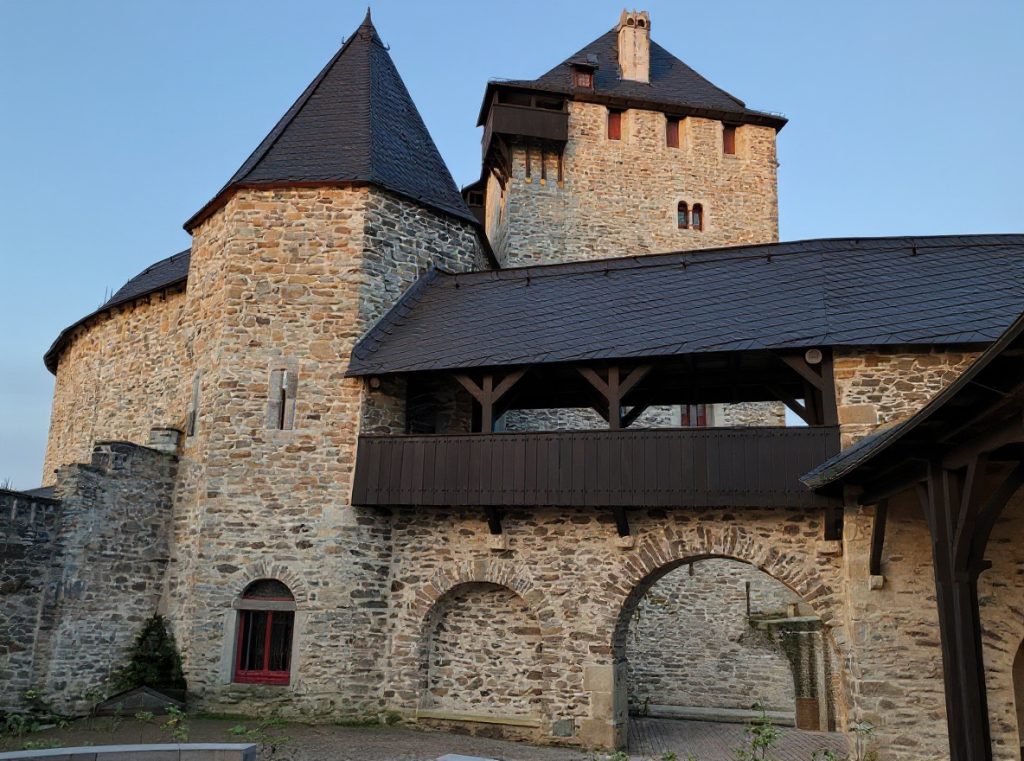
Count Adolf II of Berg built the original fortress after 1113. Construction truly began around 1130 when he established his family seat on this strategic height above the Wupper. The settlement initially bore the name Neuenburg or Burg Neuenberg. Only in the 15th century did it acquire its current designation. Archbishop Engelbert of Cologne significantly expanded the complex between 1218 and 1225. He transformed it into the principal residence of his lineage. Throughout the 13th and 14th centuries the castle remained the main seat of the Counts of Berg. This family’s power steadily grew across the region.
The fortress played a role in major medieval events. In fact, the 1288 Battle of Worringen saw Count Adolf V of Berg emerge victorious in one of north-west Europe’s largest medieval clashes. Yet when the dukes moved their seat to Düsseldorf from 1380 onwards, the castle’s military significance waned. New warfare techniques rendered its hilltop defences obsolete, so the complex assumed a secondary role. The dukes used it as a hunting lodge and ceremonial venue. The Thirty Years’ War brought devastation when Swedish, Hessian and Imperial troops captured the fortress. They used it as a warehouse, then destroyed its defences when they withdrew.
By the early 19th century the castle had fallen into French hands under Napoleon. His administration even attempted to auction the crumbling structure. Prussian state ownership followed, and the castle served various commercial purposes. Workers even dismantled the roof to provide materials for the local courthouse. Decay accelerated until concerned citizens formed the Schlossbauverein Burg an der Wupper in the late 1800s. Architect G. A. Fischer led reconstruction efforts from 1887 onwards. He used donations and public funds to rebuild the castle between 1890 and 1919.
Current status
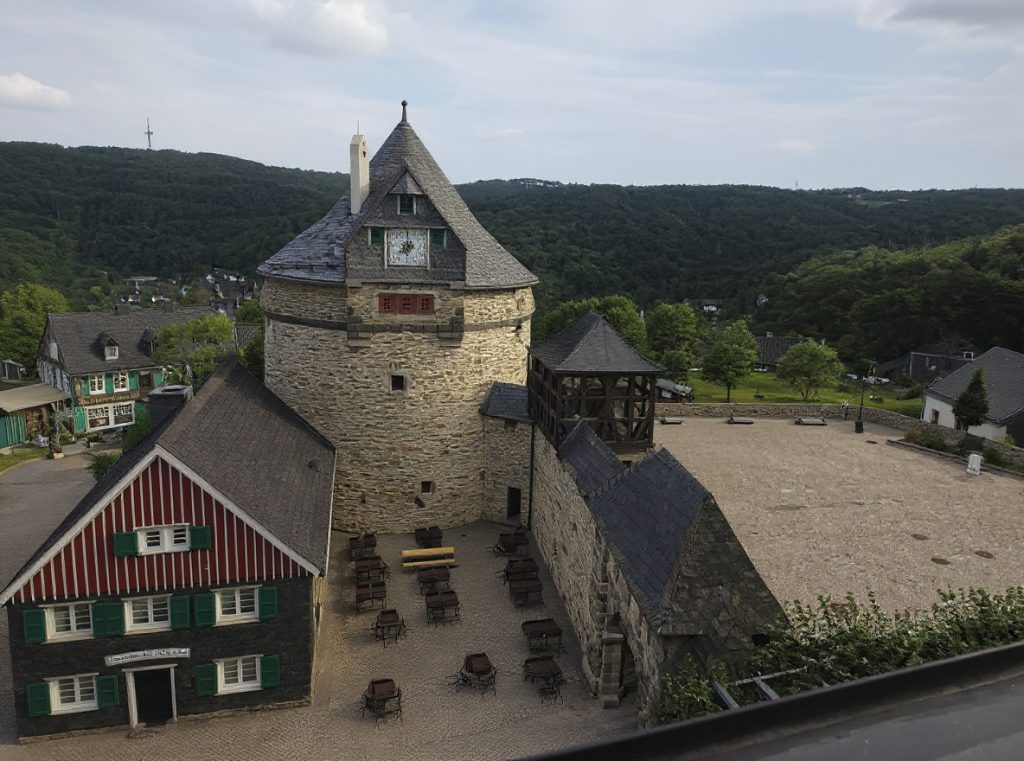
The Schlossbauverein continues to manage Schloss Burg. The castle functions today as both a museum and a popular event venue. The Bergisches Museum occupies the historic rooms and displays collections that illustrate life in the late Middle Ages. The exhibits also document the region’s trade history. Visitors explore the knights’ hall with its wall paintings, the ancestral gallery, the ladies’ chamber, and the castle chapel. They can also walk the defensive walkways. Nearly every room opens to the public and offers insight into daily routines within a medieval fortress. Admission fees apply, and opening hours vary seasonally. The castle typically closes on Mondays except public holidays.
The site hosts numerous events throughout the year. Medieval festivals and craft markets draw crowds, while concerts and historical re-enactments fill the atmospheric courtyards. Traditional half-timbered houses cluster around the castle and house cosy cafés. These establishments serve regional specialities including Bergische Waffeln. The complex provides spaces for private functions, weddings and conferences in rooms such as the knights’ hall and chapel. Educational programmes and guided tours bring the castle’s turbulent history alive for school groups and families. The combination of authentic architecture, museum displays and cultural programming makes this one of the most visited destinations in the Bergisches Land. Yet the fortress retains the austere grandeur of its medieval origins. Its towers and ramparts still command the wooded valley as they have for nearly nine centuries.
Castles near Schloss Burg, Solingen
Frequently asked questions
How long does it take to visit Schloss Burg?
The castle recommends allowing approximately 90 minutes for a visit. This covers the museum rooms, courtyards, knight's hall, chapel and tower.
Can I take the chair lift to Schloss Burg?
Yes, Germany's oldest double-seater chair lift connects Unterburg in the valley with Oberburg at the castle. Built in 1952, it offers scenic views over the Wupper valley.
Is Schloss Burg open on Mondays?
The castle is closed on Mondays except on public holidays. It is also closed on 24, 25 and 31 December.
What can I see inside Schloss Burg?
Visitors can explore the Bergisches Museum, knight's hall, chapel, ancestral hall, tower and restored medieval rooms. The museum focuses on courtly life in the Middle Ages and the history of the Counts of Berg.
How do I get to Schloss Burg from Cologne by public transport?
Take the S-Bahn from Cologne to Solingen, then bus line 683 to either Burg Seilbahn (for the chair lift) or Burg Schloss stop. The journey takes about 1 hour.
Popular right now
Featured listings