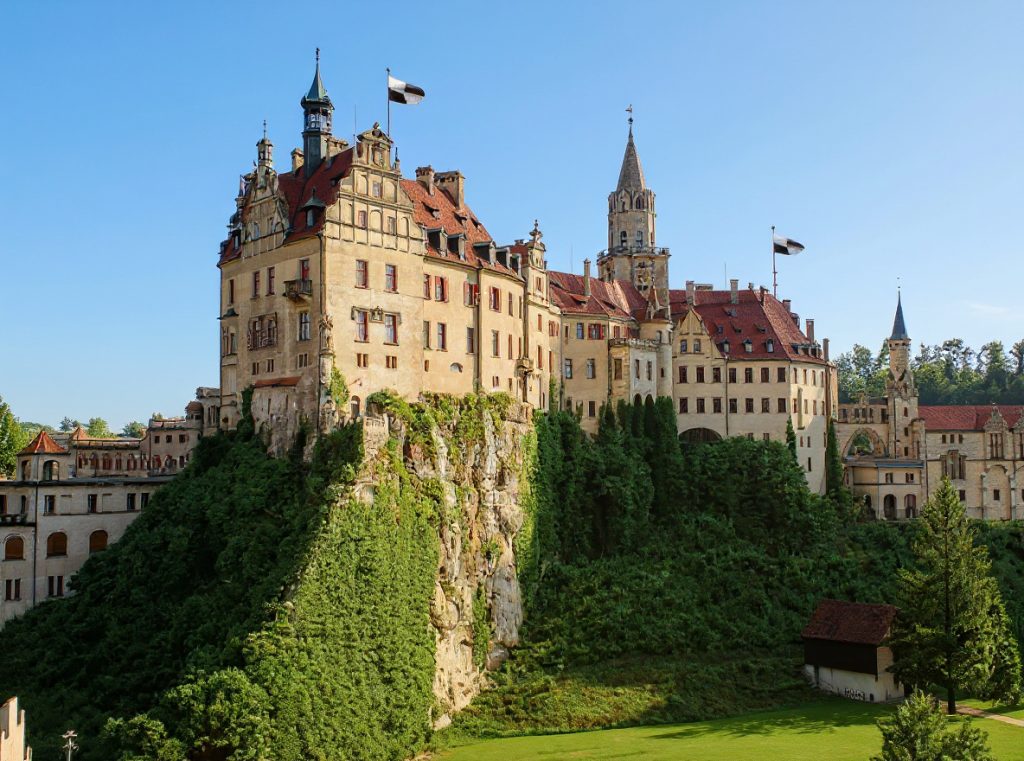
Rising dramatically from a limestone cliff above the Danube River, Sigmaringen Castle commands the skyline of southern Baden-Württemberg with its towers and turrets. This former princely castle served as the seat of government for the Princes of Hohenzollern-Sigmaringen. Its walls tell stories spanning nearly a millennium. The castle evolved from a medieval fortress into an elegant residence through centuries of rebuilding, fires and transformations. Today it welcomes visitors who come to explore its opulent interiors and armory collections. They also witness the architectural legacy of one of Europe’s most important dynasties.
Plan your visit to Sigmaringen Castle
Thu–Sun 10:00–17:0010 Mar–9 Nov daily 09:30–17:30; 10 Nov–23 Dec Thu–Sun 10:00–17:00; closed 7 Jan–9 Mar, 24, 25, 31 Dec, 1 Jan
Location of Sigmaringen Castle
The castle sits in the Swabian Alb region of Baden-Württemberg, Germany, and dominates the skyline of the town of Sigmaringen. Builders raised it atop a free-standing limestone rock approximately 200 meters long. The castle rises up to 35 meters above the Danube River. The town lies roughly 100 kilometers south of Stuttgart, so regional train services make it accessible. Sigmaringen station connects to the Tübingen–Sigmaringen railway, the Ulm–Sigmaringen railway and the Engstingen–Sigmaringen railway. As a result, rail travelers find direct routes from multiple directions. The castle sits in the heart of the town at Karl-Anton-Platz 8. Visitors enjoy an easy walk from the station and the historic center.
History of Sigmaringen Castle
Chronicles first mentioned the castle in 1077 following the unsuccessful siege by Rudolf of Rheinfelden in his fight against King Henry IV. Sections that survive today, including the gate, great hall and keep, date back to the Staufer period around 1200. Through the medieval centuries, ownership changed hands repeatedly among noble families. Between 1209 and 1258, Graf Gottried von Sigmaringen-Helfenstein and his son occupied the castle. It then passed to the Habsburgs and later the Counts of Württemberg.
In 1535, the last male Werdenberg heir died. Emperor Charles V then granted the castle to Charles I of Hohenzollern. This transfer marked the beginning of the Hohenzollern-Sigmaringen lineage’s control. From 1576 to 1850 the castle served as the principal home of that family branch. Between 1627 and 1630, master builder Hans Alberthal of Dillingen oversaw widescale transformation. The castle underwent conversion from fortress to Renaissance château. Swedes occupied the castle during the Thirty Years’ War, yet it survived and continued to evolve.
From 1860 to 1880, royal architect Josef Laur introduced a Gothic Revival style. A great fire in 1893 destroyed almost the entire castle. This disaster prompted an extensive rebuilding campaign. The family rebuilt large sections in Neo-Gothic style after the fire, transforming it from fortress into princely residence. Workers completed the Portuguese Gallery in 1902. This gallery encloses the inner courtyard on the side facing the city and marked the end of this period of alterations.
Current status
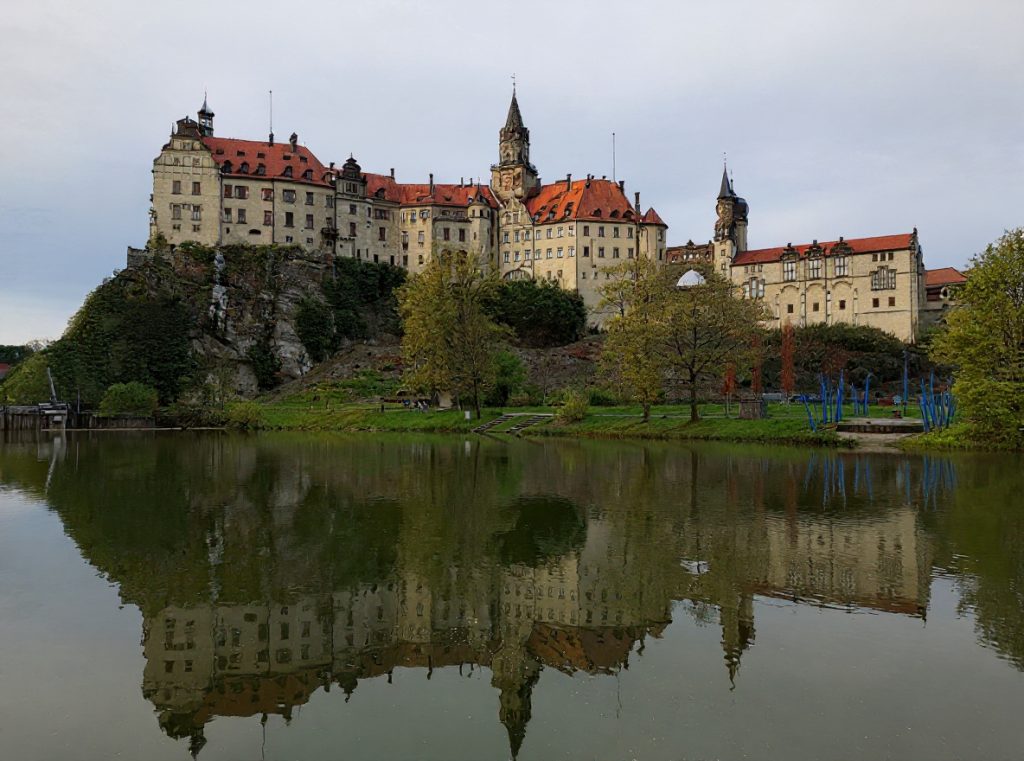
The Hohenzollern-Sigmaringen family still owns the castle, although they no longer reside there. Visitors may tour the castle and museums throughout the year, but only on guided tours. The Unternehmensgruppe Fürst von Hohenzollern manages the property and organizes daily tours. Visitors explore sumptuous rooms filled with antique furniture, Flemish tapestries and valuable paintings. The armory collection holds over 3,000 pieces. This ranks among Germany’s finest private collections of historic weapons and armor.
The castle’s interior showcases multiple architectural periods. The French Hall displays French Baroque elegance with gilded decorations and crystal chandeliers. The chapel features stunning stained glass windows and intricate woodwork. The Gallery of Ancestors dates from 1736, though renovations transformed it in 1879. It displays portraits of the Hohenzollern lineage. Audio guides allow visitors to explore at their own pace. Groups seeking deeper insights can arrange themed tours by appointment. These tours focus on specific aspects of the castle’s history or collections.
Beyond its role as a museum, the castle functions as a cultural landmark for the region. The dramatic silhouette defines Sigmaringen’s identity. The fortress on its rock anchors the town visually just as it has for centuries. The interplay between the castle’s medieval foundations, Renaissance transformations and Neo-Gothic flourishes creates an architectural narrative. This narrative reveals how noble families adapted their residences to changing tastes while honoring their heritage. The limestone cliff, the towers reaching skyward, and the view across the Danube combine to offer an experience. Here, history feels immediate and the past speaks clearly through stone and craftsmanship.
Castles near Sigmaringen Castle
Frequently asked questions
Can I visit Sigmaringen Castle without a guided tour?
Yes, you can explore the castle independently at any time using the included audio guide in seven languages. Guided tours also run daily at 10:00, 12:00, 14:00 and 16:00.
Is Sigmaringen Castle wheelchair accessible?
No, the castle tour is not suitable for people with reduced mobility. The historic building and layout make wheelchair access difficult.
What can I see inside Sigmaringen Castle?
The tour includes magnificently furnished apartments, opulent state rooms, a portrait gallery of the Hohenzollern family and one of the largest private arms collections in Europe. Last admission is one hour before closing.
How do I get to Sigmaringen Castle from Tübingen by train?
Take a regional train (RE6a) from Tübingen Hauptbahnhof to Sigmaringen Bahnhof; the journey takes about one hour. The castle is a short walk from the station.
Is Sigmaringen Castle open in winter?
The castle is closed from 7 January to 9 March each year. From 10 November to 23 December, it opens Thursday to Sunday only, 10:00–17:00.
Popular right now
Featured listings