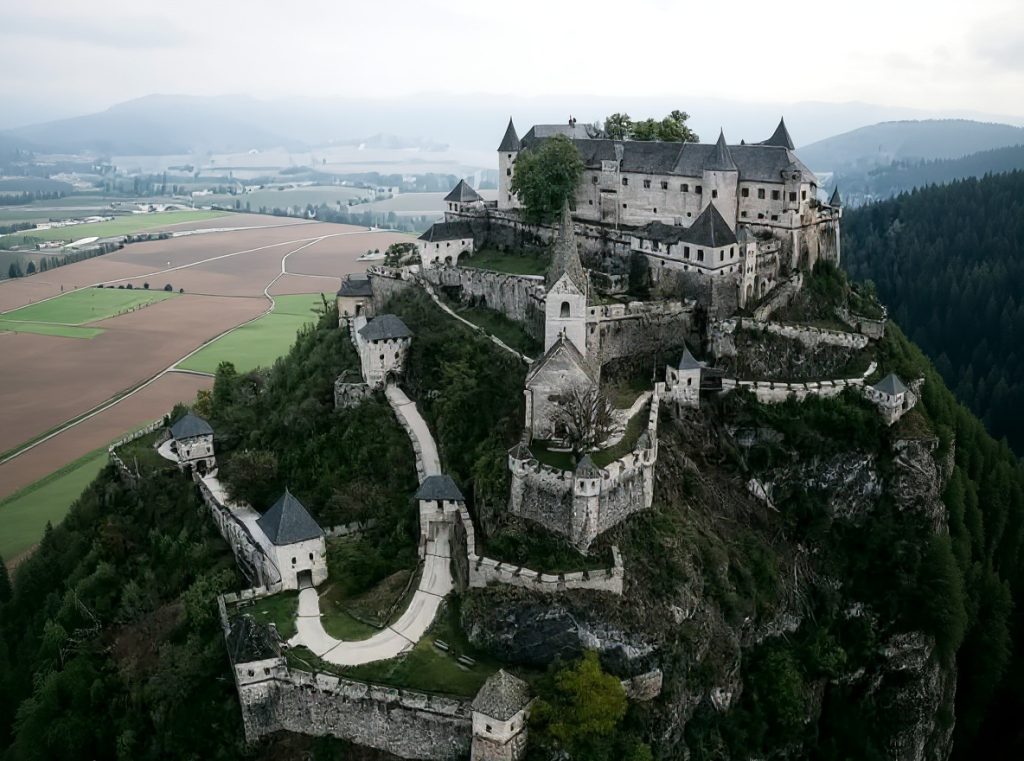
Rising 172 metres above the Carinthian valley on a sheer dolomite rock, Hochosterwitz Castle commands one of Austria’s most dramatic natural strongholds. A winding path climbs through fourteen successive fortified gates before reaching the summit fortress. Each gate forms another layer of defence in a system so effective that no attacking army ever breached it. The castle has remained in the Khevenhüller family for over four and a half centuries.
Plan your visit to Hochosterwitz Castle
Location of Hochosterwitz Castle
The castle sits near Sankt Georgen am Längsee in Carinthia, about seven kilometres east of Sankt Veit an der Glan. It lies roughly thirty minutes’ drive northeast of Klagenfurt. On clear days the fortress appears visible from thirty kilometres away. Regional trains run on the Sankt Veit–Friesach line and stop at Launsdorf-Hochosterwitz station. From there a three-kilometre walk or drive leads to the castle entrance. A lift operates during the visitor season for those who prefer not to walk the steep approach. The fortress perches on the rim of the historic Zollfeld plain at 664 metres above sea level.
History of Hochosterwitz Castle
Archaeological finds show that people settled the rock as far back as the Bronze Age. King Louis the German first documented the site in 860 when he donated properties in Carantania to the Archdiocese of Salzburg. The site then bore the Slavic name Astarwiza. In the eleventh century Archbishop Gebhard of Salzburg ceded the castle to the Dukes of Carinthia from the House of Sponheim. He did so in return for their support during the Investiture Controversy. The Osterwitz family held the fortress from the mid-1100s until 1478, serving as hereditary cupbearers to the Carinthian dukes. When Georg von Osterwitz died in Turkish captivity in 1475, the family line ended. Emperor Frederick III took possession in 1478.
Emperor Maximilian I granted the castle as a fief to Matthäus Lang von Wellenburg in 1509. Lang, then Bishop of Gurk and later Archbishop of Salzburg, initiated early expansions. In 1571 Baron Georg Khevenhüller purchased the fortress. Ottoman armies threatened southern Austria at the time. Between 1570 and 1586 Khevenhüller transformed the medieval structure into a Renaissance fortress designed to resist Turkish siege warfare. Italian architect Domenico dell’Allio designed the fourteen fortified gates that still climb the rock face today. Each gate presented attackers with different obstacles – drawbridges, spike traps, murder holes for boiling oil, and flanking fire positions. The system worked flawlessly because enemies had to conquer each gate in sequence while defenders attacked from multiple angles. Legend holds that besieging forces never passed the fourth gate.
A marble plaque from 1576 in the castle courtyard records Georg Khevenhüller’s request that his descendants preserve the fortress and keep it in family hands forever. Since the sixteenth century no major structural changes have altered Hochosterwitz. The castle never fell to enemy assault.
Current status
The Khevenhüller family still owns and manages Hochosterwitz Castle. Parts of the fortress open to visitors each year from April through October. The 620-metre approach path winds through all fourteen gates, and interpretive diagrams at each explain the defensive mechanisms. Inside the upper castle a museum displays prehistoric artefacts, Renaissance paintings, weapons, and armour. The collection includes a suit of armour that stands 2.4 metres tall, once worn by Burghauptmann Schenk. A small chapel on the courtyard’s north side features beautiful frescoes and a Carinthian altar dated 1673. A church at the southwestern end houses a high altar from 1729. A restaurant serves traditional Carinthian cuisine. Guided tours of the historical apartments show period furnishings and the Khevenhüller armoury.
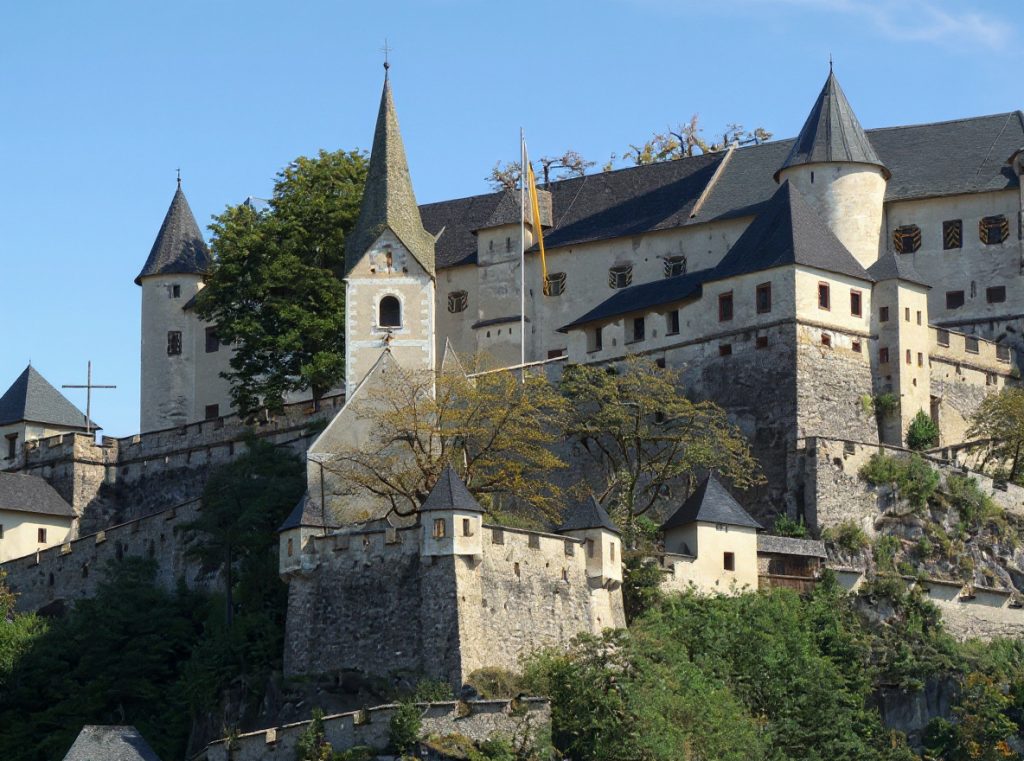
The castle functions as one of Carinthia’s premier tourist attractions and a major landmark for the region. The square tower known as the Bergfried recalls the fourteenth and fifteenth centuries, when it controlled entry to the castle yard. Protecting walls with battlements reflect the era when crossbows dominated warfare. The fortress hosts special events including medieval festivals, concerts, and exhibitions. Its exceptional state of preservation and dramatic hilltop setting make it one of Austria’s most photographed castles. From the summit, panoramic views sweep across the Carinthian plain and surrounding Alpine ridges. Hochosterwitz demonstrates Renaissance military architecture and the enduring stewardship of a noble family across five centuries.
Castles near Hochosterwitz Castle
Frequently asked questions
How many gates does Hochosterwitz Castle have?
The castle has 14 fortified gates along the ascent, each with different defensive mechanisms. Visitors walk through all 14 gates on the 620-metre pathway to reach the upper castle.
Can I take a lift to the top of Hochosterwitz Castle?
Yes, the Fürst-Max-Bahn inclined lift is available for €12 per person (€7 downhill only). The lift is wheelchair-accessible and is not included in the standard admission price.
Is Hochosterwitz Castle open all year?
No, the castle is open from April to early November only. Opening hours vary by season, with daily hours in summer (June–August) and reduced days in spring and autumn.
What can I see inside Hochosterwitz Castle?
The castle includes a museum with an armoury, weapons collection, paintings from the Renaissance, and prehistoric artefacts. The admission fee includes access to the museum and castle grounds.
How do I get to Hochosterwitz Castle from Klagenfurt?
Take the S-Bahn train to Launsdorf-Hochosterwitz station (about 30 minutes), then walk 2 km or take bus line 5373. By car it's a 25-minute drive; parking is included in the admission fee.
Featured listings