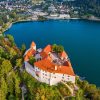

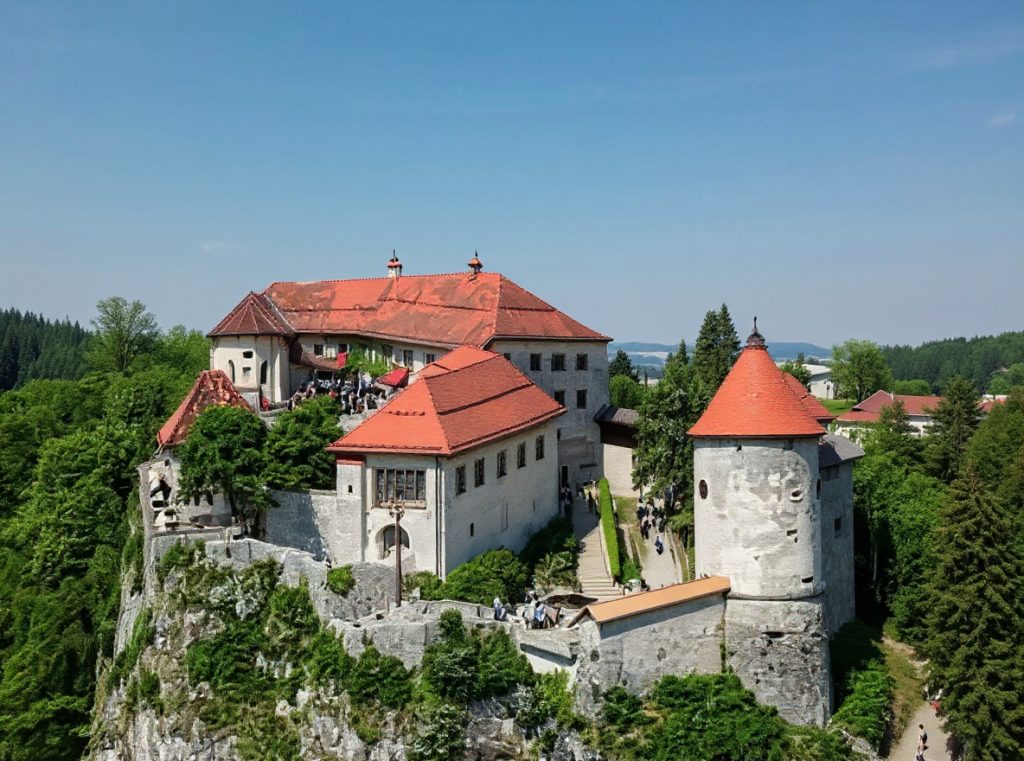
Perched on a sheer cliff 130 metres above the emerald waters of Lake Bled, Bled Castle commands one of Slovenia’s most spectacular settings. This medieval fortress rises dramatically from its rocky precipice. It holds the distinction of being the oldest castle documented in Slovenian written records. The Julian Alps form a magnificent backdrop to this thousand-year-old stronghold. Meanwhile, the lake below—with its tiny island church—completes a scene that has captivated visitors for centuries.
Plan your visit to Bled Castle
Location of Bled Castle
Bled Castle sits in northwestern Slovenia, approximately 50 kilometres from the capital city of Ljubljana. The castle occupies the summit of a steep cliff in the town of Bled. This location sits in the Upper Carniola region near the Austrian border. Visitors can reach the site by car via Grajska cesta, which winds up to a car park near the entrance. For those who prefer to walk, several footpaths climb through the forest from the lakeshore to the castle gates. The journey takes about 20 minutes. The location offers commanding views across Lake Bled, the surrounding forests, and the peaks of the Karawanks mountain range. Public buses connect Bled with Ljubljana and other regional towns. The nearest international airport lies in Ljubljana.
History of Bled Castle
German King Henry II first granted the estate of Bled to Bishop Albuin of Brixen on 10 April 1004. The castle itself appears in written sources for the first time on 22 May 1011. A donation deed from that date referred to it as “castellum Veldes”. At that time, a Romanesque tower already stood on the rocky outcrop. The Bishops of Brixen held the castle for eight centuries, though they rarely visited their distant possession 300 kilometres away. Instead, ministeriales—bonded knights—and castellans managed the estate according to feudal practices.
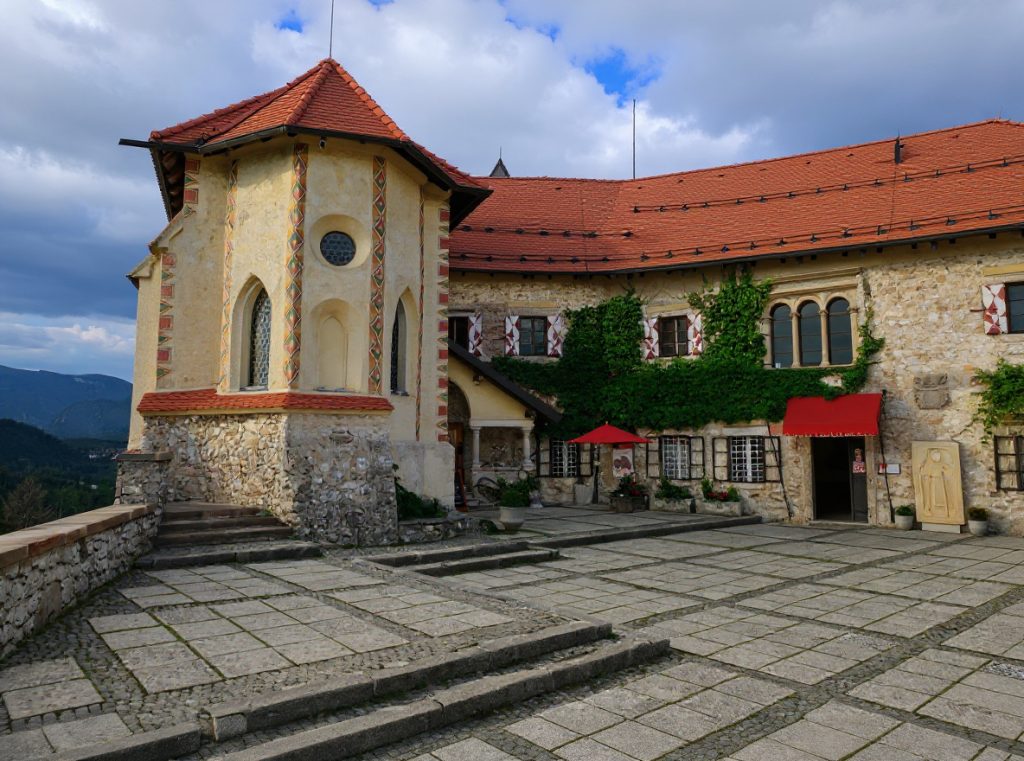
During the Middle Ages, builders added new towers and strengthened the fortifications. The original Romanesque walls and entrance tower remained, yet the castle grew into a more complex structure. In 1278, the area passed to the Austrian House of Habsburg, though the bishops retained control of the estate. Workers erected Renaissance-style buildings around two courtyards connected by a central staircase. Earthquakes struck the castle in 1511 and 1690, causing severe damage and prompting extensive reconstruction. A Gothic chapel dedicated to Saints Albuin and Ingenuin acquired Baroque elements and vibrant frescoes after the 1690 quake.
By the late 19th century, ownership changed hands several times. A devastating fire swept through Bled Castle in 1947, destroying much of the interior. Between 1951 and 1961, the local community undertook major restoration work led by architect Anton Bitenc. He preserved the medieval character while ensuring modern functionality. The castle’s current appearance reflects this sensitive 20th-century conservation approach alongside its medieval and Renaissance roots.
Current status
The Bled Cultural Institute manages Bled Castle today, working in collaboration with the National Museum of Slovenia. Since 1957, the castle has housed a museum that presents the history of Bled. The exhibits cover Ice Age hunters through to the present day. Fourteen chambers in the former residential rooms display archaeological finds, medieval weapons, traditional crafts, and domestic artefacts. The museum exhibition chronicles the early Slavic settlement, the bishopric era, and Bled’s transformation into a famous health resort in the 19th century.
Visitors can explore the castle printing works, which houses a reconstructed Gutenberg press. This press links to early Slovenian printing traditions. The wine cellar offers tastings of local vintages. A restaurant occupies one of the castle buildings, serving modern interpretations of Slovenian cuisine. The 16th-century Gothic chapel retains its historical frescoes and Baroque furnishings. A traditional forge demonstrates medieval metalworking techniques. The castle also serves as a venue for weddings, state visits, and cultural events such as medieval reenactments. Officials designated it a national cultural monument in 1999. The castle now ranks as one of Slovenia’s most visited attractions, drawing hundreds of thousands of guests each year.
Stone terraces surrounding the courtyards provide sweeping panoramas across the lake, the island, and the Alps beyond. Whether visitors come for the historical collection, the architecture, or simply the views, Bled Castle remains a vivid link to Slovenia’s feudal past. The ancient walls, the quiet courtyards, and the vista from the ramparts convey the enduring power of this clifftop fortress. More than a millennium of history unfolds here against an Alpine horizon.
Castles near Bled Castle
Frequently asked questions
Is Bled Castle worth the entrance fee?
Yes, particularly for the panoramic terrace view over Lake Bled and the Julian Alps. The ticket includes access to the museum, printing works, chapel and all castle courtyards.
Can I drive to Bled Castle?
Yes, a paved road leads to a small parking area near the entrance. Parking costs €3 per hour but spaces are very limited and fill by mid-morning in summer; walking up from the lake (15–20 min) is often easier.
What are the opening hours of Bled Castle?
Bled Castle is open every day of the year, including holidays. Hours are 08:00–20:00 from April to October and 08:00–18:00 from November to March; last entry is 30 minutes before closing.
How long does it take to walk up to Bled Castle?
The steep footpath from the lakeshore to the castle entrance takes around 15 to 20 minutes. Several marked trails are available, including the Rikli Trail from near the swimming area.
What can you see inside Bled Castle?
The ticket gives access to the castle museum, a 16th-century printing press replica, the chapel, wine cellar, blacksmith's forge and the famous terraces overlooking the lake. The castle restaurant is accessible without a ticket.
Featured listings