
Ljubljana Castle commands Castle Hill above Slovenia’s capital, where ancient fortifications rise from wooded slopes that people have defended for nearly a millennium. This complex of medieval walls, Renaissance halls, and Gothic towers forms the city’s most recognisable landmark. The castle hill shelters permanent exhibitions on Slovenian history, cultural venues, and a viewing tower that surveys the surrounding Julian Alps.
Plan your visit to Ljubljana Castle
Location of Ljubljana Castle
The castle sits atop Castle Hill in central Ljubljana, directly south of the Old Town and the Ljubljanica River. Visitors reach the summit by glass funicular from Krekov trg, which climbs through greenery in just one minute. Alternatively, several walking paths wind up the wooded hillside from the city centre, though the ascent is steep. Bus route 32 stops at Ljubljanski grad for those who prefer road access. The castle’s elevated position, 376 metres above sea level, places it roughly 70 metres above the streets below. As a result, views sweep across Ljubljana’s terracotta roofs to the marshlands and mountains beyond.
History of Ljubljana Castle
Builders probably constructed the first fortification in the 11th century as a wooden and stone fortress. The oldest written mention appears in a parchment from 1161, which records farmsteads beside the castle. The House of Sponheim took control of the castle before 1144. In 1256 chroniclers mentioned it as the most important castle of the rulers of Carniola. King Ottokar II of Bohemia conquered it in the late 1270s. After his defeat in 1278, however, Rudolph of Habsburg claimed the property. From the first half of the 14th century, provincial governors used it as their seat.
Construction of the present castle began in the mid-1400s under Austrian emperor Frederick III. He needed fortification against Ottoman invasions, so builders almost completely demolished and rebuilt it. Workers erected complete walls and towers at the entrance, where they placed a drawbridge. They also built a chapel during this period. Craftsmen consecrated the Gothic chapel of St George in 1489. In the 16th and 17th centuries, builders gradually added other structures. The fortifications proved effective because invaders never successfully breached the castle.
In the 17th and 18th centuries the castle became an arsenal. French armies then occupied it in 1797 and 1809. It lost its function as fortress and residence in the 17th century. During the Napoleonic interlude, authorities used it as military hospital and arsenal. From the early 19th century, officials turned it into a penitentiary. In the first half of the 20th century, people lived there as a residential complex. In 1905 Ljubljana’s mayor Ivan Hribar purchased the castle for the city, planning a museum. The city settled poor families inside instead, and residents stayed until 1963 when complete renovation started.
Current status
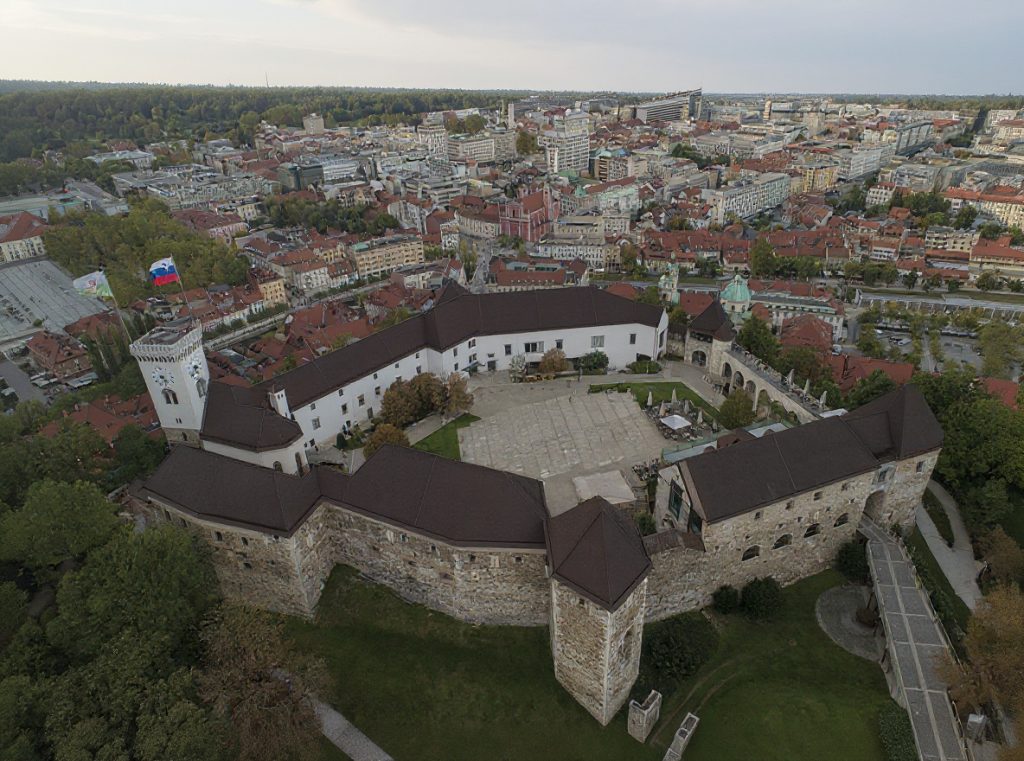
Since 2011 the Ljubljanski grad Public Institute has managed the venue. The castle sits on a small hill in the centre of Ljubljana, where over 400 events attract up to a million visitors per year. The castle opens 365 days a year. A castle ticket includes return funicular journey, the viewing tower, a 4D film Virtual Castle, video mapping, and the Museum of Puppetry. It also covers the Slovenian History permanent exhibition and temporary exhibitions.
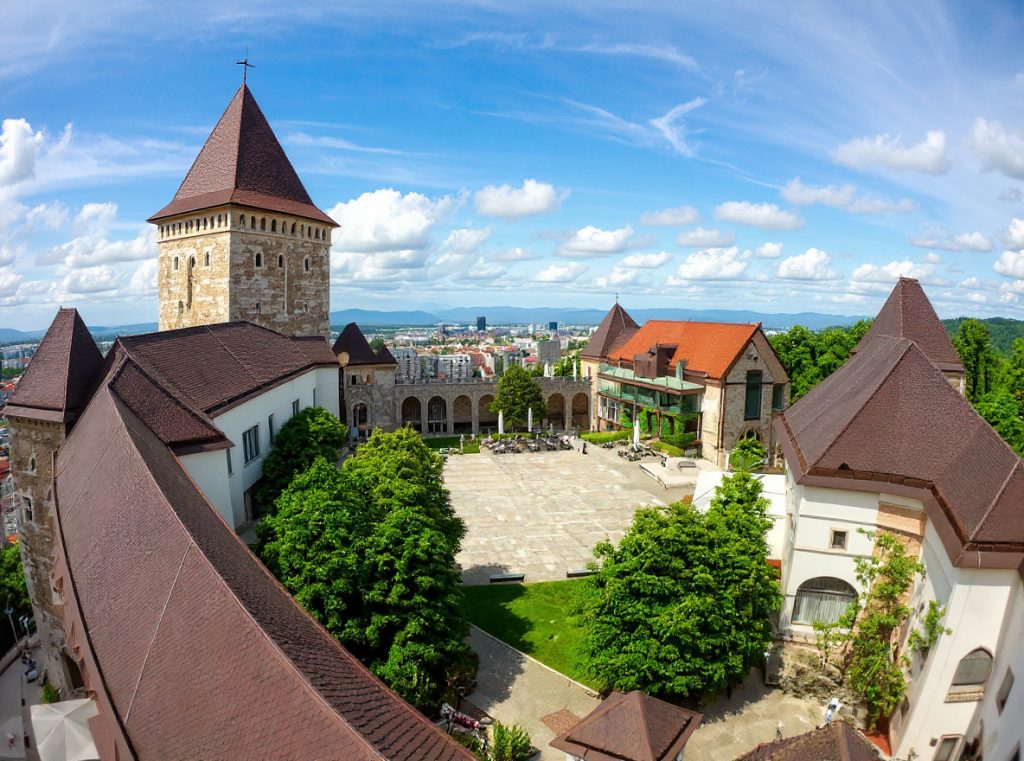
The castle offers a tourist viewing tower, a virtual museum, a chapel and several cultural venues. These include Hribar’s Hall, Palatium, Pentagonal Tower, and various towers. In May 2015 a newly established Museum of Puppetry opened at the castle. The Chapel of St George retains Gothic windows alongside 18th-century Baroque renovations. Artists painted coats of arms of Carniolan governors there in 1747. The Pentagonal Tower preserves the two original entrance openings where drawbridges once crossed a defensive moat. Restaurants and cafés operate within the courtyards, while the ramparts provide walkways along the ancient defensive walls.
The castle anchors Ljubljana’s cultural calendar with film screenings, concerts, and exhibitions throughout the year. Summer evenings bring open-air cinema to the courtyard. The halls host weddings and formal receptions as well. The wooded Castle Hill surrounding the fortifications offers quiet paths away from the city, yet the Old Town lies just minutes below. When the viewing tower’s bell tolls, the sound carries across the red rooftops and the green Ljubljanica. This serves as a reminder that this hilltop has watched over the city for nine centuries.
Castles near Ljubljana Castle
Frequently asked questions
Is the courtyard of Ljubljana Castle free to visit?
Yes, the castle courtyard, ramparts and grounds are free to explore. You only need a ticket (€15 for adults) to access the Viewing Tower, exhibitions, Museum of Puppetry, Virtual Castle film and chapel.
How does the funicular to Ljubljana Castle work?
The funicular runs every few minutes from Krekov trg near the Central Market to the castle, taking 60 seconds. A return ticket costs €6 for adults, or €19 combined with castle entry.
What exhibitions are included in the Ljubljana Castle ticket?
The castle ticket includes the Viewing Tower, Museum of Puppetry, Slovenian History permanent exhibition, Virtual Castle 4D film, video mapping in the Casemate, and temporary exhibitions. All are accessed with one ticket.
Can I walk up to Ljubljana Castle instead of taking the funicular?
Yes, several scenic walking paths lead to the castle from the Old Town, taking 15–20 minutes. Popular routes start from Vodnikov trg, Stari trg and Mestni trg.
Is Ljubljana Castle open year-round?
Yes, Ljubljana Castle is open 365 days a year. Opening hours are 09:00–20:00 from May to September and 09:00–18:00 from October to April, with last admission one hour before closing.
Featured listings