Commanding the landscape from its hilltop above the River Arun, Arundel Castle rises as one of England’s most impressive fortified residences. This restored medieval stronghold has served as the ancestral seat of the Dukes of Norfolk and their predecessors for nearly a thousand years. The castle retains both defensive features and palatial interiors that chronicle centuries of English aristocratic power, from its Norman origins through Gothic Revival splendour.
Plan your visit to Arundel Castle
Tue–Sun 10:00–17:00Open 1 Apr–1 Nov; closed Mon except bank holidays & Aug; castle rooms 12:00–17:00, gardens & keep 10:00–17:00.
Location of Arundel Castle
Arundel Castle sits in the market town of Arundel in West Sussex. The town lies roughly midway between Chichester and Worthing on the south coast of England. The castle occupies a defensive position on a prominent hill overlooking the River Arun as it flows through the South Downs. Visitors can reach Arundel by train from London Victoria, with regular services throughout the day. Trains arrive at Arundel station approximately ten minutes’ walk from the castle. By car, the castle lies just off the A27 coastal route. Follow signs for Arundel town centre and the main entrance on Mill Road. A pay-and-display car park sits directly opposite. Gatwick Airport provides the nearest air access, connected to Arundel by the London Victoria rail line.
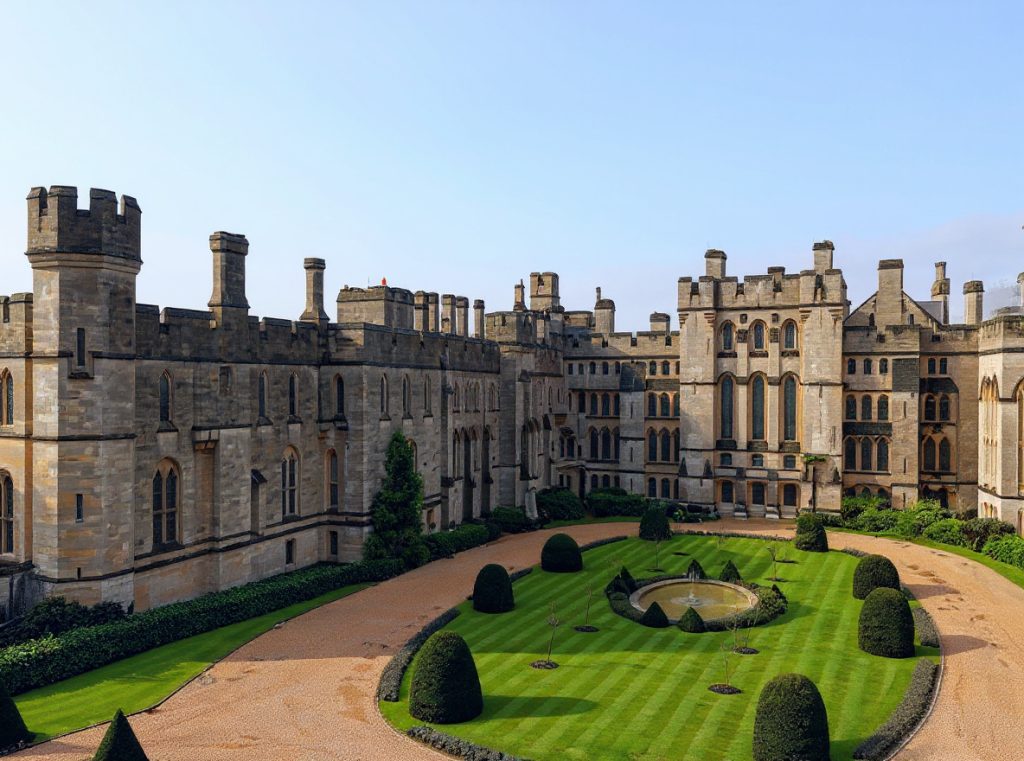
History of Arundel Castle
Roger de Montgomery founded Arundel Castle on Christmas Day 1067, shortly after the Norman Conquest. William the Conqueror granted Montgomery a third of Sussex. He then commanded him to build a fortress near the River Arun’s mouth to protect against Continental invasion. Roger became the first Earl of Arundel around 1071. The original structure consisted of a motte-and-bailey fortress with a high earthen mound, dry moat and unusual double bailey similar to Windsor Castle. After Roger died in 1094, the castle returned to the Crown.
King Henry I later gave both castle and lands to his second wife, Adeliza of Louvain. After Henry died in 1135, Adeliza married William d’Aubigny. William then constructed the stone keep and carried out major improvements. He became Earl of Arundel in 1143 and built substantial stone enclosures around the earlier earthwork defences. When William died in 1176, the castle reverted to the Crown under Henry II. Henry spent vast sums restructuring the building for domestic needs. Richard I later granted Arundel to William d’Aubigny’s heir. The d’Aubigny line held it until Hugh d’Aubigny died in 1243.
John FitzAlan inherited the castle through his mother and received the earldom of Arundel. The FitzAlan family held Arundel until 1580, though the Crown temporarily confiscated it several times. In 1272, five-year-old Richard FitzAlan inherited the castle after his father died. Thirteen years later, Edward I granted Richard the right to hold two annual fairs at the castle. He also granted him the right to collect taxes. Parliamentarians under Sir William Waller besieged the castle in December 1643 during the English Civil War. The siege ended when the castle surrendered to Parliamentary forces. The structure suffered significant damage as a result.
Current status
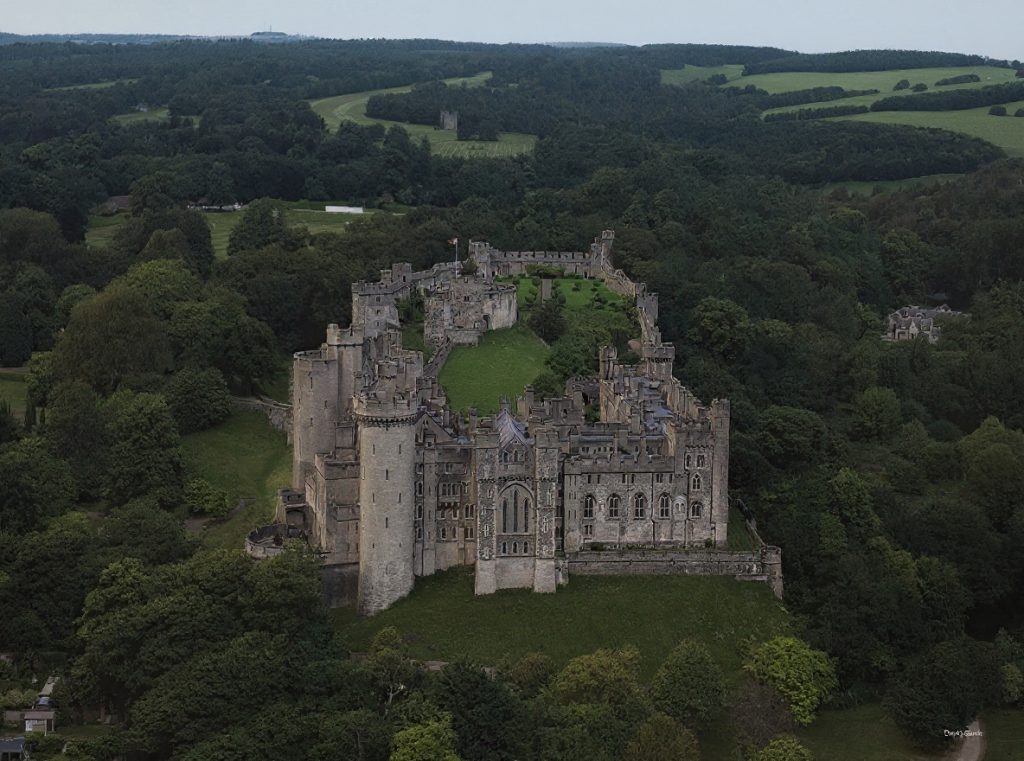
The Arundel Castle Trust now manages the castle to guarantee its future preservation. The castle remains the family home of the Duke of Norfolk. He serves as Earl Marshal and heads the College of Arms, the official heraldic authority in England and Wales founded in 1484. Despite its residential status, substantial portions open to visitors from March through October. The castle houses exceptional collections of furniture, paintings, clocks, tapestries and armour. These include personal possessions of Mary, Queen of Scots. Original medieval features survive, such as the Norman keep, medieval gatehouse and barbican, and the lower sections of Bevis Tower.
The castle grounds encompass forty acres of gardens featuring subtropical borders, English herbaceous borders, a stumpery, glasshouses, and walled flower and organic kitchen gardens. The Fitzalan Chapel dates from 1390, when the 4th Earl of Arundel founded it within the castle grounds. It continues to serve as the burial place for the Dukes of Norfolk. Visitors explore the Regency Library, Barons’ Hall, Drawing Room and Dining Room, among other state apartments. The castle provides restaurant facilities in the original Servants’ Hall and a coffee shop in the former Castle Pantry. As one of the longest continuously inhabited country houses in England, Arundel forms a living monument. Nearly a millennium of aristocratic heritage meets twenty-first-century cultural stewardship here.
Castles near Arundel Castle
Frequently asked questions
Is Arundel Castle still lived in?
Yes, Arundel Castle remains the family home of the Duke of Norfolk and his family after nearly 1,000 years. The state rooms open to visitors at 12:00 because the family uses them in the morning.
Can I visit just the gardens at Arundel Castle?
Yes, gardens-only tickets are available for £17 (adults) and £8 (children), giving access to 38 acres including the tulip displays, rose garden, and organic kitchen garden. Gardens-only tickets are not sold during special events.
What can I see inside Arundel Castle?
Visitors can explore the Victorian state rooms with paintings by Van Dyck, Gainsborough and Canaletto, climb the Norman keep for views over the South Downs, visit the private Fitzalan Chapel, and see the Barons' Hall. Some tickets include access to the ducal bedrooms.
Does Arundel Castle have special events?
The castle hosts a full calendar including the April tulip festival, medieval jousting tournaments in July, living history weekends, and Shakespeare theatre performances in August. Event tickets vary in price and most activities are included in admission.
How do I get to Arundel Castle from London?
Take a Southern Railway train from London Victoria to Arundel station (approximately 1 hour 45 minutes). The castle is a 10-minute walk from the station. By car, Arundel is 98 km from London via the A27.
Featured listings